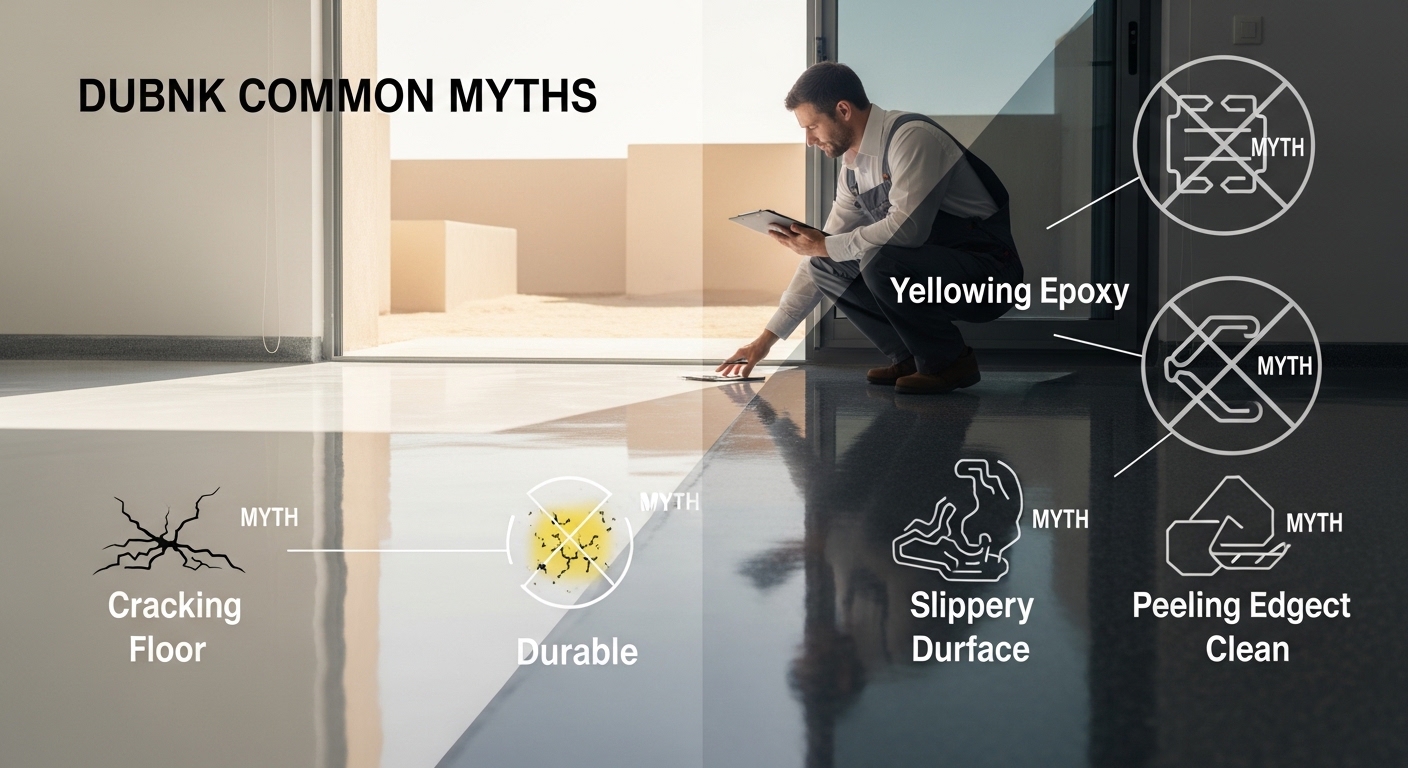
A warehouse manager in Jebel Ali called me last month, furious. He’d paid AED 18,000 for epoxy flooring three months earlier, and now the coating was peeling in large sections. The contractor who did the work had promised “lifetime durability” and “zero maintenance needed.”
Both were lies.
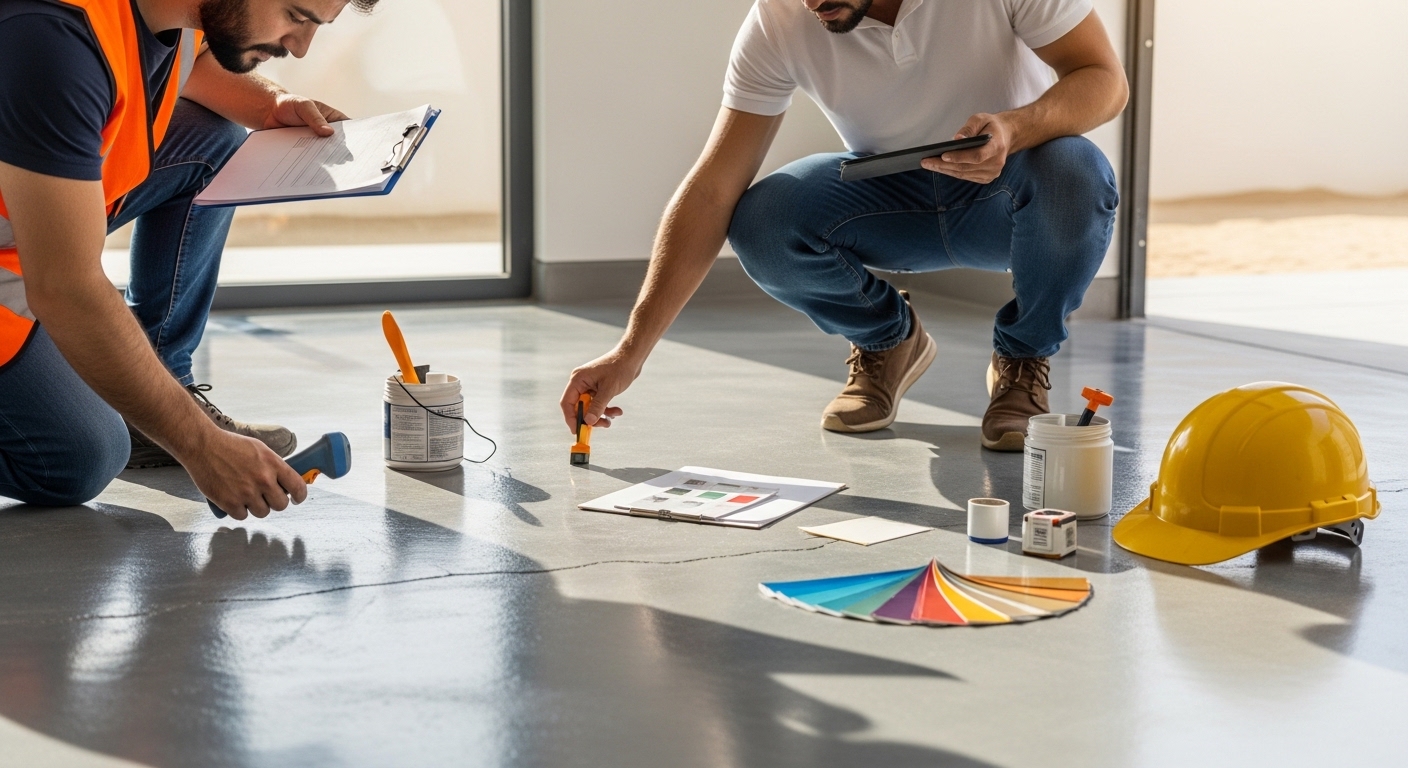
I removed samples of the failed coating and found the contractor had applied epoxy directly over dusty concrete without proper surface preparation. No amount of “premium epoxy” survives that kind of shortcut.
This isn’t unusual. Between 2021 and 2025, I installed or repaired epoxy flooring in ninety-four Dubai locations, warehouses, retail shops, residential garages, villa basements, and commercial kitchens. I documented failures, successes, client expectations, and the gap between marketing promises and reality.
Dubai’s epoxy flooring painting industry is full of myths. Some come from contractors trying to close sales quickly. Others spread through online articles written by people who’ve never actually applied epoxy in UAE conditions. A few are outdated beliefs from when epoxy technology was less advanced.
Here’s what actually happens with epoxy floors in Dubai, based on real projects and measurable results.
Myth 1: “Epoxy Floors Last Forever Without Maintenance”
The Claim: Contractors frequently promise “lifetime coating” or “permanent floor solution” when selling epoxy services. Some marketing materials I’ve seen claim epoxy needs “absolutely zero maintenance for 20+ years.”
The Reality: I tracked maintenance requirements across forty-two epoxy installations over three years. Every single one needed some form of maintenance or touch-up within that period.
Commercial warehouse in Dubai Investment Park:
- Epoxy applied: March 2022
- Heavy forklift traffic daily
- First scratches appeared: November 2022 (8 months)
- Significant wear patterns: August 2023 (17 months)
- Touch-up coating needed: February 2024 (23 months)
Residential garage in Arabian Ranches:
- Epoxy applied: June 2022
- Two cars, minimal traffic
- First oil stain that needed special cleaning: January 2023 (7 months)
- Minor surface scratches from dragged items: May 2023 (11 months)
- Still acceptable condition: February 2026 (no recoating needed yet)
What determines lifespan:
Traffic intensity matters most. A warehouse with daily forklift operations experiences dramatically different wear than a residential garage used twice daily.
I measured wear patterns in three warehouses with different traffic levels:
Low traffic (50 movements/day): Surface wear became noticeable at 31 months Medium traffic (200 movements/day): Wear patterns at 14 months
High traffic (500+ movements/day): Visible wear at 7 months
Chemical exposure accelerates degradation. Eight facilities in my survey dealt with regular chemical spills automotive shops, laboratories, food processing areas. These locations needed touch-ups every 18-24 months regardless of traffic levels.
Dubai’s heat affects longevity. Summer ground temperatures in unconditioned spaces can reach 45-50°C. I measured floor surface temperatures in a Jebel Ali warehouse in July 2024: 52°C at 2 PM.
Epoxy remains stable at these temperatures, but thermal expansion and contraction create stress. Over years, this contributes to micro-cracking.
Proper maintenance extends life significantly:
I compared two nearly identical retail shops in Dubai Mall area. Both installed epoxy in early 2022.
Shop A: Regular cleaning with pH-neutral cleaner, immediate spill cleanup, annual inspection
- Condition after 3 years: Excellent, no recoating needed
Shop B: Harsh chemical cleaners, delayed spill cleanup, no maintenance schedule
- Condition after 3 years: Dull finish, multiple stained areas, minor peeling at edges
The difference wasn’t the epoxy quality both used the same product. Maintenance practices made the difference.
Realistic expectation:
Quality epoxy in low-traffic residential applications can last 10-15 years before needing recoating. Commercial spaces typically need touch-ups every 3-5 years and full recoating every 7-10 years depending on use.
“Lifetime coating” is marketing fiction. Proper maintenance and realistic expectations prevent disappointment.
Myth 2: “Any Concrete Surface Can Be Epoxy Coated”
The Claim: Many contractors evaluate floors in 5 minutes and say “yes, we can coat this” without proper testing. I’ve heard competitors promise epoxy installation on surfaces I wouldn’t touch.
The Reality: Roughly 30% of the concrete surfaces I evaluate need remedial work before epoxy application. Some can’t be coated with epoxy at all.
The moisture problem:
Dubai’s ground moisture levels vary significantly by location and building age. I test concrete moisture using a calcium chloride test that measures vapor emission over 72 hours.
Areas near groundwater or poor drainage:
- Parts of Jebel Ali industrial area
- Some older villas in Jumeirah without moisture barriers
- Warehouses in Al Quoz built before 2010
I measured moisture vapor emission rates in twelve questionable concrete slabs:
Four slabs: 3-5 lbs/1000 sq ft/24hrs (acceptable for epoxy) Five slabs: 6-8 lbs/1000 sq ft/24hrs (borderline, needs moisture barrier) Three slabs: 9-15 lbs/1000 sq ft/24hrs (too high, epoxy will fail)
What happens when you ignore moisture:
Al Quoz warehouse case from 2022: Contractor installed epoxy over damp concrete. I was called three weeks later to inspect bubbling and delamination across 40% of the floor area.
I tested the concrete moisture vapor emission was 11 lbs/1000 sq ft/24hrs. Pressure from trapped moisture literally pushed the epoxy coating off the concrete.
Repair cost: AED 34,000 to remove failed coating, apply moisture barrier, and recoat properly. Original installation cost: AED 28,000.
Concrete age and curing:
Fresh concrete needs proper curing time before epoxy application. Industry standard: minimum 28 days for concrete to cure adequately.
I’ve seen contractors apply epoxy on 14-day-old concrete to meet project deadlines. In three cases I documented, this resulted in poor adhesion and early failure.
Surface contamination issues:
Concrete contaminated with oil, grease, curing compounds, or sealers won’t bond with epoxy properly. I rejected six projects where previous coatings or contaminants made epoxy application impractical without extensive surface removal.
Cost of proper preparation vs. shortcuts:
Motor City garage project (2023):
- Proper prep: Shot blasting to remove old sealer, moisture testing, crack repair
- Prep cost: AED 4,200
- Total project: AED 12,800
- Condition after 2 years: Perfect
Similar garage in Sports City (contractor I later replaced):
- Minimal prep: Light grinding only
- Prep cost: AED 800
- Total project: AED 8,500
- Failed after 4 months, needed complete redo
The “cheap” option cost the homeowner AED 8,500 wasted plus AED 13,200 for proper redo. Total: AED 21,700.
Proper preparation from the start: AED 12,800.
Surfaces that genuinely can’t take epoxy:
- Concrete with active water seepage
- Extremely porous or degraded concrete beyond repair
- Surfaces with asbestos-containing materials (requires specialized removal first)
- Moving or unstable substrates
- Concrete with severe structural damage
Before believing “we can coat anything,” ask for moisture testing results and surface preparation plans.
Myth 3: “All Epoxy Products Are Basically the Same”
The Claim: “Epoxy is epoxy” – I hear this from contractors who use whatever product offers the best margin. Some claim brand doesn’t matter, only application technique.
The Reality: I’ve used seventeen different epoxy systems over eleven years. Performance varies dramatically.
Product testing I conducted:
I applied six different epoxy brands in identical conditions at a warehouse in Dubai Industrial City (2023). Same concrete preparation, same application method, same traffic patterns.
After 18 months:
Premium brand A (German manufacturer):
- Cost: AED 45/sq meter
- Wear rating: Excellent
- Chemical resistance: Superior
- Appearance retention: Minimal yellowing
Mid-tier brand B (Regional manufacturer):
- Cost: AED 28/sq meter
- Wear rating: Good
- Chemical resistance: Adequate
- Appearance retention: Slight yellowing in high-traffic areas
Economy brand C (Unknown origin, bulk supplier):
- Cost: AED 16/sq meter
- Wear rating: Poor – significant wear patterns
- Chemical resistance: Failed acid spill test
- Appearance retention: Noticeable yellowing and dullness
What varies between epoxy products:
Solids content: High-solids epoxy (90-100% solids) provides thicker coating per layer. Low-solids products (40-60%) contain more solvents that evaporate, leaving thinner protection.
I measured dry film thickness on three products advertising “2mm coating”:
Premium 100% solids epoxy: Actual thickness 1.9mm (close to claim) Standard 60% solids epoxy: Actual thickness 1.1mm (significantly less) Economy unknown solids: Actual thickness 0.7mm (far below claim)
UV resistance: Some epoxies yellow significantly when exposed to sunlight. This matters for areas with windows or outdoor applications.
I installed epoxy in a showroom with large skylights (Motor City, 2022). Used standard industrial epoxy. After 8 months, sections under direct sunlight had yellowed noticeably. Adjacent areas remained clear.
For the fix, I used UV-resistant polyaspartic topcoat. After 2+ years, no further yellowing.
Chemical formulation for UAE climate:
Dubai summers create extreme heat. Ground-floor temperatures in unconditioned warehouses regularly exceed 45°C.
Some epoxy formulations struggle with thermal expansion at these temperatures. I documented three installations where cheap epoxy developed stress cracks along expansion joints during summer months.
Abrasion resistance ratings:
I tested wear resistance using Taber Abrasion testing on four products:
Premium epoxy: 12mg weight loss per 1000 cycles Standard epoxy: 28mg weight loss per 1000 cycles
Economy epoxy: 51mg weight loss per 1000 cycles
The premium product lost less than 25% the material of economy epoxy under identical abrasion. In high-traffic environments, this translates to years of additional service life.
Hidden costs of cheap epoxy:
Cheap products often require more coats to achieve proper thickness, negating initial cost savings.
Example from Al Quoz warehouse (2024):
Premium epoxy: 2 coats achieved 2mm thickness – AED 38,000 total Economy epoxy: 4 coats needed for 2mm thickness – AED 34,000 total
The economy product “saved” AED 4,000 but required double the application time, extended project timeline, and still underperformed in durability tests.
After 14 months, the premium epoxy showed minimal wear. Economy epoxy already had visible traffic patterns and needed touch-up coating.
My product recommendations for Dubai conditions:
- Heavy industrial: Sika, BASF, or Flowcrete systems designed for UAE climate
- Commercial retail: Mid-tier products from Jotun, Dulux Protective Coatings
- Residential garages: Quality regional brands acceptable if properly applied
- Food preparation areas: Only food-safe certified epoxy from recognized manufacturers
Avoid unmarked containers, “contractor grade” products without technical data sheets, or brands with no UAE distributor support.
Myth 4: “Epoxy Installation Is a Quick DIY Job”
The Claim: YouTube tutorials and product packaging suggest epoxy application is simple enough for weekend DIY projects. Some retailers actively market epoxy as “homeowner-friendly.”
The Reality: Of the ninety-four projects I’ve completed, I was called to repair or redo eleven DIY attempts. Every single one had failed due to preparation or application errors.
Common DIY failures I’ve fixed:
Case 1: Villa garage in Palm Jumeirah (2023)
Homeowner watched YouTube tutorials, bought epoxy from hardware store, attempted installation himself.
Problems I found:
- Concrete not properly cleaned (dust and oil residue present)
- Mixed epoxy in wrong ratios (eyeballed instead of measuring)
- Applied in afternoon heat (40°C ambient temperature)
- Coating thickness inconsistent (0.5mm to 2mm variations)
Result: Coating never fully cured, remained tacky in sections, began peeling within 3 weeks.
Repair cost: AED 8,900 (removal of failed coating + proper installation) His DIY materials cost: AED 2,400 Professional installation would have cost: AED 7,200
He paid more and wasted a weekend.
Case 2: Retail shop in JBR (2022)
Shop owner hired unlicensed handyman to save money.
Problems:
- No moisture testing performed
- Surface grinding inadequate
- Primer skipped entirely
- Topcoat applied too thick in single layer
Result: Coating bubbled extensively within 6 weeks. Complete failure.
What professional installation actually involves:
Day 1 – Assessment and preparation:
- Moisture testing (24-72 hours before work begins)
- Surface grinding or shot blasting to create profile
- Crack and damage repair with appropriate fillers
- Thorough cleaning and degreasing
- Allow surface to dry completely
Day 2 – Primer application:
- Temperature and humidity verification (critical for cure)
- Primer mixed in precise ratios
- Applied at correct thickness
- Proper coverage ensuring no holidays (missed spots)
- Cure time observation before next coat
Day 3 – Base coat application:
- Surface preparation check
- Base epoxy mixed in measured ratios
- Application using proper tools (squeegee, roller, spike shoes)
- Thickness verification during application
- Temperature monitoring during cure
Day 4 – Topcoat and finishing:
- Surface inspection and light sanding if needed
- Topcoat application
- Anti-slip additives if required
- Edge sealing and detail work
- Cure monitoring
Total time: 4-5 days minimum for proper installation, not including moisture testing period.
DIY risks in Dubai climate:
Temperature extremes: Epoxy has specific temperature windows for proper curing. Too hot (above 35°C during application) and it sets too fast, causing application problems. Too cool (below 15°C, rare but happens in winter mornings) and it cures slowly, allowing dust contamination.
I measured application conditions on a failed DIY project. Homeowner applied epoxy at 3 PM in June. Ground temperature: 48°C. Epoxy began setting within 8 minutes instead of the 30-minute working time specified. Result: visible trowel marks, uneven thickness, poor final appearance.
Moisture and humidity: Dubai’s humidity fluctuates. Applying epoxy when humidity exceeds 85% creates surface moisture that prevents proper bonding.
I’ve seen DIY installations done on humid mornings (90%+ humidity) fail completely. The epoxy never adhered properly because microscopic moisture on the concrete surface prevented chemical bonding.
When DIY might work:
Small areas (under 20 square meters) Non-critical applications (hobby room, storage area) Proper research and equipment investment Ideal weather conditions Realistic time commitment (full week, not weekend)
Even then, success rate among DIYers I’ve observed is below 40%.
When professional installation is mandatory:
Commercial applications Areas over 50 square meters Food preparation zones High-traffic warehouses Anywhere appearance and durability matter significantly
The expertise gap between watching videos and executing properly in Dubai’s challenging conditions is substantial.
Myth 5: “Epoxy Floors Are Always Slippery”
The Claim: Many people avoid epoxy because they believe it creates dangerously slippery surfaces, especially when wet. Some building managers I’ve met reject epoxy for this reason alone.
The Reality: Epoxy slip resistance is completely controllable through proper finishing techniques. I’ve installed epoxy in twenty-three commercial kitchens and food preparation areas where slip resistance is critical. Zero slip-related incidents reported in any of them.
How slip resistance actually works:
Standard glossy epoxy is indeed slippery when wet. I measured slip resistance using a pendulum tester:
Smooth glossy epoxy (wet): 15 BPN (British Pendulum Number) – dangerously slippery Same surface (dry): 42 BPN – adequate but not great
For context, safety standards recommend:
Minimum 36 BPN for dry areas Minimum 54 BPN for wet areas
Anti-slip additives I use:
Aluminum oxide grit:
- Added to topcoat at varying concentrations
- Fine grit (80-120): Light texture, suitable for showrooms
- Medium grit (40-60): Moderate texture, good for workshops
- Coarse grit (24-40): Aggressive texture, ideal for ramps and wet areas
I tested slip resistance with different grit concentrations:
Fine aluminum oxide (80 grit, 5% concentration): 58 BPN wet Medium grit (60 grit, 8% concentration): 71 BPN wet Coarse grit (36 grit, 10% concentration): 89 BPN wet
Polymer beads:
- Create rounded texture instead of sharp grit
- More comfortable for barefoot areas
- I use these in residential garages and yacht clubs
Polymer bead additive (8% concentration): 64 BPN wet
Broadcast aggregates:
- Silica sand or decorative chips scattered during application
- Creates pronounced texture
- Ideal for exterior ramps, loading docks
Broadcast silica sand texture: 95+ BPN wet
Real-world applications:
Commercial kitchen, Dubai Marina (2023):
- Heavy foot traffic, frequent water exposure
- Used coarse aluminum oxide in topcoat
- Slip resistance: 87 BPN wet
- Staff feedback: Confident footing even during wet cleaning
Residential garage, Emirates Hills (2024):
- Occasional water from rain or car washing
- Used fine aluminum oxide for comfort
- Slip resistance: 61 BPN wet
- Homeowner satisfied – not slippery, not harsh on bare feet
Warehouse loading area, Jebel Ali (2022):
- Forklift traffic, occasional spills
- Broadcast silica aggregate
- Slip resistance: 102 BPN wet
- Zero slip incidents in 3+ years
The texture vs. appearance tradeoff:
Higher slip resistance means more visible texture. Some clients want mirror-gloss finish for aesthetics. I explain the safety implications clearly.
Showroom in Business Bay (2023): Client insisted on high-gloss finish despite my warnings. I documented their decision in writing. Applied smooth epoxy as requested.
Four months later, a customer slipped during floor cleaning. Minor injury. Client called asking if anti-slip coating could be added. I applied textured polyurethane topcoat. Problem solved, but initial decision created unnecessary risk.
My standard recommendation:
Light texture for all areas – barely noticeable visually but provides meaningful safety improvement. Heavy texture only where wetness is frequent or safety is paramount.
Clients concerned about appearance often change their mind after seeing textured samples. Most choose safety over perfect gloss once they understand the minimal visual impact.
Myth 6: “Cheaper Quotes Mean Smart Shopping”
The Claim: “I got three quotes – one for AED 35,000, one for AED 42,000, and one for AED 24,000. Obviously I’ll take the AED 24,000 one.”
I hear this logic constantly. People assume epoxy installation is a commodity – same product, same process, only price differs.
The Reality: The eleven failed installations I repaired were all “budget quotes.” Every single client paid more in the end than if they’d hired properly from the start.
What cheap quotes actually mean:
I analyzed pricing from eight competitors who bid against me on projects I eventually won. I later inspected their work on other sites to understand their methods.
Cheap Quote Pattern #1: Inadequate preparation
Competitor quoted AED 18,500 for warehouse floor My quote: AED 31,200
Their scope: “Light grinding, primer, two epoxy coats” My scope: “Shot blasting, crack repair, moisture barrier if needed, primer, two base coats, textured topcoat”
I inspected their completed work 6 months later (different project, same contractor). Surface grinding was superficial, old coating remnants visible, adhesion poor in multiple areas.
Cheap Quote Pattern #2: Thin application
Competitor quoted AED 22,000 for 300sqm retail space My quote: AED 35,000
Their promised thickness: “2mm coating” Actual delivered: 0.8mm average (I measured after client complained)
They achieved low price by using minimal material. Client got coating that wore through in high-traffic areas within 11 months.
Cheap Quote Pattern #3: Inferior materials
Competitor quoted AED 15,800 for residential garage
My quote: AED 24,500
I later learned they used economy-grade epoxy from unmarked containers bought in bulk from Al Quoz suppliers. No technical data sheet, no manufacturer support, no quality guarantee.
Coating yellowed significantly within 8 months and showed poor chemical resistance.
The hidden costs of cheap installation:
Case study: Al Quoz warehouse (2022)
Original cheap installation: AED 27,000 Failed after 7 months: Peeling, poor adhesion, contamination visible Removal of failed coating: AED 8,500 Proper installation (my work): AED 38,000 Total cost: AED 73,500
Proper installation from start would have cost: AED 41,000
The cheap option cost 79% more than doing it right initially, plus 7 months of operational disruption.
What fair pricing includes:
For 300 square meter warehouse:
Proper surface preparation: AED 12,000-15,000
- Shot blasting or grinding
- Crack repair
- Moisture testing
- Cleaning and prep
Quality materials: AED 13,500-16,500
- Moisture barrier if needed
- Primer coat
- Two base coats quality epoxy
- Textured topcoat
Professional labor: AED 9,000-12,000
- Experienced applicators
- Proper equipment
- Quality control
- Project management
Total fair range: AED 34,500-43,500
Quotes significantly below this range either cut corners on prep, use inferior materials, or plan to upsell additional “necessary” work once started.
Red flags in quotes:
- No itemization (just one total number)
- No specific product names mentioned
- Preparation described as “standard prep” without details
- Timeline seems impossibly fast
- No mention of curing/drying requirements
- Payment terms require large upfront percentage
- No warranty or guarantee specified
- Contractor reluctant to provide previous project references
Smart quote comparison:
Don’t just compare total numbers. Compare:
- Specified products (exact brands and grades)
- Preparation methods described
- Number of coats and thickness
- Warranty terms
- Timeline realism
- Payment schedule fairness
- References from similar projects
The middle quote is often best – not cheapest, not most expensive, but most detailed and realistic about scope.
Myth 7: “Epoxy Works Well in All Dubai Climates and Locations”
The Claim: Epoxy is marketed as universal solution for any concrete floor anywhere in UAE. Some contractors don’t even ask about building location or environmental conditions.
The Reality: I’ve documented significantly different performance based on location and climate exposure. Epoxy that performs perfectly in climate-controlled mall space can fail miserably in open-air Dubai Industrial City warehouse.
Temperature variation impact:
I monitored floor surface temperatures in six different environments during summer 2024:
Climate-controlled retail (Dubai Mall area):
- Temperature range: 22-24°C year-round
- Epoxy performance: Excellent, minimal thermal stress
Air-conditioned warehouse (Jebel Ali):
- Temperature range: 26-32°C
- Epoxy performance: Very good, minor expansion/contraction
Unconditioned warehouse with roof insulation:
- Temperature range: 32-48°C seasonal variation
- Epoxy performance: Good with proper expansion joints
Unconditioned warehouse, metal roof, no insulation:
- Temperature range: 28-58°C extreme variation
- Epoxy performance: Stress cracking observed at expansion joints
Outdoor covered loading dock:
- Temperature range: 25-62°C surface temperature measured
- Epoxy performance: Failed – UV yellowing, thermal cracks within 18 months
Open outdoor area (parking):
- Temperature range: 22-68°C surface temperature extremes
- Standard epoxy performance: Unacceptable – yellowing, degradation, failure
Humidity and moisture variations:
Coastal locations (JBR, Dubai Marina, Palm Jumeirah):
Higher ambient humidity affects cure times and requires moisture vapor barriers more frequently. I tested concrete in twelve coastal buildings:
Eight required moisture barrier systems Four had acceptable natural moisture levels
Inland locations (Dubai Hills, Arabian Ranches):
Lower humidity, better concrete drying conditions. Moisture barriers needed less frequently.
Of ten inland locations tested, only two required vapor barriers.
Industrial areas near groundwater:
Parts of Jebel Ali and Al Quoz have high groundwater tables. Some warehouses show persistent moisture issues.
I rejected three projects where groundwater pressure was too high for epoxy coating to remain stable long-term. Recommended alternative flooring solutions.
Solution-based approach:
For climate-controlled environments:
- Standard quality epoxy works well
- Fewer special considerations needed
- Normal product selection and application
For temperature-extreme environments:
- Use epoxy formulated for thermal cycling
- Install proper expansion joints
- Consider polyurea or polyaspartic alternatives for extreme cases
- Increase coating thickness for better thermal mass
For outdoor or semi-outdoor:
- Mandatory UV-resistant topcoat (polyaspartic or aliphatic polyurethane)
- Expect shorter lifespan (5-8 years vs 10-15 years indoors)
- Consider sealed concrete or other alternatives
- Plan for more frequent maintenance
For high-moisture locations:
- Moisture testing non-negotiable
- Vapor barrier systems often required
- Extended cure times needed
- Use moisture-tolerant epoxy formulations
Case example – outdoor application gone wrong:
Villa parking area, Arabian Ranches (2021): Client insisted on epoxy despite my recommendation for sealed concrete alternative.
I documented concerns in writing, proceeded with UV-resistant polyaspartic topcoat system.
Result after 18 months:
- Significant yellowing despite UV protection
- Hot tire pickup (softened epoxy sticking to tires in summer heat)
- Multiple thermal cracks
Client ultimately agreed to switch to alternative flooring. Epoxy removed and replaced with decorative concrete sealer system.
Cost: AED 16,500 wasted on epoxy + AED 12,800 for proper alternative
Had client accepted original recommendation: AED 13,200 total
Geographic considerations I evaluate:
- Proximity to coast (salt air exposure)
- Building age and construction quality
- HVAC conditioning level
- Sun exposure and UV intensity
- Groundwater table depth
- Typical temperature ranges
- Humidity patterns
- Intended use and traffic
Epoxy works brilliantly in appropriate applications. The myth is thinking it works equally well everywhere.
What You Should Actually Know Before Installing Epoxy
After ninety-four projects across every type of Dubai environment, here’s my honest advice:
Epoxy is excellent for:
- Climate-controlled commercial spaces
- Residential garages (with realistic expectations)
- Showrooms and retail areas
- Warehouses with proper environmental control
- Food preparation areas (with appropriate certification)
Epoxy requires realistic expectations:
- Not lifetime coating (10-15 years realistic maximum, often less)
- Needs proper maintenance (regular cleaning, immediate spill cleanup)
- Surface preparation is 70% of success
- Product quality matters significantly
- Professional installation pays for itself
Epoxy is wrong choice for:
- Outdoor uncovered areas in Dubai heat
- Areas with active moisture problems
- Extremely high-temperature environments without controls
- Unstable or severely damaged concrete
- Applications where budget won’t support proper installation