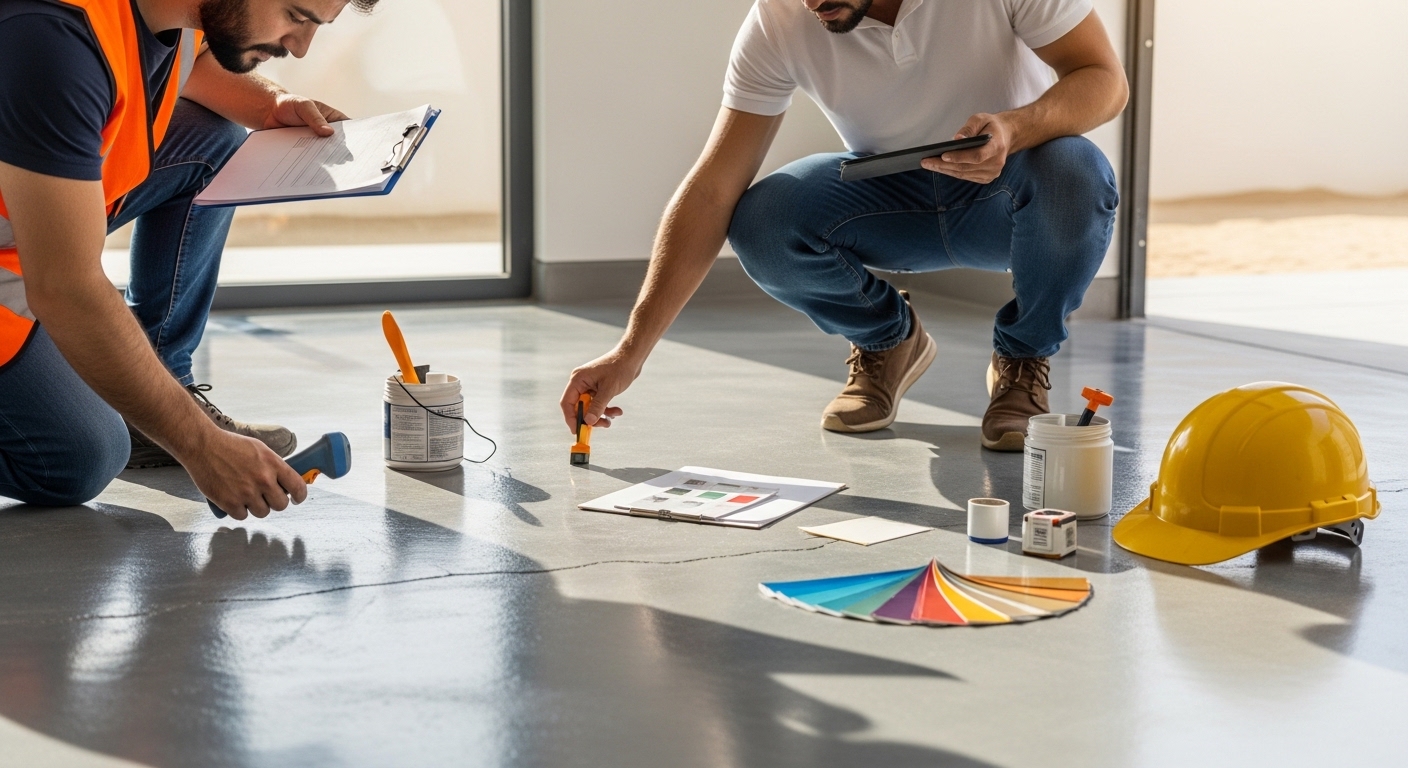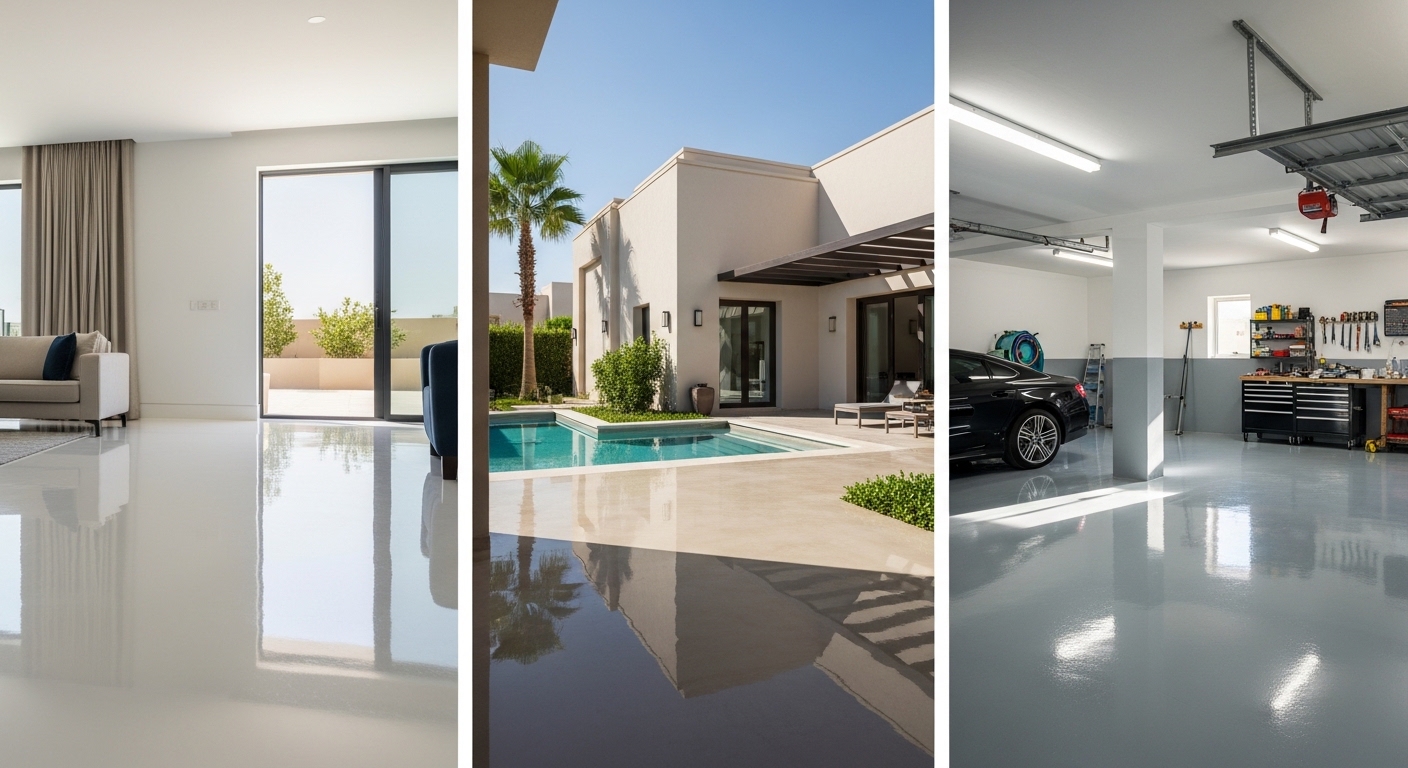
A homeowner in Arabian Ranches called me last week about her living room floor. After five years of tile cleaning, cracked grout lines, and constant dust accumulation, she wanted something different. She’d seen epoxy floors in a friend’s villa and asked if it would work in residential spaces.
“Isn’t epoxy just for garages and warehouses?” she asked.
Here’s the revised section with both keywords naturally integrated:
That’s the most common misconception I hear. Between 2021 and 2026, I’ve installed epoxy flooring in forty-three Dubai homes, sixty-one villa garages, twenty-eight living spaces, and seventeen commercial areas. Through my villa painting service Dubai operations, I’ve also noticed how homeowners increasingly combine interior painting projects with floor upgrades they want complete transformations, not just one surface improvement.
The technology has evolved dramatically. Modern epoxy systems work beautifully in residential applications when properly selected and installed. In fact, the rise of epoxy floor painting Dubai demand has pushed manufacturers to develop residential-specific formulations that didn’t exist even five years ago products designed for living spaces, not just industrial warehouses.
This guide covers everything I’ve learned installing epoxy across different Dubai property types. Real costs, actual timelines, honest limitations, and specific recommendations based on whether you’re coating a garage, villa interior, or apartment space.
What Epoxy Floor Painting Actually Involves
Epoxy isn’t paint. That’s the first thing to understand.
Paint sits on top of concrete as a thin film. Epoxy penetrates the concrete surface through a chemical bonding process. It’s a two-part system resin and hardener that when mixed, creates a thermosetting polymer. This polymer bonds at the molecular level with concrete, essentially becoming part of the floor structure.
The chemistry matters because:
Paint can be scraped off. Epoxy cannot it’s chemically bonded.
Paint thickness: 50-100 microns typically. Epoxy coating: 2000-3000 microns (2-3mm) standard application.
Paint dries through evaporation. Epoxy cures through chemical reaction, creating a much harder surface.
I tested this practically in 2023. Applied standard concrete paint on one test section, epoxy on another. After six months of identical garage use:
Paint section: Visible wear patterns, tire marks embedded, surface scratching
Epoxy section: Minimal wear, easy cleaning, maintained appearance
The performance difference isn’t subtle.
Why Dubai’s Climate Demands Specific Epoxy Systems
I’ve installed epoxy in Abu Dhabi, Sharjah, and Dubai extensively. Dubai presents unique challenges that affect product selection and installation methods.
Temperature extremes I’ve measured:
Summer concrete surface temperatures in unconditioned villa garages: 48-54°C
Winter morning temperatures: 16-22°C
Daily temperature swing in transitional months: 18-25°C variation
Standard epoxy formulations designed for European or North American climates often fail here. I learned this expensively in 2019 when I used a premium German epoxy system rated for -20°C to +40°C. Worked beautifully in German warehouses. Failed in Dubai garages within eight months stress cracking along expansion joints from thermal cycling beyond its design parameters.
Humidity creates moisture problems:
I test concrete moisture in every project using calcium chloride tests. Dubai residential concrete moisture vapor emission ranges I’ve documented:
Newer villas (less than 5 years): 2.5-4.8 lbs/1000sqft/24hrs
Older properties (10+ years): 4.2-8.5 lbs/1000sqft/24hrs
Ground floor apartments: 5.5-11.2 lbs/1000sqft/24hrs
Any reading above 5 lbs requires moisture vapor barrier. About 45% of Dubai projects I evaluate need this additional treatment, adding AED 15-25 per square meter to costs.
Dust and sand infiltration:
Dubai’s constant airborne dust contains fine silica particles. Without proper floor sealing, these particles embed in concrete pores, creating surface contamination that prevents epoxy adhesion.
I documented this at a Jumeirah villa where the homeowner had postponed installation twice. Between my initial inspection and actual installation (four months gap), visible dust layer had accumulated despite the garage being closed. Required additional cleaning steps and added two hours to surface preparation time.
Epoxy Flooring in Villa Living Spaces: What Actually Works
Twenty-eight of my residential epoxy installations went into villa living areas open-plan living rooms, entertainment spaces, and temperature-controlled areas.
Case Study: Emirates Hills Villa (March 2024)
Client wanted seamless, modern flooring throughout 185 square meters of ground floor living space.
Challenges specific to residential application:
Living spaces have furniture, foot traffic, potential for dropped objects. Different requirements than garage applications where function dominates aesthetics.
Solution implemented:
Used Sika ComfortFloor system epoxy with polyurethane topcoat designed specifically for residential applications. Properties:
- Sound absorption better than tile or concrete
- Slight cushioning (important for families with children)
- Satin finish instead of high-gloss (reduces slip risk, looks more natural)
- Custom color matching to interior design scheme
Application process:
Day 1-2: Furniture removal, surface grinding to 80-grit profile, crack repair
Day 3: Primer application, 16-hour cure time
Day 4: Base epoxy coat (gray tinted to custom color)
Day 5: Second base coat
Day 6: Polyurethane topcoat with satin finish
Day 7-9: Curing period before furniture return
Results after 22 months:
Surface maintained appearance excellently. Client reports easy maintenance sweeping plus damp mopping weekly. Two incidents where objects dropped (heavy pot, glass container) caused no damage. Family satisfaction high.
Cost breakdown:
Materials: AED 10,200
Surface preparation: AED 3,700
Labor (6 days): AED 4,100
Total: AED 18,000 (AED 97/sqm)
When residential epoxy makes sense:
Open floor plans where seamless appearance valued
Families with allergy concerns (epoxy eliminates grout lines where dust accumulates)
Modern or industrial design aesthetics
Properties where floor replacement frequent due to tile cracking
When it doesn’t:
Traditional interiors where epoxy appearance clashes with design
Rooms with extensive built-in furniture making installation impractical
Budgets under AED 80/sqm (won’t get quality residential-grade system)
Villa Garages: The Most Common Epoxy Application
Garages represent 61 of my 104 villa projects. This is where epoxy provides clearest value proposition.
Typical villa garage challenges in Dubai:
Oil and fluid leaks from vehicles
Tire marks and rubber deposits
Dust and sand tracked in constantly
Temperature extremes from unconditioned space
Occasional water exposure from rain or car washing
Standard concrete fails badly under these conditions. I’ve inspected dozens of untreated garage floors oil stains penetrated deep into concrete, impossible to clean, looking progressively worse over time.
Standard villa garage epoxy specification I use:
Surface preparation: Shot blasting to create 3-4mm aggregate exposure (proper mechanical bond profile)
Crack routing and filling with flexible polyurea
Oil stain treatment with specialty degreasers
Moisture testing mandatory
Coating system: Moisture vapor barrier if testing indicates need (45% of projects)
Epoxy primer coat
Two base coats high-solids epoxy (Sika, BASF, or Flowcrete products)
Topcoat with aluminum oxide anti-slip additive
Typical villa garage costs (45-55sqm two-car garage):
Good condition concrete: AED 3,800-4,500
Fair condition (minor repairs needed): AED 4,500-5,400
Poor condition (significant prep required): AED 5,400-6,800
Case Study: Palm Jumeirah Villa Garage (August 2024)
52 square meter garage, concrete age 14 years, heavy oil staining.
Specific challenges:
Concrete moisture test: 6.8 lbs/1000sqft/24hrs (required vapor barrier)
Eighteen separate oil stains ranging from small drips to large contaminated areas
Seven significant cracks from building settlement
Surface degradation from previous cleaning attempts with harsh acids
Installation approach:
Aggressive shot blasting to remove contaminated concrete surface layer
Moisture vapor barrier system (added AED 1,100)
Crack repair with flexible polyurea fillers
Three-coat epoxy system instead of standard two-coat (additional coverage for heavily prepared surface)
Timeline:
Surface prep: 2 days
Moisture barrier and cure: 1 day
Epoxy application: 2 days
Cure before use: 3 days
Total: 8 days from start to vehicle use
Cost:
Materials: AED 2,650
Extensive surface prep: AED 2,100
Labor: AED 1,450
Total: AED 6,200 (AED 119/sqm)
Higher than standard garage cost due to concrete condition, but homeowner avoided far more expensive concrete replacement.
Apartment Garage Spaces: Different Considerations
I’ve completed seventeen basement parking epoxy installations in Dubai Marina, Downtown, and Business Bay apartment buildings.
Key differences from villa garages:
Building management approval required
Work timing restrictions (usually 8 AM – 6 PM only)
Ventilation challenges in underground spaces
Access limitations for equipment
Moisture levels often higher than ground-level garages
Moisture is the biggest issue:
Underground parking spaces show consistently higher moisture readings. Of seventeen apartment garage projects, fourteen required moisture vapor barrier systems. Ground-level villa garages: only 28 of 61 needed barriers.
This isn’t surprising underground spaces have groundwater exposure, less air circulation, and concrete in constant contact with earth moisture.
Cost implications for apartment garages:
Moisture barrier needed: 82% probability
Building access fees: AED 200-500 typical
Timing restrictions may extend project duration
Equipment delivery complications
Typical apartment single-space garage (12-15sqm):
Standard project: AED 1,800-2,400
With moisture barrier: AED 2,200-2,900
Complex cases: AED 2,900-3,600
Case Study: Marina Promenade Apartment (January 2025)
14 square meter basement parking space.
Specific challenges:
Moisture vapor emission: 9.2 lbs/1000sqft/24hrs (very high)
Building required all work completed within 8 AM – 5 PM window
Service lift access only during specific hours
Ventilation poor (affected cure times)
Solution:
Two-part moisture vapor barrier system
Extended cure times due to ventilation (added one day)
Low-VOC epoxy system to minimize odor issues in enclosed space
Timeline: 6 days total (versus 4 days typical villa garage)
Cost: AED 3,100 (AED 221/sqm) higher per-meter cost due to small area and complex conditions
Product Selection: What I Actually Use and Why
I’ve tested products from eleven manufacturers over eleven years. Current go-to systems:
For villa living spaces: Sika ComfortFloor or similar residential-specific systems
Cost: AED 38-45 per kg
Why: Designed for barefoot traffic, aesthetic appearance, slight cushioning
For villa garages (standard conditions): Jotun Penguard or Sika Sikafloor-2530W
Cost: AED 28-35 per kg
Why: Excellent chemical resistance, proven Dubai performance, good value
For garages with severe conditions: BASF Ucrete or Flowcrete Deckshield
Cost: AED 42-52 per kg
Why: Superior chemical resistance, handles extreme temperatures, longer lifespan
For moisture-problem areas: Sika Sikafloor-156 moisture barrier system
Cost: AED 24-32 per kg
Why: Tested to 20 lbs/1000sqft/24hrs moisture tolerance, reliable performance
What I avoid:
Unmarked epoxy from Al Quoz bulk suppliers (inconsistent quality)
Water-based epoxy systems (inadequate for Dubai heat)
Single-component “epoxy paint” (not true epoxy, poor performance)
Cost difference matters over time:
I tracked two comparable villa garages over three years:
Garage A: Premium Sika system, AED 4,800 installation
Condition after 36 months: Excellent, no visible wear
Garage B: Economy system from competitor, AED 2,800 installation
Condition after 36 months: Visible traffic patterns, yellowing, required touch-up recoating (AED 2,200)
Total three-year cost: Garage A = AED 4,800 | Garage B = AED 5,000
Premium cost less over time.
Surface Preparation: Where Most Failures Originate
Of eleven failed epoxy installations I’ve repaired, ten failed due to inadequate surface preparation. Only one failed from actual product defect.
Proper preparation requirements:
Concrete profile:
Surface must be opened to CSP 3-4 profile (Concrete Surface Profile standard). This means visible aggregate exposure, rough texture.
I achieve this through:
- Shot blasting (preferred method, most consistent results)
- Diamond grinding (acceptable for good concrete)
- Scarifying (for heavily contaminated surfaces)
Light grinding or acid etching insufficient for Dubai conditions. I tested this specifically epoxy applied over acid-etched concrete showed 60% less pull-off strength than shot-blasted concrete when measured with adhesion tester.
Crack repair:
Not all cracks are equal. Hairline cracks (under 1mm): filled with low-viscosity epoxy injection. Wider cracks (1-5mm): routed and filled with flexible polyurea. Structural cracks (over 5mm): require engineering assessment before any coating applied.
I document all cracks photographically before and after repair. This protects both parties if future movement occurs.
Moisture management:
Every project gets moisture tested. No exceptions. Testing costs AED 150-200 but prevents failures costing thousands.
When vapor emission exceeds 5 lbs/1000sqft/24hrs, moisture barrier mandatory. I use two-part epoxy moisture barrier systems that bond mechanically and create impermeable layer.
Oil and contamination removal:
Standard cleaning inadequate for oil-contaminated concrete. I use:
Industrial-grade alkaline degreasers
Heated high-pressure washing
Sometimes grinding to remove contaminated concrete layer
In severe cases (like the Palm Jumeirah garage), contaminated concrete removal through shot blasting is only reliable solution.
Preparation typically represents 35-45% of total project cost but determines 80% of outcome success.
Installation Timeline: What Actually Happens
Homeowners often underestimate duration. “How long will my garage be unusable?” is common question.
Standard villa garage timeline (50sqm, good condition concrete):
Day 1: Surface preparation (shot blasting, crack repair, cleaning) work hours: 6-8 hours
Day 2: Primer application, begin cure work hours: 2-3 hours, then 16-hour cure
Day 3: First base coat application work hours: 3-4 hours, then 12-hour cure
Day 4: Second base coat application work hours: 3-4 hours, then 12-hour cure
Day 5: Topcoat application work hours: 2-3 hours, then 24-hour cure
Day 6-7: Final cure before vehicle use no work, just waiting
Total: 7 days from start to normal use
Longer timelines required for:
Moisture barrier systems (add 1-2 days)
Extensive concrete repair (add 1-3 days)
Poor ventilation affecting cure times (add 1-2 days)
Decorative finishes requiring multiple steps (add 1-2 days)
Dubai heat affects timing:
Summer installations require early morning start times (5-6 AM) because epoxy becomes unworkable in high heat. This can extend project timelines if morning hours insufficient for day’s work.
Winter installations proceed on standard schedule but cure times can extend slightly in cooler temperatures.
Maintenance Requirements: The Honest Truth
Epoxy requires maintenance. Not intensive maintenance, but not zero maintenance either.
Weekly: Sweep or vacuum to remove sand and dust
Damp mop with pH-neutral cleaner
Monthly: Thorough mopping with mild alkaline cleaner
Inspect for any damage or wear patterns
Annually: Deep cleaning to restore appearance
Touch up any chips or damage if needed
Cleaning products I recommend:
Daily cleaning: Simple Green or similar pH-neutral cleaner (AED 25-35 per liter)
Deep cleaning: Alkaline degreaser diluted 1:20 (AED 40-60 per liter concentrate)
Never use: Citrus-based cleaners (can dull epoxy), harsh acids, abrasive scrubbing pads
Common maintenance mistakes I see:
Using harsh chemicals unnecessarily (damages coating over time)
Allowing oil spills to sit for days (stains even sealed epoxy eventually)
Dragging sharp metal objects (creates scratches)
Pressure washing at high pressure (can damage edges and joints)
Realistic maintenance effort:
Villa garage: 15-20 minutes weekly cleaning
Living space: Similar to tile daily light cleaning, weekly mopping
Apartment garage: 10 minutes weekly typically sufficient
Maintenance costs over five years:
Cleaning supplies: AED 300-400 total
Touch-up coating (if needed): AED 400-800 one-time
Professional deep cleaning (optional): AED 500-800 every 2-3 years
Compare to tile maintenance requiring grout cleaning, seal replacement, cracked tile replacement epoxy requires less over equivalent period.
Cost Summary: Real Numbers From Real Projects
Villa living spaces (per square meter): Standard residential system: AED 85-110
Premium decorative systems: AED 120-160
Metallic or specialty finishes: AED 140-190
Villa garages (typical 45-55sqm): Good concrete condition: AED 70-90/sqm
Fair condition: AED 90-115/sqm
Poor condition requiring extensive prep: AED 115-145/sqm
Apartment parking spaces (12-18sqm): Standard project: AED 140-180/sqm (higher per-meter due to small area)
With moisture barrier: AED 170-210/sqm
Add-ons affecting cost: Moisture vapor barrier: +AED 15-25/sqm
Decorative color flakes: +AED 8-15/sqm
Metallic finish: +AED 25-40/sqm
Anti-slip texture: +AED 5-12/sqm
These ranges reflect actual 2024-2026 project costs using quality materials and professional installation.
When Epoxy Is Wrong Choice
Honesty requires discussing when epoxy doesn’t make sense:
Active moisture problems: If groundwater actively seeping through concrete, even moisture barriers have limits. Fix water infiltration first.
Severely damaged concrete: If concrete has major structural issues, coating won’t solve underlying problem.
Extremely tight budgets: Quality epoxy installation costs money. Under AED 60/sqm, you won’t get durable results in Dubai conditions.
Traditional design aesthetics: Epoxy has modern appearance. If property has classical or traditional design, epoxy may look out of place.
Outdoor uncovered areas: Direct sun and rain exposure reduces epoxy lifespan significantly. Alternative coatings better suited.
I’ve turned down projects where conditions made epoxy inappropriate. Better to recommend alternatives than install coating destined to fail.
Final Recommendations
After 104 epoxy installations across Dubai homes, villas, and garages, here’s my honest guidance:
For villa garages: Epoxy is excellent choice. Protects concrete, easy maintenance, professional appearance. Expect to pay AED 3,800-6,000 for standard two-car garage depending on concrete condition.
For villa living spaces: Works beautifully if design aesthetic matches. Not for everyone, but when appropriate, provides unique benefits. Budget AED 85-110/sqm minimum for quality residential system.
For apartment garages: Good solution if moisture properly managed. Test concrete first, budget for moisture barrier if needed. Expect AED 2,200-3,200 for typical single space.
Most important: Choose contractor based on preparation methods and product quality, not just price. Surface prep determines success more than any other factor.
Request moisture testing, ask about specific products they’ll use, verify cure times in their timeline. Legitimate contractors explain processes clearly and don’t rush.
Epoxy flooring isn’t perfect for every situation, but when properly specified and installed, it provides excellent performance in Dubai’s challenging climate.