A honest, detailed guide for homeowners and property owners in Dubai who want the full picture before making a flooring decision.
Before You Read
Epoxy flooring is genuinely excellent for a wide range of applications in Dubai but it is not perfect for everything, and some of its limitations are more significant in the UAE’s climate than most guides acknowledge. This article gives you the complete, honest picture: what epoxy genuinely does well, what it genuinely does not, what the real costs look like in dirhams, and the specific Dubai factors UV exposure, coastal moisture, summer heat that most competitors either miss or get wrong. By the end, you will know whether epoxy is the right decision for your specific space.
What Is Epoxy Flooring and What It Is Not
Before discussing advantages and disadvantages, it is worth being precise about what epoxy flooring actually means. Confusion between epoxy paint and professional epoxy coating is widespread and leads to genuinely poor purchasing decisions.
Professional epoxy floor coating is a two-component system. Component A is an epoxy resin. Component B is a hardener. When mixed together in the correct ratio, they trigger a chemical reaction called cross-linking, forming a dense network of interlocked polymer chains. This cures into a surface that does not merely sit on top of the concrete it penetrates the pores of the substrate and bonds chemically to it. The result is significantly thicker, harder, and more durable than any paint product. This is precisely what separates professional epoxy floor painting Dubai contractors from anyone applying a basic hardware store coating the chemistry, the preparation, and the system behind it are fundamentally different.
Epoxy paint sold in hardware stores across Dubai is a completely different product. It contains some epoxy resin as one ingredient in a water or solvent-based paint. It cures by evaporation rather than chemical reaction. The film it creates is thin and has a fraction of the durability of a professional coating system. Many Dubai homeowners who have had poor experiences with epoxy actually applied epoxy paint, not a professional two-component system. This distinction matters enormously when evaluating what epoxy can and cannot do.
A professional epoxy coating system will always involve two separate components mixed immediately before application. If a contractor arrives with a single pre-mixed product, or if the quote references a one-coat application with no mention of surface grinding, you are looking at epoxy paint not a professional floor coating system.
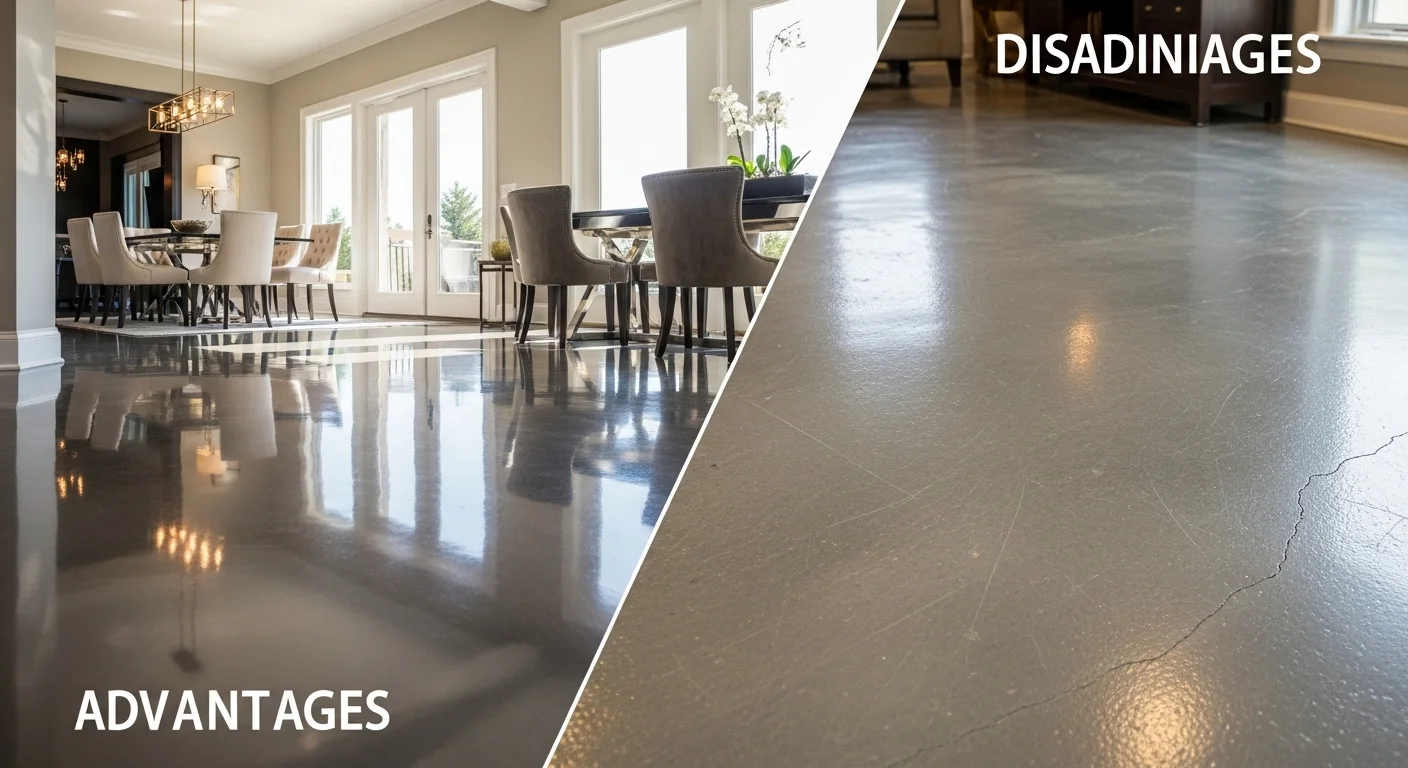
The Real Advantages of Epoxy Flooring
These are not marketing bullet points. Each advantage below is explained with the specific detail that tells you why it matters, how significant it actually is, and what it means for your property in Dubai.
Durability That Genuinely Outlasts Most Alternatives
A professionally installed epoxy floor coating in a Dubai villa or commercial space will typically last 12 to 20 years in residential applications before any significant wear is visible. And when it does eventually show wear, the floor does not need to be demolished and replaced. It can be refreshed with a new topcoat at a fraction of the original installation cost. This repairability is one of epoxy’s most underappreciated advantages over tiles, carpet, and vinyl all of which must eventually be ripped out and sent to landfill.
The durability comes from the chemical structure of the cured polymer. Cross-linked epoxy resins resist impact, compression, and abrasion at levels that far exceed paint or surface sealers. A vehicle driven daily over an epoxy garage floor, heavy racking in a warehouse, or constant foot traffic in a retail showroom epoxy handles all of these without cracking, chipping, or delaminating, provided the original installation was done correctly.
In high-use garages and commercial kitchens across the UAE, properly installed epoxy floors regularly reach the 15-year mark with nothing beyond routine cleaning. The equivalent tile floor in those environments typically requires grout repair within 3 to 5 years and tile replacement long before the 15-year mark.
Seamless Surface With No Grout Lines and No Hidden Dirt
Every tile floor has grout lines. Those grout lines stain, harbour bacteria, collect cooking oil, absorb cleaning chemicals, and gradually discolour regardless of how diligently you clean them. In a city where fine desert sand is a constant presence in every home, grout lines become sand traps that require regular deep cleaning and eventually professional re-grouting an ongoing cost that tile owners consistently underestimate.
Epoxy creates a fully seamless, non-porous surface from one wall to the other, with no joints anywhere. Spills sit on the surface. Bacteria has nowhere to accumulate. Fine desert sand does not embed anywhere it sits on top and sweeps away cleanly. This is why commercial kitchens, pharmaceutical facilities, hospitals, and food processing plants across Dubai choose epoxy as their floor of choice. The hygienic advantage of a seamless surface is structural, not cosmetic.
After a shamal sandstorm, fine silica dust settles on every surface in a home. On an epoxy floor, it sits on the surface and is removed with a single dust mop pass. On a tiled floor, it settles into grout lines where regular mopping redistributes it rather than removing it.
Chemical and Stain Resistance Broader Than Most People Realise
Epoxy resists a wide range of chemicals without staining or degrading motor oil, brake fluid, transmission fluid, household cleaning agents, dilute acids and alkalis, most solvents, and food-grade substances. This resistance comes from the dense cross-linked polymer structure that has very low porosity, meaning liquids sit on the surface rather than being absorbed.
In a Dubai villa garage, oil drips from a car, tyre marks from hot rubber in summer, and spills from cleaning products all wipe up without leaving permanent marks. In a commercial kitchen, cooking oil and food acids that would stain or etch natural stone simply wipe off an epoxy surface.
One important caveat: certain concentrated chemicals battery acid, strong oxidising agents, some industrial solvents can attack specific epoxy formulations with prolonged contact. For industrial applications involving particularly aggressive chemicals, the specific chemical resistance of the epoxy system should be verified against the manufacturer’s technical data sheet. For residential use, this is rarely a meaningful concern.
Design Range That Has Moved Far Beyond Industrial Grey
The image of epoxy as a plain grey industrial floor is at least a decade out of date. Modern epoxy systems offer a design range that rivals and in some cases exceeds what is available in tiles. Metallic pigment systems create swirling 3D liquid-marble and molten-metal effects that cannot be replicated in any tile format. Self-levelling systems in warm neutral tones deliver a seamless architectural floor that suits luxury villa interiors beautifully. Decorative vinyl flake systems offer dozens of colour combinations that complement virtually any exterior or interior palette.
For open-plan villa living areas increasingly common in Dubai’s modern residential developments a seamless epoxy floor that flows continuously from the kitchen through the living area creates a spatial coherence that a tiled floor with grout lines cannot match. The floor reads as one uninterrupted surface, which makes rooms feel significantly larger.
Metallic and self-levelling epoxy systems are now being specified in newly built villas across Dubai Hills Estate, Meydan, and Mohammed Bin Rashid City as deliberate design choices by interior designers not merely as practical alternatives to tiles.
Lower Long-Term Cost Than Most Flooring Alternatives
Epoxy’s upfront cost sits in the mid-range compared to the full spectrum of flooring options in Dubai more expensive than basic ceramic tile, broadly comparable to quality porcelain, and significantly less than premium natural stone. Where epoxy pulls ahead economically is in the total cost of ownership over 10 to 15 years.
Tiles require re-grouting. Cracked tiles require replacement which is complicated by the fact that tile batches change, making exact matches difficult or impossible. Carpet in Dubai’s dusty environment needs professional cleaning and eventually full replacement. Vinyl peels in the heat. Epoxy, by contrast, needs only routine cleaning for its entire service life, and when it eventually shows wear, a professional topcoat recoat restores it completely without any demolition or major disruption.
To put a real number on this: a 60 sqm villa garage coated with a quality flake epoxy system at AED 80 per sqm costs AED 4,800. Lasting 15 years, that works out to approximately AED 320 per year for a floor that never needs re-grouting, never cracks under tyre weight, and requires only a weekly sweep and occasional mop to maintain.
Improves Safety Through Light Reflection
High-gloss and semi-gloss epoxy finishes reflect ambient light significantly better than bare concrete, most tiles, or matte floor surfaces. In a large garage, warehouse, or commercial kitchen, this can dramatically improve visibility without adding lighting infrastructure. Industrial facilities in Dubai regularly report measurable reductions in lighting energy costs after epoxy installation, simply because the reflective floor bounces existing light more effectively around the space.
For residential garages and utility areas, better visibility means safer working conditions seeing clearly under and around vehicles, finding items stored on shelves, and identifying any spills or hazards on the floor before they cause accidents.
Handles Dubai’s Interior Climate Better Than Most Surfaces
Dubai’s extreme temperature differential between air-conditioned interiors typically 20 to 24°C and the heated concrete substrate beneath means floor surfaces experience constant thermal cycling, expanding slightly as temperatures rise and contracting as cooling kicks in. Over years, this thermal movement stresses adhesive bonds and can cause tiles to crack or tent away from the substrate if expansion gaps were not correctly calculated during installation.
A properly installed epoxy system, bonded directly to the concrete rather than adhered with a separate compound, moves with the slab rather than against it. This is one reason why professionally installed epoxy floors in Dubai interiors show a notably lower rate of thermal delamination than tiled floors in the same buildings over a 10-year period.
Environmentally Responsible and Recoatable Rather Than Replaceable
Epoxy flooring is one of the very few floor finishes that does not have to be completely removed and sent to landfill when it shows wear. When an epoxy floor reaches the end of its cosmetic life perhaps after 12 to 15 years of service a professional contractor lightly abrades the surface and applies a fresh topcoat. The result looks and performs like a new installation. Tiles, carpet, vinyl, and most other flooring systems must be torn out entirely when they fail, generating significant construction waste. In Dubai’s growing emphasis on sustainable building practices, this recoatability is a meaningful long-term advantage.
The Honest Disadvantages Without Minimising Any of Them
Every guide on epoxy flooring lists the same disadvantages in one or two sentences and then immediately reassures you they are manageable. Some of them are. Some of them are more significant than most guides admit. Here is the unminimised picture.
Standard Epoxy Yellows Outdoors, and This Is a Chemistry Issue Not a Quality Issue
This is the most important limitation for Dubai property owners and the most commonly misunderstood one. Standard epoxy resins including premium, professional-grade products from reputable manufacturers are not UV-stable. When exposed to direct sunlight, UV radiation breaks down the epoxy polymer structure, causing visible yellowing, chalking, and loss of gloss. In Dubai’s intense solar environment, this can become noticeable within three to six months of application to an outdoor surface.
The critical point that most guides get wrong is attributing this to low-quality materials. Buying more expensive standard epoxy does not solve the problem. The solution is using a different chemistry altogether a polyaspartic coating or an aliphatic polyurethane topcoat over the epoxy base. These products are specifically formulated to resist UV degradation and will hold their colour and gloss outdoors in UAE conditions for years.
For any Dubai villa driveway, terrace, pool surround, or outdoor entertaining area, specifying a UV-stable topcoat is not a luxury upgrade. It is the minimum correct specification. Any contractor who quotes standard epoxy for an outdoor Dubai surface without raising this point is either inexperienced or cutting costs at your expense.
Installation Failure Is Common and Almost Always Caused by Poor Surface Preparation
The number one cause of epoxy floor failure delamination, peeling, bubbling, uneven adhesion is inadequate surface preparation. Industry professionals consistently place this figure at 70 to 80 percent of all early epoxy failures. The concrete must be mechanically ground or shot-blasted to open the pores, degreased to remove any contamination, and repaired where cracks or damage exist. Any contamination remaining on the slab residual curing compounds from the original concrete pour, construction release agents, oil from previous garage use, mineral salts from moisture migration will prevent proper chemical bonding regardless of how good the epoxy product itself is.
In Dubai’s villa market, concrete slabs in older properties frequently have one or more of these contamination issues. A contractor who cleans the floor with a mop and applies epoxy the same day without any mechanical preparation is setting the floor up for failure, potentially within 12 to 18 months. Mechanical grinding generates noise, dust, and takes time. If a quote is unusually cheap or unusually fast, inadequate surface preparation is the most likely explanation.
What proper preparation looks like: diamond grinding or shot-blasting the surface, removing all existing coatings and contamination, repairing cracks and chips with compatible filler, applying a penetrating primer coat, and allowing adequate drying time before the base coat. This should represent a full working day for a standard residential garage in Dubai.
Moisture Vapour from Below Can Cause Bubbling a Dubai-Specific Risk
This disadvantage rarely appears in guides written for temperate climates, but it is genuinely relevant in the UAE. Properties in coastal Dubai Marina, JBR, Jumeirah, the Palm, Creek areas and buildings with older foundations can experience elevated moisture vapour emission from the concrete slab. Groundwater vapour migrates upward through the concrete under pressure. If epoxy is applied over a slab with high moisture vapour emission without a moisture-tolerant primer or vapour barrier layer, the hydrostatic pressure eventually pushes the coating away from the slab surface, causing bubbling and delamination that cannot be repaired without completely removing and reapplying the coating.
A simple plastic sheet test taping a piece of clear plastic to the floor with all edges sealed and leaving it for 24 hours can identify this risk before any application begins. If you see condensation on the underside when you lift it, the slab has elevated moisture vapour emission and the specification must account for this. On any ground-floor or basement slab in Dubai, particularly in coastal locations, requesting this test is simply prudent.
Strong Chemical Fumes During Installation Require Genuine Ventilation
Two-component epoxy systems release volatile organic compounds during application and during the initial curing phase. The smell is strong and the coated area needs to be vacated during application and for several hours afterward. Adequate cross-ventilation or mechanical air movement must be maintained throughout.
For a villa garage with large doors, ventilation is usually straightforward. For interior living spaces in an enclosed villa room, more careful planning is required. Summer in Dubai adds a further complication opening windows for ventilation in July or August is not always practical, meaning temporary ventilation equipment or early morning scheduling is needed. This is a logistical consideration that must factor into your project planning, particularly for interior residential applications.
The Full Cure Period Is 7 Days, Not “a Day or Two”
Epoxy reaches light foot traffic strength within approximately 24 hours of application. But full chemical cure the point at which the floor has reached its maximum hardness, chemical resistance, and load-bearing capacity takes 7 full days under normal temperature conditions. Parking a vehicle on a garage floor on day two, placing heavy racking on a warehouse floor on day three, or dragging heavy furniture across a living room floor before the week is out can permanently indent or mark the surface before it has fully hardened.
Many guides tell readers to wait “a day or more” before use. This is seriously misleading for anything heavier than careful foot traffic. The 7-day full cure period should be built into your project timeline as a firm commitment. In Dubai’s summer heat, cure rates can vary from standard international guidelines, and your contractor should give you specific guidance based on the ambient conditions at the time of installation.
Slippery When Wet, but Completely Addressable With the Right Specification
A smooth high-gloss epoxy floor without any texture additive is slippery when wet comparable to polished marble or high-gloss ceramic tile. For a dry living room or bedroom, this is not a practical concern. For a kitchen, bathroom, villa entrance, pool surround, or any area that sees wet footwear or spills, it must be addressed during the installation specification.
The solution is standard practice among professional contractors: fine aluminium oxide or quartz aggregate is incorporated into the final topcoat during application, providing excellent wet traction without significantly affecting the visual finish. Slip resistance can be specified on a sliding scale depending on the needs of the specific space. This is not a product limitation you simply accept it is a specification decision that should be made upfront and confirmed with your contractor before any coating is applied.
Hard Underfoot, the Same as Tile and Different from Carpet
Epoxy over concrete is a hard floor. It has no give and no cushioning. For Dubai residents transitioning from tile floors which describes most villa owners in the UAE this is not a significant change, because tile over concrete is equally hard. The difference becomes relevant if you are replacing carpet or if extended barefoot comfort in a bedroom or family room is a priority.
The practical mitigation is simple: area rugs in seating areas and bedside mats in bedrooms. These are design choices most homeowners make regardless of the floor type beneath them. For anyone with joint conditions or elderly family members who spend significant time standing, anti-fatigue mats in kitchen and workshop areas are a worthwhile addition regardless of whether the floor is epoxy, tile, or concrete.
Dubai-Specific Factors Most Guides Never Mention
Most articles about epoxy flooring are written for temperate climates. The UAE is a different environment, and several factors that barely matter elsewhere are genuinely significant in Dubai.
Summer Installation and the Heat Problem
Concrete surface temperatures in un-shaded Dubai garages and outdoor areas can exceed 55 to 60°C during July and August. At those temperatures, the working time of mixed epoxy drops dramatically. The coating can begin to skin over before it has fully levelled, resulting in surface defects and compromised adhesion. Professional contractors in Dubai schedule summer applications in early morning hours before the slab heats up, use temporary shading structures, or work exclusively in air-conditioned interior spaces during peak summer months. A contractor who shows no awareness of this issue for an outdoor summer project in Dubai should be questioned carefully.
Coastal Humidity and Salt Exposure
Properties within a few kilometres of Dubai’s coastline experience elevated ambient humidity and occasional salt-laden air. For coastal properties, specifying a moisture-tolerant epoxy primer as the first coat rather than a standard primer provides significantly better long-term performance. This is a specification detail that distinguishes an experienced UAE contractor from one applying generic international practice.
Desert Dust and the Correct Maintenance Order
Fine desert sand is mildly abrasive. The correct maintenance protocol for an epoxy floor in Dubai is to dry-sweep or dust-mop before introducing any moisture. Mopping a sandy floor without sweeping first drags abrasive particles across the surface under wet friction which over years progressively dulls a gloss finish. This is a maintenance habit specific to the UAE context that most international epoxy guides never mention.
Real Costs in AED Across Every System Type
Vague statements about epoxy costing more than basic tiles are not useful when planning a real project. Here are current realistic market rates for Dubai, inclusive of surface preparation, materials, and professional labour.
Solid Colour Epoxy: AED 40 to 65 per square metre. Utility rooms, storage areas, basic garage or warehouse applications.
Decorative Flake System: AED 65 to 100 per square metre. Villa garages, basements, gym rooms the most popular residential system in Dubai.
Self-Levelling Epoxy: AED 80 to 130 per square metre. Living rooms, kitchens, open-plan villa areas.
Metallic or 3D Epoxy: AED 120 to 200 per square metre. Feature rooms, luxury villa interiors, showrooms and retail spaces.
Quartz Anti-Slip System: AED 75 to 120 per square metre. Kitchens, pool surrounds, building entrances, wet areas.
Polyaspartic Outdoor System: AED 110 to 170 per square metre. Driveways, terraces, outdoor pool decks UV-stable specification required for all outdoor UAE applications.
Be cautious of quotes significantly below these ranges. Surface preparation alone represents a substantial portion of a quality job, and a quote that seems unusually low almost always reflects a compromise in preparation time, coating thickness, or material quality all of which directly affect how long the floor lasts.
The True Maintenance Picture
The standard claim that epoxy is low maintenance is true but vague. Here is exactly what maintaining an epoxy floor in a Dubai home actually involves, and what to avoid.
What you should do: Dry-sweep or dust-mop daily or after any sandstorm event, always before introducing moisture. Mop once or twice a week with warm water and a pH-neutral floor cleaner. Address spills promptly. Use felt pads under furniture legs to prevent point-load scratching on gloss finishes. Inspect the floor annually for any signs of delamination at edges or in high-traffic zones and address them early before they spread.
What you must avoid: Never use acidic cleaning products tile descalers, vinegar-based cleaners, or citrus cleaning solutions that are popular in UAE households for limescale removal. Acids break down the topcoat chemistry gradually and will dull and degrade the surface over time. Never use steam mops, which concentrate heat in a way that can soften and blister certain topcoat formulations. Never mop a dusty or sandy floor without sweeping first.
When to recoat: After 8 to 12 years of heavy residential use, the topcoat may begin to show visible wear, dullness, or minor surface scratching. At this point, a professional contractor lightly abrades the surface and applies a fresh clear topcoat. This process takes one to two days, costs a fraction of the original installation, and restores the floor to new appearance without any demolition, waste, or major disruption.
Who Should Choose Epoxy and Who Should Not
Choose epoxy if you are coating a villa garage, workshop, or utility room. If you want a seamless, hygienic surface for a kitchen or commercial space. If you want a modern, minimal aesthetic for an open-plan living area. If long-term low maintenance matters more to you than design variety. If you are near the Dubai coastline and want moisture-resistant flooring. If you want a floor that lasts 15 or more years without replacement. If you are fitting out a retail showroom or commercial space. If you want a floor that can be refreshed rather than demolished when it eventually shows wear.
Consider alternatives if you prefer the wide design variety of traditional tiles for a bedroom. If soft, warm underfoot feel is your priority for a living area. If the concrete slab is freshly poured wait a minimum of 28 days before any epoxy application. If the slab has severe structural cracking that requires engineering attention before any surface coating. If you cannot vacate the space for the installation and full cure period.
Frequently Asked Questions
Is the UV yellowing of epoxy really that bad in Dubai, or is it exaggerated?
It is not exaggerated for outdoor surfaces. Dubai receives UV radiation levels among the highest in the world, and standard epoxy resin is genuinely not formulated to withstand this. On a south-facing driveway or uncovered pool surround, visible yellowing and surface chalking can begin within three to six months. For interior surfaces a living room, kitchen, or garage with UV-filtered glass doors this is not a meaningful concern because direct UV does not reach the floor. The risk is entirely site-specific: outdoor and partially covered surfaces in direct UAE sunlight. In those locations, always specify a polyaspartic or aliphatic urethane topcoat from the start. Treating UV-stable topcoats as an optional upgrade for outdoor Dubai applications misunderstands the nature of the problem.
How do I know if my Dubai villa slab has a moisture vapour problem before committing to epoxy?
The simplest initial test costs nothing and takes 24 hours. Tape a piece of clear plastic sheeting roughly 500mm square flat against the floor with all edges sealed. Leave it for 24 hours. If you see condensation or moisture droplets on the underside when you lift it, your slab has elevated moisture vapour emission that must be addressed in the epoxy specification. For a more precise measurement, a professional moisture vapour emission rate test gives a quantitative reading that allows the contractor to specify the correct primer system. Ground-floor and basement slabs in coastal Dubai properties Marina, Jumeirah, JBR, the Palm, creek-adjacent areas are the highest-risk category and should always be tested before application.
What cleaning products should I never use on an epoxy floor in Dubai?
The products most commonly used in UAE households that damage epoxy floors are acidic cleaners tile and bathroom descalers, vinegar-based multi-surface sprays, citrus cleaning solutions, and some limescale removers. Dubai’s hard water creates significant limescale buildup, and many residents routinely use acidic products to address it. On epoxy floors, these same products gradually break down the topcoat chemistry, causing dullness, micro-etching, and eventually loss of the protective layer. The correct maintenance product is a pH-neutral floor cleaner. For oil or grease contamination in a garage, a diluted alkaline degreaser is appropriate, followed by a clean water rinse. Steam mops should be avoided entirely. When in doubt, plain warm water is always safe on a cured epoxy floor.
Does epoxy flooring add value to a Dubai property?
For a villa garage, almost certainly yes. A clean, professionally finished epoxy garage floor is now a standard expectation among buyers and tenants in the premium Dubai villa market. The cost of a quality flake epoxy installation is modest relative to villa values in Dubai, and it consistently features as a positive in property viewings. For interior living areas, the impact depends on the quality and style of the installation. A stunning metallic epoxy feature floor in a luxury villa living room, when done well, is an asset that distinguishes the property in a competitive market. As with any interior design choice, the context neighbourhood, buyer profile, villa style matters alongside the flooring type itself.
How do the advantages and disadvantages of epoxy change for a commercial kitchen in Dubai?
In a commercial kitchen context, the advantages of epoxy are significantly amplified and the disadvantages largely neutralised by correct specification. The seamless, non-porous surface meets Dubai Municipality’s food safety requirements for kitchen flooring in a way that tiled floors with grout lines structurally cannot grout harbours bacteria and is considered a food safety risk in commercial kitchen environments. Chemical resistance to cooking oils, food acids, cleaning agents, and sanitising chemicals is directly relevant in a busy kitchen. For commercial kitchen specification, a quartz-filled anti-slip epoxy system is standard practice the quartz aggregate provides the wet grip required on a surface that sees constant water and oil exposure. The curing period disadvantage is managed by scheduling installation during a kitchen shutdown period. In a correctly specified and installed commercial kitchen, the advantages of epoxy significantly outweigh the disadvantages in virtually every practical measure.