A detailed, honest comparison for Dubai villa owners, homeowners, and commercial property managers covering durability, real costs in AED, climate performance, hygiene, and exactly which option suits which space.
The Short Answer If you are choosing a floor for a Dubai villa garage, commercial kitchen, warehouse, or any high-use area epoxy wins on nearly every practical measure. If you are furnishing a bedroom, traditional living room, or bathroom where texture and design variety matter most quality tiles are still the right call. The real answer, as always, depends on your specific space. This guide gives you everything you need to decide.
This is a question that comes up constantly among Dubai homeowners. And it makes sense you are making a decision that will affect how your property looks, functions, and holds its value for the next decade or more. Tiles have been the default choice in the UAE for years. Epoxy flooring is now rapidly gaining ground, and for good reason searches for epoxy floor painting Dubai have grown steadily as more villa and apartment owners discover what a quality coating system actually delivers compared to what they have been living with.
So here is a genuinely detailed breakdown. Not just “epoxy is durable and tiles have more patterns” but the real nuances that matter specifically in Dubai’s climate, real estate market, and daily living conditions. We’ll cover everything from moisture vapour under your slab near the Marina to what happens to standard epoxy when UAE sunlight hits it for six months.
What’s In This Guide
- Understanding Both Options
- Durability in Dubai’s Climate
- Hygiene & Cleanliness
- Appearance & Design
- Real Cost Comparison (AED)
- Installation & Disruption
- Long-Term Maintenance
- Safety & Comfort
- Which Suits Which Space?
- Full Pros & Cons
- Final Verdict
- FAQs
Understanding Both Options First
Before comparing, it’s worth being clear about what each of these actually is — because “epoxy flooring” in particular is a term that gets used loosely and often incorrectly.
What Epoxy Floor Coating Actually Is
Epoxy floor coating is a two-component system made of an epoxy resin (Part A) and a hardener (Part B). When these two are mixed together, they trigger a chemical reaction that creates a hard, rigid polymer material. This mixture is applied directly onto a prepared concrete surface, where it penetrates the concrete pores and chemically bonds to the substrate it doesn’t just sit on top like paint does.
Once cured, epoxy becomes a seamless, non-porous surface that is significantly harder and more chemically resistant than bare concrete or any coating paint. The thickness depends on the system — a basic protective coating might be 0.3mm, while a heavy industrial mortar system can build up to several millimetres.
Important Distinction
Epoxy paint from a hardware store is not the same thing as professional epoxy floor coating. Epoxy paint contains epoxy resin as just one ingredient in a water or solvent-based paint — it cures by evaporation and is far thinner and less durable. True epoxy coating is a 100% solids, two-component system that cures by chemical reaction. If a quote seems unusually cheap, ask what product is actually being used.
What Tile Flooring Is (and Its Many Variations)
Tile flooring covers a wide category — ceramic, porcelain, natural stone (marble, travertine, limestone), and engineered stone. Each behaves differently. Ceramic is the most affordable and least durable. Porcelain is denser, more water-resistant, and significantly tougher. Natural stone is beautiful but porous and requires sealing and more careful maintenance, particularly in Dubai’s dusty environment.
All tile floors share one characteristic that matters enormously in any comparison with epoxy: grout lines. Every tile floor has joints filled with grout, and those joints are the weak point in terms of hygiene, durability, and maintenance effort. It doesn’t matter how good the tiles themselves are — the grout lines are always there.
Durability — and How Dubai’s Climate Affects Both
Dubai’s environment puts flooring through a very specific kind of stress. Temperatures regularly exceed 40°C outdoors. Concrete slabs expand and contract through thermal cycling. Near the coast — Jumeirah, Dubai Marina, Palm Jumeirah, JBR — buildings experience elevated humidity and moisture vapour pressure from below ground. And throughout the year, fine silica-rich desert dust finds its way into every interior space, acting as a mild abrasive on floor surfaces over time.
How Epoxy Handles Dubai Conditions
A correctly specified and installed epoxy system performs very well in Dubai interiors. The seamless surface gives fine desert dust nowhere to settle and embed. The chemical bond to the concrete substrate means it moves with the slab through thermal cycles rather than popping loose the way tiles can. Impact resistance is high — dropping tools in a garage, rolling furniture, or heavy foot traffic does not cause the kind of damage that chips tiles or cracks grout.
The one area where epoxy demands respect in the UAE is outdoor exposure. Standard epoxy resins are not UV-stable. In direct Dubai sunlight, they will visibly yellow and chalk within months. This catches many property owners by surprise because the floor looks perfect indoors but degrades quickly on a sun-exposed villa driveway or terrace. The solution is straightforward — always specify a UV-stable polyaspartic or aliphatic polyurethane topcoat for any outdoor or partially exposed application — but this needs to be built into the specification from the start.
How Tiles Handle Dubai Conditions
Good quality porcelain tiles are genuinely tough and have a long track record in the UAE. They handle heat well on their own. The problem is not usually the tiles themselves — it is the system as a whole. Grout lines in high-traffic areas crack and stain over time. If expansion gaps are not correctly calculated during installation (a surprisingly common error in Dubai where temperature differentials between air-conditioned interiors and the hot substrate below can be extreme), tiles can crack or tent — lifting away from the adhesive bed.
Natural stone, while beautiful, is porous and requires regular sealing in Dubai’s dusty environment. Without consistent maintenance, sand and dust embed into the stone surface and dull it progressively. For high-use areas like garages or commercial kitchens, natural stone is not a practical choice regardless of how it looks in a showroom.
The Critical Variable Most Guides Miss
In Dubai properties near the coast or with older foundations, moisture vapour emission from the concrete slab is a genuine issue. If epoxy is applied over a slab with elevated moisture vapour pressure, it will eventually bubble and peel from below — even if the surface prep was otherwise perfect. The same moisture also works under tiles over time, weakening adhesive bonds and causing hollow, loose tiles. A moisture vapour emission test before any flooring installation is worth every dirham it costs.
Hygiene and Cleanliness — A Clear Winner
This is one category where epoxy flooring has an unambiguous, structural advantage over tiles — and it matters more in Dubai than in most other cities because of the ever-present fine desert dust.
Epoxy’s seamless, non-porous surface means there are no joints, no grout lines, no micro-cracks, and no pores. Dust sits on the surface and gets removed with a simple sweep or mop. Bacteria has nowhere to accumulate. Spills cannot soak in. This is why epoxy is the preferred flooring in commercial kitchens, hospital clinics, pharmaceutical production facilities, and food processing plants — all environments where the UAE’s strict food safety and healthcare standards require hygienic, cleanable surfaces.
Tile floors, by contrast, always have grout lines. Even freshly grouted joints will, over time and with regular exposure to moisture, cooking oil, cleaning chemicals, and foot traffic, begin to discolour and harbour bacteria. Deep cleaning grout is laborious and often only partially effective. Re-grouting is expensive and disruptive. In a Dubai commercial kitchen or any villa where hygiene matters, the grout line problem is a real, ongoing cost.
Epoxy — Hygiene
- Fully seamless — no joints or grout
- Non-porous — nothing soaks in
- Bacteria and mould have nowhere to accumulate
- Meets strict commercial kitchen and healthcare standards
- Easy daily cleaning in dusty UAE conditions
Tiles — Hygiene
- Grout lines collect bacteria over time
- Porous grout stains and discolours
- Natural stone requires ongoing sealing
- Deep cleaning is labour-intensive
- Re-grouting is an eventual certainty
Appearance and Design Options
This is the category where honest nuance matters most, because the picture here is more balanced than either side tends to admit.
Tile’s Genuine Advantage: Design Variety and Familiarity
The tile industry offers an extraordinary range of formats, patterns, colours, and textures. Large-format marble-look porcelain slabs for a villa living room. Hand-crafted zellige for a kitchen backsplash. Dark textured stone-effect tiles for a dramatic bathroom. There is a reason tiles have been the default flooring choice in luxury residential properties across Dubai for decades — when used well, they are genuinely beautiful and offer design versatility that epoxy cannot fully match.
Tiles also feel warm and familiar underfoot in a way that some residents prefer in bedrooms and living areas. They carry associations of quality and tradition that many homeowners, particularly in the premium villa market, still value highly.
Epoxy’s Design Capabilities Are Often Underestimated
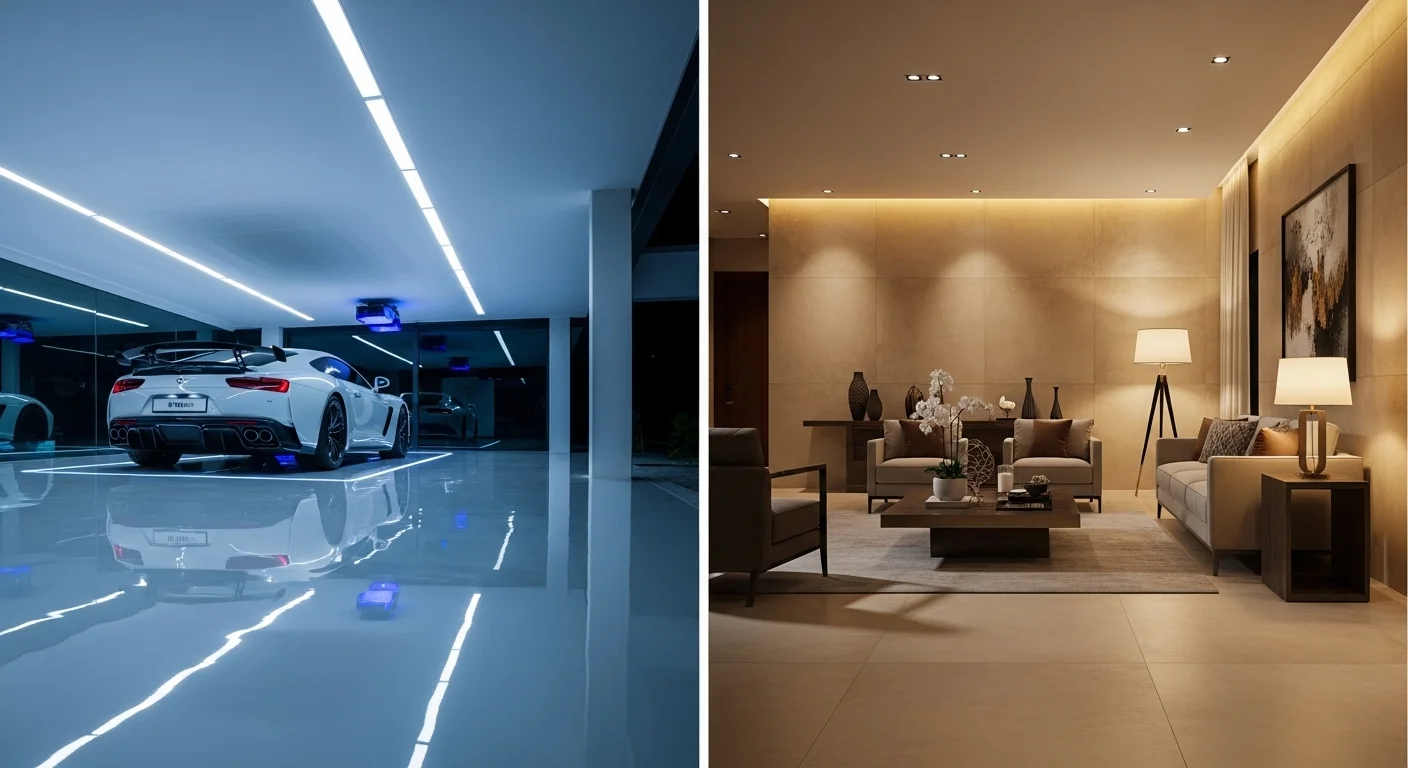
Many people still picture basic grey industrial epoxy when they hear the word — and that image is outdated. Modern metallic epoxy systems create genuinely stunning 3D marble and liquid-metal effects that work beautifully in luxury villa interiors and high-end commercial spaces. Self-levelling epoxy in a polished, neutral tone delivers a sleek, contemporary look that suits open-plan villa layouts extremely well. Decorative flake systems offer dozens of colour combinations and give a professional, high-end finish to garages and utility spaces.
The key difference from tiles is that epoxy is a seamless canvas — the look it creates is architectural and minimal rather than decorative and patterned. Depending on your taste and the style of your property, that can be either an advantage or a limitation.
Dubai Design Trend Note
In the past three years, self-levelling epoxy and polished concrete overlays have been increasingly specified in newly built villas across Meydan, Dubai Hills, and MBR City as a deliberate design choice — not just a practical one. The industrial-chic aesthetic has moved firmly into premium residential interiors across the city.
Real Cost Comparison in Dubai (AED Breakdown)
Let’s talk actual numbers, because vague statements like “epoxy costs more upfront” without any figures are not useful when you are planning a real project. The following ranges reflect current market pricing in Dubai for supply and professional installation.
Epoxy Flooring — Dubai Market Rates
Epoxy
Solid Colour
AED 40–65
per sq. metre · Warehouses, utility rooms, basic commercial
Epoxy
Flake / Chip System
AED 65–100
per sq. metre · Villa garages, residential basements
Epoxy
Metallic / 3D
AED 120–200
per sq. metre · Luxury villas, showrooms, hotel lobbies
Epoxy
Industrial Mortar
AED 90–160
per sq. metre · Factories, warehouses, forklift traffic
Tile Flooring — Dubai Market Rates
Tiles
Standard Ceramic
AED 25–55
per sq. metre · Basic residential, utility areas
Tiles
Quality Porcelain
AED 60–110
per sq. metre · Standard residential, commercial spaces
Tiles
Large Format / Designer
AED 120–250
per sq. metre · Premium villas, luxury interiors
Tiles
Natural Stone
AED 150–400+
per sq. metre · High-end marble, travertine, limestone
The True Long-Term Cost Picture
Looking at supply and installation costs alone, mid-range epoxy and mid-range porcelain tiles are broadly comparable in Dubai’s market. Where the long-term economics diverge significantly is in ongoing maintenance and eventual repair.
A quality epoxy floor installed correctly on a well-prepared surface can last 15 to 20 years in a residential setting without replacement — and when it begins to show wear, it can be refreshed with a new topcoat at a fraction of the original installation cost. Tiles, when they crack or when grout begins to fail, require individual tile replacement (which often means matching the existing batch, which may no longer be in production) and periodic re-grouting. Over a 15-year period, the total cost of ownership for a quality epoxy floor is typically lower than for an equivalent tile floor in a high-use space.
Installation Process and Disruption
Both options require professional installation. The nature of the disruption is different enough to be worth understanding before you commit.
Tile installation is a familiar, well-understood process across Dubai — finding experienced tilers is easy. However, it is labour-intensive and sequential. Each tile is laid individually, adhesive must cure, then grout is applied and must cure. For a medium-sized villa space of 60–80 sqm, professional tile installation typically takes 3 to 5 days, with the space unusable during that period. Matching existing tiles in a partial repair scenario is often difficult because tile batches change.
Epoxy installation is faster in terms of coverage — a skilled team can coat large areas in a single day — but the critical constraint is curing time. The floor cannot be used during the curing period, which is typically 24 hours for foot traffic and up to 7 full days before vehicles or heavy loads can be placed on it. The surface preparation phase (grinding, degreasing, crack repair) typically adds a further day before any coating begins. During application, strong chemical odours are present and good ventilation is essential.
Summer Installation Note for Dubai
In July and August, concrete surface temperatures in un-air-conditioned Dubai garages and warehouses can exceed 55–60°C under direct sunlight. At those temperatures, mixed epoxy has a dramatically shorter working time and the risk of surface defects (bubbling, uneven cure) is high. Professional contractors schedule summer applications for early morning hours or use temporary climate control equipment. If a contractor is willing to apply epoxy on a sun-baked surface in the peak of Dubai summer without any controls, that is a warning sign.
Long-Term Maintenance in Dubai’s Environment
Maintenance might be where the practical difference between epoxy and tiles is most felt in day-to-day Dubai living.
Epoxy’s seamless surface is genuinely easy to maintain. Daily sweeping or dust mopping removes the fine desert sand before it can abrade the surface (always sweep before mopping — dragging wet sandy grit across a gloss surface will dull it over time). Mopping with a pH-neutral cleaner is all that is normally needed. Avoid steam mops, which can soften certain topcoat formulations. Avoid acidic cleaning products — popular in some UAE households for descaling — which can break down epoxy topcoats over time. When the floor eventually begins to look worn after many years, a full topcoat recoat restores it completely without any demolition or waste.
Tile maintenance is more demanding — not dramatically so, but consistently. Grout lines require specific attention; standard mopping doesn’t clean them adequately. In Dubai’s dusty environment, fine sand settles into grout and darkens it over time. White or light-coloured grout, common in villa interiors, looks tired within a year or two in areas of heavy use. Periodic professional grout cleaning and re-sealing adds to the ongoing cost. Cracked tiles in high-traffic areas are an eventual certainty, and sourcing a perfect match in the same batch is frequently impossible.
Safety, Comfort, and Underfoot Feel
Both flooring types can be slippery when wet if the wrong finish is specified. This is an important point because many people assume tiles are automatically safer — they are not, particularly the large-format polished porcelain formats popular in Dubai villa interiors.
A smooth, high-gloss epoxy floor without any texture additive will be slippery when wet — similar to polished marble or high-gloss ceramic. However, this is entirely addressable. Anti-slip additives — fine aluminium oxide or quartz aggregate — are incorporated into the final topcoat during application. The result is a surface with excellent wet grip that still looks sleek. For areas around villa pools, villa entrances, and commercial kitchens, anti-slip specification is standard practice among professional contractors.
On underfoot comfort and feel, tiles have a slight edge in residential settings. Natural stone and quality porcelain have a solidity and temperature that many residents find pleasant, particularly in air-conditioned interiors. Epoxy floors are harder underfoot than thick carpet, obviously, but comparable to tile in practice. In areas where people stand for extended periods — commercial kitchens, for example — an anti-fatigue mat is useful regardless of which floor type is installed.
Which Option Suits Which Space in Your Dubai Property?
Rather than a generic recommendation, here is room-by-room guidance based on the specific demands of each space in a typical Dubai villa or commercial property.
Villa Garage
Epoxy — Clear Winner
Oil resistance, tyre mark resistance, heat stability, and easy cleaning after sandstorm dust. Flake epoxy systems are the professional standard for Dubai villa garages.
Commercial Kitchen
Epoxy — Clear Winner
Hygiene regulations, seamless surface, chemical resistance, and anti-slip specification. Grout lines in commercial kitchens are a food safety risk.
Warehouse / Industrial
Epoxy — Clear Winner
Forklift traffic, chemical spills, and heavy loads demand epoxy mortar systems. Tiles would crack under this use within months.
Villa Bedroom
Tiles — Preferred
Design variety, warmth underfoot, and the familiar aesthetic of quality porcelain or natural stone suits this space well. Lower stress use means grout lines are manageable.
Villa Bathroom
Tiles — Preferred
Wet areas with standard residential use. Anti-slip tiles with water-resistant grout are the established, tested solution. Epoxy works here too but tiles are more cost-effective.
Open Plan Living Area
Either — Depends on Style
Both work well here. Large-format porcelain gives a luxurious traditional look. Self-levelling or metallic epoxy creates a striking contemporary aesthetic. The right choice depends on the overall design direction of the villa.
Retail / Showroom
Epoxy — Preferred
Seamless gloss or metallic epoxy makes an immediate visual impression and handles foot traffic well. Easy to clean and maintain in a commercial setting.
Pool Surrounds / Outdoor
Epoxy with UV Topcoat
Anti-slip quartz-filled epoxy with a polyaspartic UV-stable topcoat. Standard epoxy without UV protection will yellow outdoors in Dubai — always specify correctly for outdoor use.
Full Honest Pros & Cons
Epoxy Flooring — Complete Picture
Advantages
- Seamless, fully non-porous — no grout lines ever
- Exceptional durability under heavy use and impact
- Chemical and stain resistant — oil, solvents, cleaning agents
- Easy to clean in Dubai’s dusty environment
- Can be refreshed with a topcoat — no demolition or waste
- Wide design range including metallic, flake, solid, and quartz
- Lower total cost of ownership over 10–15 years
- Reflective finishes improve light distribution in large spaces
- Anti-slip additives easily incorporated
- Handles thermal cycling in Dubai well when correctly installed
Disadvantages
- Standard epoxy yellows outdoors under UAE UV exposure
- Strong chemical fumes during installation — ventilation needed
- Requires skilled installation — poor prep causes early failure
- Moisture vapour from below can cause bubbling if not tested
- Slippery without anti-slip additive on gloss finishes
- Cannot be applied to a damp or freshly poured slab
- Higher upfront cost than basic tile options
- Summer heat in Dubai requires careful scheduling
Tiles Flooring — Complete Picture
Advantages
- Wide design variety — colours, patterns, textures, formats
- Familiar, well-established material with long track record in UAE
- Quality porcelain is genuinely durable in low-stress areas
- Comfortable, pleasant underfoot feel in residential spaces
- Lower entry-level cost for basic ceramic options
- Works well in bathrooms and bedrooms
- Large-format natural stone delivers unmatched luxury aesthetics
- Individual tile replacement is possible (if the batch matches)
Disadvantages
- Grout lines collect bacteria, sand, and staining over time
- Tiles can crack under impact or thermal expansion in Dubai
- Grout maintenance and re-grouting is ongoing and costly
- Polished tiles are slippery when wet
- Matching replacement tiles is frequently impossible
- Natural stone requires regular sealing in dusty UAE conditions
- Adhesive bonds weaken over time under thermal cycling
- Higher ongoing maintenance cost compared to epoxy
Head-to-Head Comparison Table
| Factor | Epoxy Flooring | Tile Flooring | Winner |
|---|---|---|---|
| Durability under heavy use | Very high — seamless, impact resistant | Medium — tiles hold up, grout does not | Epoxy |
| Hygiene & cleanliness | Excellent — fully non-porous | Poor in grout lines — bacteria risk | Epoxy |
| Design & aesthetic variety | High — but architectural, not patterned | Very high — enormous range | Tiles |
| Upfront cost (mid-range) | AED 65–100 per sqm typical | AED 60–110 per sqm typical | Similar |
| Long-term cost of ownership | Lower — recoatable, minimal repairs | Higher — re-grouting, tile replacement | Epoxy |
| Dubai climate performance | Excellent interior · UV-topcoat needed outdoors | Good interior · grout issues over time | Epoxy |
| Daily maintenance | Very low — sweep and mop | Medium — grout needs attention | Epoxy |
| Safety (wet slip resistance) | Good when anti-slip specified | Good when matte/anti-slip tiles used | Equal |
| Underfoot comfort | Hard — comparable to tile | Solid and familiar — preferred by many | Tiles (slight edge) |
| Repairability | Excellent — topcoat refresh, no waste | Difficult — batch matching often fails | Epoxy |
| Best for garages & industrial | Yes — the professional standard | Not suitable | Epoxy |
| Best for bedrooms & bathrooms | Functional but less common | Yes — well-suited | Tiles |
The Final Verdict — Broken Down Honestly
Choose Epoxy If…
You are flooring a garage, commercial kitchen, warehouse, showroom, or any high-traffic area. You prioritise hygiene, durability, and low maintenance over the next 15+ years. You want a modern, seamless aesthetic for a villa interior or open-plan space. You are installing near the Dubai coastline and want a surface that handles moisture vapour and humidity better than tiles. You want a floor that can be refreshed rather than demolished when it eventually wears.
Choose Tiles If…
You are flooring a bedroom, traditional living room, or bathroom where design variety, pattern, and the familiar underfoot feel of stone or porcelain matter most. You are working with a tight budget on a basic residential space with light use. You prefer the wide aesthetic range that the tile market in Dubai offers for creating a highly specific interior look. You are installing in an area where individual tile replacement is likely to be needed and manageable.
Frequently Asked Questions
Can I put epoxy flooring directly over my existing tiles in Dubai?
In some cases, yes — but with important caveats. If your existing tiles are fully bonded, in good condition, and have no hollow or loose areas, epoxy can theoretically be applied over them after proper mechanical preparation. However, the surface profile achievable on a tile surface is generally inferior to that of properly prepared concrete, and if any tiles are even slightly loose, the epoxy will eventually fail in those areas as the tile below flexes.
In practice, most professional epoxy contractors in Dubai recommend removing tiles and working directly on the concrete substrate. If removal is genuinely not feasible, a self-levelling skim coat or overlay product is often applied first to create a proper substrate. The additional cost of doing this correctly is almost always worth it over a 10-year horizon.
Does epoxy flooring yellow in Dubai’s sunlight, and how do I prevent it?
Standard epoxy resins absolutely do yellow under direct UV exposure, and Dubai’s sunlight intensity will accelerate this significantly compared to temperate climates. If you apply standard epoxy to a driveway, villa entrance, pool surround, or any outdoor or partially covered area, expect visible yellowing and chalking within 6 to 12 months.
The solution is to specify a UV-stable topcoat — either a polyaspartic coating or an aliphatic polyurethane — over the epoxy base. These products are designed to resist UV degradation and will hold their colour for years in outdoor UAE conditions. They cost more than a standard epoxy clear topcoat, but for any outdoor application they are not optional — they are the correct specification. Always confirm this with your contractor before work begins.
Which is genuinely cheaper over 10 years epoxy or tiles?
For a high-use area like a villa garage or commercial space, epoxy is cheaper over a 10-year period in the vast majority of cases. The logic is straightforward: epoxy has minimal ongoing maintenance costs, does not require re-grouting, and when it eventually shows wear, a topcoat refresh is far less expensive than tile replacement. Tiles in high-traffic areas will typically require grout repairs within 3 to 5 years, and cracked tile replacement becomes increasingly expensive as sourcing a perfect match from the original batch becomes impossible.
For a low-traffic bedroom or bathroom, the calculation is more balanced. Basic porcelain tiles with light use will need minimal repair for a decade, and the upfront cost is often lower. In those spaces, the long-term cost difference narrows significantly.
Is epoxy flooring slippery especially around pools or in Dubai’s sandy conditions?
A smooth, high-gloss epoxy finish without any texture additive is slippery when wet — similar to polished marble or high-gloss porcelain. This is a valid concern, particularly around villa pools, building entrances, and anywhere sandy or dusty footwear is common in Dubai.
The solution is straightforward and standard practice: anti-slip aggregate is broadcast into the final topcoat during application. Fine aluminium oxide or quartz sand provides excellent wet grip without significantly affecting the visual finish. Slip resistance can be specified on a scale — more aggregate gives more grip at the cost of a slightly textured look; less aggregate maintains a cleaner visual with somewhat lower traction. A professional contractor will discuss the appropriate slip resistance rating for your specific area as part of the specification process.
How long does professional epoxy flooring last in a Dubai villa garage?
A professionally installed flake or solid-colour epoxy system in a Dubai villa garage, applied over properly prepared concrete, should give you 10 to 15 years of good service before any significant cosmetic wear is visible. With good maintenance regular dust mopping and pH-neutral cleaning — and no major mechanical damage, some installations last considerably longer.
The variables that most affect longevity are: quality of the original surface preparation (the single most important factor), the thickness and quality of the coating system specified, how the floor is maintained day-to-day, and whether vehicles are parked before the floor has fully cured (at least 7 days). Garages with hot tyre contact in the Dubai summer are particularly demanding a quality topcoat specification is important in this environment.
Can epoxy flooring be installed in a villa that is currently occupied?
Yes, but it requires careful planning. The primary constraints are the chemical fumes during application and the curing period during which the coated area cannot be used. Most professional contractors approach occupied villas by working in sections — coating one area, allowing it to cure, then moving to the next — to minimise the total disruption at any one time. The coated area needs good ventilation during and after application, which in a Dubai summer means temporary air movement rather than simply opening windows.
For a garage, disruption is usually minimal since residents can temporarily park elsewhere. For large interior areas, it is worth planning the work around a period when the property can be partially vacated, even if only for a few days. A good contractor will give you a clear phasing plan and realistic daily timeline before work begins.
What is the difference between epoxy and polyaspartic flooring — and does it matter in Dubai?
This distinction matters specifically in the UAE context. Epoxy is the base coating system — it provides the bond, thickness, and structural performance of the floor. Polyaspartic is a topcoat material — it sits over the epoxy and provides the surface wear layer. The key advantage of polyaspartic is that it is UV-stable and cures far faster than standard epoxy topcoats.
For indoor applications in Dubai, a standard epoxy system with a quality clear topcoat performs very well and is the most common specification. For any outdoor or sun-exposed area — villa driveways, terraces, pool surrounds, car park decks a polyaspartic topcoat over the epoxy base is the correct and necessary specification to prevent UV yellowing. Some contractors offer pure polyaspartic systems throughout (base and top), which are faster to install and highly durable, though typically at a premium cost.