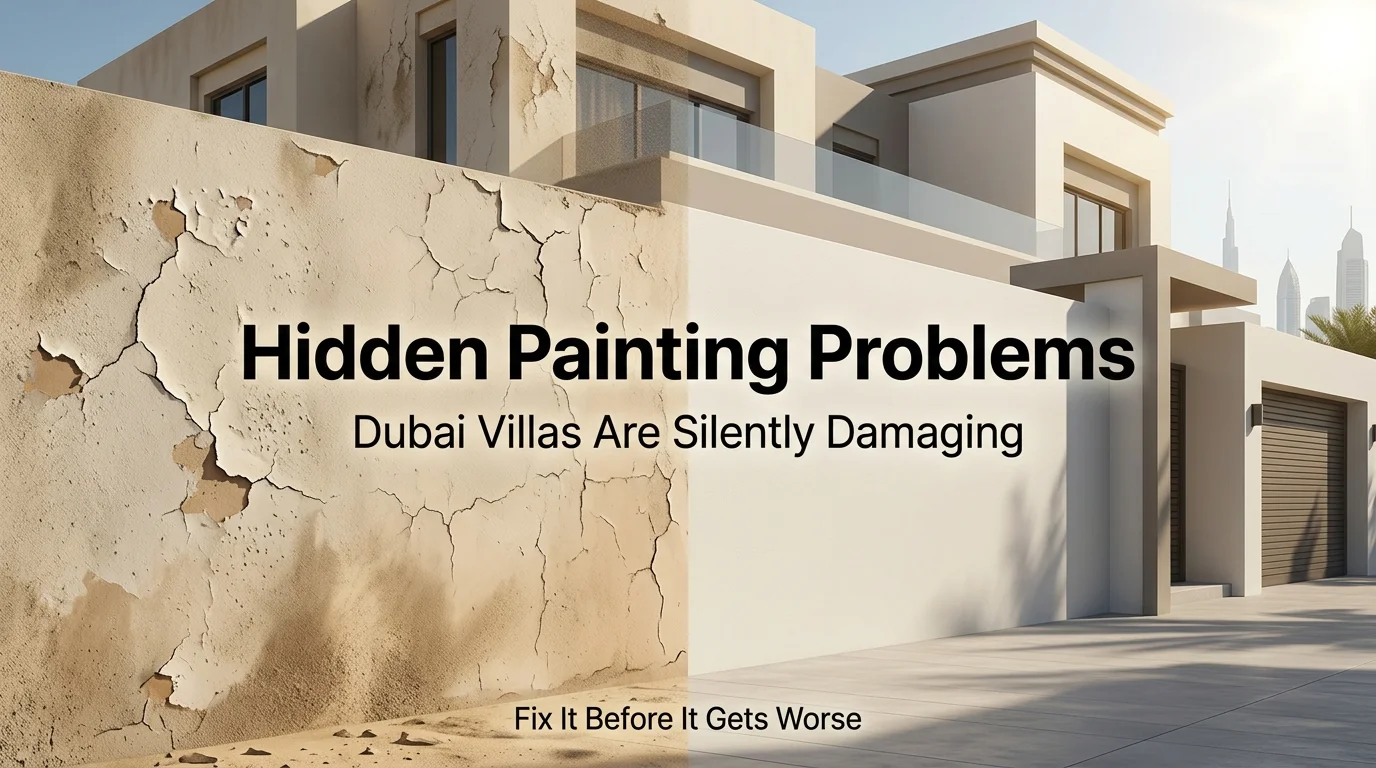
Why Villa Paint in Dubai Fails And Why It’s Rarely the Paint’s Fault
I got a call last October from a homeowner in Al Barsha 2. He had repainted his villa exterior six months earlier twice. Same wall, same contractor, same peeling result both times. The third contractor he called told him the problem was the paint brand. So he bought more expensive paint. By the time he reached us, the wall was peeling in sheets again and he was convinced the problem was the wall itself.
It wasn’t the wall. It wasn’t the paint brand. The problem as it almost always is was hidden moisture in the concrete block, combined with a primer that was chemically incompatible with the topcoat the contractor had specified. Two very fixable issues that no one had bothered to check before lifting a brush.
I’ve been painting villas in Dubai since 2008. In those sixteen years, I’ve seen paint fail for dozens of reasons, but the overwhelming majority come down to the same cluster of hidden problems that most contractors either don’t know how to diagnose or don’t want to spend the time fixing properly. This guide explains what those problems are, how to spot them, and exactly how we fix them so you don’t end up repainting the same wall for the third time.
| The Dubai Climate Your Paint Has to Survive Summer ambient temperature: 40–48°C | Floor and wall surface temps in direct sun: 60–75°C | August peak humidity: 85–95% | UV Index: 11–12 (Extreme classification) | Daily thermal swing: up to 25°C between night and midday. Standard paints formulated for European or North American climates are not designed for this. Choosing the right product for Dubai’s conditions is not optional it is the foundation of everything else in this guide. |
Why Does Dubai Villa Paint Start Failing Before It Should?
The most common misunderstanding I encounter is that paint failure is a paint problem. Homeowners look at a peeling wall and think: wrong brand, wrong colour, bad batch. In my experience, approximately 80% of premature paint failure in Dubai is a surface preparation failure not a product failure.
Here is what I mean. When we arrive on a site before painting, we do a systematic assessment that most contractors skip entirely because it adds time. We check substrate moisture with a pin-type moisture meter. We look for hairline cracks using raking light in the morning. We test the existing paint for adhesion using a cross-cut tape test. We ask the homeowner which walls face south and west, and we check whether previous layers are still bonded or just sitting on top of each other.
On the Al Barsha villa I mentioned at the start, our moisture meter showed 18% relative humidity in the concrete block on the south-facing wall well above the 12% maximum threshold for painting that Jotun and Dulux both specify in their technical data sheets. The wall felt dry to the touch. It wasn’t.
That moisture, trapped under a paint film in a Dubai summer, heats up, expands, and eventually pushes the paint off the wall from the inside. No paint in the world can bond to a substrate that is doing that. The fix was not a new coat of paint it was identifying and sealing the water ingress point at the roof parapet, allowing the wall to dry out over six weeks, then applying a moisture-tolerant primer before any topcoat. The wall has now held for two years without a single bubble.
| Key Diagnostic Step: Moisture Testing Before Any Painting Before painting any Dubai exterior wall, measure substrate moisture with a calibrated pin-type or capacitance moisture meter. Maximum acceptable reading for most UAE-specified paint systems: 12% for masonry and concrete block. A wall that reads 15–20% and ‘feels dry’ is not dry it has trapped moisture that will cause delamination within 6–18 months, especially on south and west-facing elevations. |
Why South-Facing Walls Fade Faster And What to Do About It
This is one of the questions I get most often from villa owners who notice uneven fading: one side of their villa looks fresh after two years, while the side that catches the afternoon sun looks chalked and dull within twelve months of repainting.
The explanation is solar heat loading combined with UV degradation. A south or west-facing wall in Dubai can reach surface temperatures of 65–72°C in July and August. That is not a rounding error that is hot enough to cause significant thermal stress in conventional paint films, accelerate the breakdown of organic pigments, and dramatically shorten the expected lifespan of any coating that wasn’t designed for it.
The Right Product for Each Wall Direction
South and west-facing exterior walls: Specify a high-reflectance masonry paint with a Solar Reflectance Index (SRI) of 78 or higher. In practice, this means Jotun Jotashield Extreme, Dulux Weathershield Maximum Protect, or AkzoNobel’s Wanda Superlatex Exterior in light colours. These products reduce surface temperature by 8–14°C compared with standard white emulsion a meaningful difference that translates directly to longer paint lifespan.
North and east-facing walls: These walls receive less direct UV but tend to retain moisture longer due to limited drying time. Here you need a breathable, anti-fungal exterior system not the same high-build UV-resistant coat used on sun-facing elevations. Jotun Jotashield Antifungal or Dulux Weathershield with a fungicide additive works well on shaded walls in Dubai’s humid summer months.
Interior walls near bathrooms and AC ducts: These need a moisture-resistant, washable interior emulsion with anti-mould properties. We specify Jotun Majestic or Dulux EasyCare for Dubai apartment bathrooms and utility rooms standard interior emulsions begin to develop mould patches within 12–18 months in high-condensation zones.
The Hidden Cost of Skipping Primer And Why It Always Catches Up
Primer is the single most commonly cut step in low-cost painting contracts in Dubai. I understand why a proper priming coat adds time, adds material cost, and is invisible in the finished job. A contractor cutting corners can save a meaningful amount per square metre by skipping or thinning it. The client can’t see the difference on the day of completion.
They see it about fourteen months later.
Here is what primer actually does that paint alone cannot. Primer penetrates the masonry pores and creates a chemical bond between the substrate and the topcoat not just a mechanical adhesion, but a molecular one. It seals minor surface porosity that would otherwise cause the topcoat to be absorbed unevenly, leaving thin spots. It creates a stable, consistent surface pH (particularly important on new cement-rendered walls, which are highly alkaline and will saponify chemically attack paint films that are applied directly without an alkali-resistant primer).
On our Al Barsha villa case, the original contractor had applied a water-based topcoat directly to freshly rendered cement that was less than three weeks old. The cement was still curing and still alkaline. Without an alkali-resistant primer, that is a guaranteed delamination the chemistry is working against adhesion from day one.
Primer Selection for Dubai Conditions
- New cement render (under 4 weeks old): Alkali-resistant primer essential Jotun Jotashield Primer or Dulux Weathershield Primer are both specified for UAE conditions.
- Existing painted surfaces being overcoated: Adhesion primer or wash primer. Cross-cut tape test first if the existing paint fails the tape test, it must be removed, not overcoated.
- Moisture-affected walls: Moisture-tolerant penetrating primer (e.g., Sika Primer-3N) applied after substrate has dried below 12% moisture content. Do not attempt to paint over a problem solve the problem first.
- Interior walls: Water-based interior sealer or PVA diluted at manufacturer’s ratio. Full-strength PVA is too thick and creates a non-breathable membrane that traps moisture behind it a common mistake even among experienced painters.
| Quick Test: Is the Existing Primer Doing Its Job? Cross-cut tape test: score a 10x10cm grid of cuts through the existing paint down to the substrate, apply a strip of strong packing tape, press firmly, and pull sharply. If more than 15% of the paint squares lift with the tape, the existing coating has failed adhesion and painting over it is throwing money away. Strip and re-prime. |
Micro-Cracks: How Dubai’s Thermal Cycling Creates Paint’s Worst Enemy
Dubai buildings go through daily thermal cycling that would surprise most people from cooler climates. On a summer night, an exterior wall cools to around 25°C. By midday, the same wall if south-facing can be at 70°C. That is a 45-degree swing, every single day, for five months of the year.
Concrete and cement render expand and contract with temperature. Over time, this repeated movement creates hairline cracks often too fine to see without raking light or a magnifying glass. The problem is that paint does not. Standard paint films have a limited capacity for movement. When the substrate cracks and the paint cannot follow, the paint cracks too, and water finds its way in. In Dubai’s humidity, once water gets behind a paint film, the next cycle of heat expansion and contraction blows the paint off the wall in blisters.
How We Classify and Treat Cracks
Hairline cracks under 0.2mm: These are treated with a flexible acrylic filler, sanded flush, and sealed with primer before painting. They look minor and they are if caught and filled correctly before painting over them.
Cracks between 0.2mm and 0.5mm: These need a polymer-modified render fill, allowed to cure fully (minimum 48 hours in Dubai summer), then primer and topcoat. The movement capacity of the filler must match or exceed the expected thermal movement of the substrate.
Cracks above 0.5mm, or cracks that are still active and growing: These indicate ongoing structural movement. Filling and painting over them is a waste of money they will reopen. The correct specification here is an elastomeric bridging paint system such as Jotun Jotashield Extreme or Dulux Weathershield Crack Protect, which has enough elasticity to bridge a crack that continues to move seasonally. The substrate movement issue also needs investigation.
On a villa we painted in Jumeirah 1 in 2023, the owner had replastered and repainted a section of their exterior wall three times in four years because cracks kept reappearing. Our assessment found that the cracking was following the line of a concealed column a structural element that was expanding at a different rate to the surrounding masonry fill. The fix was not a better paint. It was cutting a proper expansion joint at the column-to-masonry interface, filling it with a flexible polyurethane sealant, and then using an elastomeric system across the whole elevation. No cracks have reappeared in eighteen months.
Why Dubai Dust Destroys Paint Adhesion And How to Remove It Properly
Dubai dust is not the same as household dust. The UAE sits on the edge of some of the world’s most active sand desert systems, and the particulate matter that settles on exterior walls here is predominantly fine silica particles in the PM2.5 to PM10 range, with angular, sharp-edged morphology.
When this fine silica settles into the pores of a masonry wall over months or years, it creates a physical barrier between the wall surface and any paint applied over it. You can wipe the surface with a cloth and it will look clean. The silica is still there, in the pores, acting as an anti-adhesion layer that paint bonds to instead of to the masonry itself. That is why you can see paint peeling on sections of a wall that look perfectly clean the failure point is below the visible surface.
The Correct Surface Cleaning Protocol
- High-pressure washing at 2,000–3,000 psi minimum not a garden hose. The pressure is needed to flush particles out of surface pores, not just rinse the face of the wall.
- Allow to dry fully minimum 72 hours in summer, minimum 5 days in the cooler months when evaporation is slower. Check with moisture meter before proceeding.
- Mechanical abrasion where needed a wire brush or grinding wheel on areas with failed paint, heavy silica deposits, or surface contamination from AC condensate or irrigation overspray.
- Vacuum all abraded surfaces with an industrial vacuum before priming. Compressed air blowing pushes the dust back into the pores vacuum extraction removes it.
- Prime within 4 hours of final cleaning. Do not leave a cleaned and abraded surface exposed overnight fresh silica begins settling again immediately in Dubai’s environment.
Internal Humidity in Dubai Villas: The Problem Behind the Wall
External walls get most of the attention, but in my experience some of the most persistent paint failures in Dubai villas happen on internal walls particularly in rooms near bathrooms, kitchens, and anywhere with ducted AC systems.
The mechanism is straightforward: warm, humid external air meets the cold surface of an air-conditioned interior wall and condenses. Dubai’s outdoor humidity in August regularly reaches 85–95%. When that air finds its way into wall cavities through gaps around electrical conduits, pipe penetrations, or inadequately sealed window reveals, you get persistent condensation behind the wall finish. The paint bubbles. You repaint it. It bubbles again.
Diagnosing and Fixing Internal Moisture Problems
Step 1 Identify the source, not the symptom: Bubbling or staining on an internal wall is not the problem it is the indicator. The source is almost always either rising damp from a ground-floor slab, condensation from a thermal bridge (usually a cold concrete column in a warm room), or water ingress from a failed seal around a window, door, or AC sleeve.
Step 2 Measure before specifying: We use a capacitance moisture meter on internal walls before any repainting. A reading above 15% on an internal wall means we will not paint it until the source is fixed and the wall has dried. Painting over a wet internal wall with standard emulsion will fail within six to twelve months without exception.
Step 3 Match the product to the environment: For bathrooms and kitchens in Dubai villas, we specify a two-coat moisture-resistant system a moisture-blocking primer followed by a washable, anti-fungal emulsion such as Jotun Majestic Matt or Dulux EasyCare. For areas with severe condensation, a semi-gloss finish is more practical because it is less absorbent and easier to wipe clean of mould spores before they establish.
| AC Condensate Runoff A Common and Overlooked Problem In Dubai villas with split-unit AC systems, the condensate drain pipe frequently runs down an exterior wall. Over months, this creates a persistent wet stripe on the masonry that prevents any paint from bonding correctly. The fix is to extend the condensate pipe to a proper drainage point before painting not to paint over the damp stripe and hope. We see this problem on approximately 30% of the villas we assess. |
Over-Painting: When Adding a New Coat Makes the Problem Worse
There is a point at which adding another coat of paint to a Dubai villa wall stops being a solution and starts being a liability. Most homeowners don’t know where that point is. Many contractors particularly those bidding on a repainting job don’t have much incentive to tell them.
The issue is cumulative paint film thickness. Each coat of exterior masonry paint adds roughly 40–60 microns of dried film. Standard paint systems specify a total film build of 80–120 microns (two to three coats over primer). When a wall has been repainted every two or three years for a decade without any stripping, the total film build can reach 400–500 microns or more. At that thickness, the paint film has more thermal mass than the substrate can accommodate through normal movement. Cracks propagate through the entire stack. Adhesion between layers particularly between old, chalked paint and a new topcoat fails progressively.
The diagnostic test is simple: scratch through the paint layers with a blade and count the visible bands. On one villa we assessed in the Springs community, we counted nine distinct paint layers on the exterior. The base layers had completely delaminated from the render we could flex sections of paint off the wall in sheets with no tools at all. The solution was complete paint stripping using a combination of heat gun, mechanical scraper, and chemical stripper, followed by a full inspection of the render beneath before any new work.
When to Strip and When to Overcoat
Safe to overcoat: Fewer than four paint layers, existing topcoat passes the cross-cut tape test, no delamination visible at edges or reveals, substrate moisture below 12%.
Must strip first: Five or more paint layers, any section fails the tape test, visible delamination at any point, cracking runs through all layers to the substrate, or bubbling is present anywhere on the surface.
Stripping is more expensive on the day. It is always cheaper than repainting a wall that fails again in eighteen months because nobody wanted to do the work properly the first time.
When Is the Best Time to Paint a Villa in Dubai? The Answer Matters More Than You Think
I am asked this question at least twice a week, and my answer is always the same: book your painting project between November and the end of March. That is the window in which Dubai’s climate allows paint to behave as the manufacturers intended it to.
The Optimal Window: November to March
During these months, ambient temperatures in Dubai typically range between 18°C and 30°C well within the application window for virtually all exterior paint systems. Surface temperatures on walls, even in direct sun, remain manageable. Humidity, while still present, is significantly lower than in summer. Dew point is less of a concern. Paint cures at the rate the manufacturer’s technical data sheet specifies.
Why June to September is Problematic
At 45°C ambient and 70°C wall surface temperatures, most solvent-based and water-based exterior paints have a working time the window between application and when the film is too dry to self-level and consolidate of under ten minutes. Skilled applicators can manage this with careful scheduling (beginning work at 5:30am, stopping before 9:30am on exterior elevations), but it requires genuine expertise and discipline that most crews under time pressure do not maintain.
Flash-drying where the outer surface of the paint film skins over before the material beneath has properly bonded is the result. You get a paint layer that looks dry and feels solid but has the adhesion of a sticker. The first thermal cycle that takes it above its glass transition temperature causes it to delaminate.
We still paint villas in summer when clients need us to but we always set expectations honestly about the additional preparation and scheduling discipline that is required, and we always recommend postponing exterior work to October or November if the timeline allows it.
Smart Repainting: Why You Don’t Always Need to Repaint the Whole Villa
Full villa repaints are sometimes necessary and sometimes they are not. One of the services we offer that saves our clients a meaningful amount of money is a diagnostic assessment that maps the actual condition of each elevation separately, and specifies work only where it is genuinely needed.
On a typical five-year-old villa in Jumeirah Village Circle, the north-facing elevation is often in perfectly serviceable condition the paint has not chalked, the adhesion is intact, and the film is within its remaining service life. The south and west elevations are a different story. A smart approach targets the damaged elevations with a correct specification and leaves the serviceable ones with a maintenance clean and sealant touch-up.
How We Assess Which Sections Need Work
- Adhesion test (cross-cut tape) on every distinct elevation north, south, east, west, and any setback sections that receive different sun exposure.
- Moisture reading at five points per elevation to identify any localised damp pockets.
- Visual inspection in raking morning light to identify micro-cracking, chalking, and early delamination.
- Photograph and document so the client has a clear record of which areas were treated and why, and what the standard was when we left.
This approach typically saves a homeowner 25–40% of the cost of a full repaint, applied to exactly the areas that need it at the correct specification, rather than a budget coat spread across everything.
What Cheap Painting Quotes in Dubai Actually Cost You
Low-cost painting quotes in Dubai are extremely common. I understand why they are attractive the price difference between a properly specified job and a cut-price one can be significant, and on the day the job is finished they often look similar.
Here is what the price difference is buying. In a properly specified exterior villa paint job in Dubai, the largest single cost is not the paint it is the time and labour for surface preparation. A correct prep for a 600 sqm villa exterior involves high-pressure washing, three to five days of drying time, moisture testing, crack filling and curing, priming with the specified system, and then two topcoats applied within the manufacturer’s recoat window. The labour time for prep alone often exceeds the application time.
A low-cost contractor compresses or eliminates the preparation. No moisture test. No crack treatment beyond cosmetic filler. A quick wipe-down of the surface, a single-coat prime or none at all, and two fast topcoats applied in a single day. The wall looks fine for six to twelve months. Then the problems that were never fixed begin to express themselves through the new paint.
I want to be specific about the long-term cost, because homeowners are sometimes surprised when they calculate it. A cheap repaint in Dubai for a 4-bedroom villa exterior costs approximately AED 5,000–7,000. If it fails and needs redoing in eighteen months, that is another AED 5,000–7,000, plus the cost of stripping the failed paint before the next attempt adds another AED 3,000–5,000. A properly done job at AED 12,000–16,000 from the start, with a ten-year lifespan, costs less than half per year.
| Three Questions to Ask Any Dubai Painting Contractor Before Hiring 1. ‘What moisture reading do you need before you will start painting?’ (A contractor who does not use a moisture meter cannot answer this question.) 2. ‘Which primer system are you specifying, and is it compatible with the topcoat you have proposed?’ (Incompatible primer and topcoat is one of the most common causes of delamination.) 3. ‘Can you provide the technical data sheet for the topcoat you are using?’ (A legitimate contractor specifying a legitimate product can produce this immediately.) |
Dubai Villa Painting Costs: What to Budget in 2026
The table below reflects typical installed costs in Dubai for a properly specified paint job not the cheapest available quote, and not a luxury premium. These are mid-specification prices for quality products correctly applied by experienced tradespeople.
| Job Type | Cost (AED/sqm) | Expected Lifespan | Key Specification Notes |
| Exterior masonry (standard spec) | 25–40 | 5–8 years | High-pressure wash, alkali primer, 2 topcoats. Jotashield or Weathershield. |
| Exterior masonry (premium UV spec) | 40–60 | 8–12 years | Moisture test, elastomeric primer, 2 high-reflectance UV-resistant topcoats. Suitable for south/west elevations. |
| Interior emulsion (standard rooms) | 12–20 | 5–7 years | Adhesion primer, 2 topcoats. Eggshell or matt finish. Standard bedrooms and living areas. |
| Interior (bathrooms/kitchens) | 18–28 | 5–7 years | Moisture-blocking primer, anti-fungal topcoat. Semi-gloss for washability. |
| Full villa exterior repaint (4BR villa, ~600 sqm wall area) | AED 15,000–24,000 total | 8–12 years | All elevations, complete prep, moisture testing, crack treatment, premium UV spec. |
| Crack treatment & elastomeric spec | 55–80 | 10+ years | For active cracking. Polymer filler, elastomeric bridging primer, Jotashield Extreme. |
| Paint stripping (per sqm) | 20–35 | N/A (prep only) | Required where film build exceeds 4 layers or tape test fails. Heat gun + scraper + chemical stripper. |
Paint Brand Guide for Dubai Conditions What We Actually Use
I am often asked which paint brands we recommend. The honest answer is that brand matters less than product selection within a brand every major paint manufacturer has both excellent and mediocre products in their range. That said, the following brands have UAE-specific product lines formulated for Gulf climate conditions and are the ones I specify most consistently.
| Brand | Best Product for Dubai Exterior | Best Product for Dubai Interior | Notes |
| Jotun UAE | Jotashield Extreme | Majestic Matt / All-Season | Jotun is the most widely specified paint in UAE construction. Their Jotashield Extreme is specifically formulated for Gulf UV and has excellent elasticity for thermal movement. |
| Dulux UAE (AkzoNobel) | Weathershield Maximum Protect | EasyCare Washable | Strong anti-fungal formulation in the EasyCare range. Weathershield Maximum Protect is competitive with Jotashield for UV resistance on south-facing walls. |
| Sherwin-Williams | Loxon Exterior Masonry | Cashmere Interior Latex | Good coverage and hide. Less widely available in UAE than Jotun/Dulux but growing in the premium villa market. |
| Sika (UAE) | Sika Top-N (waterproofing topcoat) | Not primary interior brand | Sika is best specified for waterproofing-critical applications (roof parapets, wet rooms) rather than decorative painting. |
Frequently Asked Questions Dubai Villa Painting
How long should exterior paint last on a Dubai villa?
A properly specified and correctly applied exterior paint system on a Dubai villa should last 6–10 years on north and east elevations, and 5–8 years on south and west elevations where UV degradation is more intense. Budget-specified systems with minimal prep often fail in 18–36 months. The lifespan difference is almost entirely a function of surface preparation quality and product specification, not brand name.
What is the best time of year to paint a villa exterior in Dubai?
November through March. This is the only window in which ambient temperatures (18–30°C) and lower humidity allow paint to cure at the rate manufacturers specify. We do paint in summer when clients require it, but we apply strict scheduling discipline (early morning application only, finishing all exterior work before 10am) and we are transparent about the increased quality risk. If your timeline allows any flexibility, wait for the cooler months.
Can I paint over existing paint, or do I need to strip the wall first?
It depends on the condition and number of existing layers. If the existing paint passes a cross-cut tape adhesion test, there are fewer than four distinct layers, and the substrate moisture is below 12%, overcoating is acceptable with the correct primer. If any of those conditions are not met particularly if there is any bubbling, delamination, or the paint lifts on the tape test stripping is necessary. Painting over a failing surface produces a failing result.
How much does it cost to repaint a 4-bedroom villa in Dubai?
For a properly specified exterior repaint on a standard 4-bedroom villa (approximately 550–650 sqm of paintable wall area), budget AED 15,000–24,000 for a quality job including surface preparation, moisture testing, crack treatment, primer, and two premium UV-resistant topcoats. Interior repaints for a full 4-bedroom villa (all rooms) typically run AED 8,000–14,000 including prep and two coats of quality emulsion. Quotes significantly below these figures are almost always cutting the preparation step.
Why does my villa paint keep peeling on the same wall?
Recurring peeling on the same wall almost always indicates an unresolved underlying problem moisture ingress, a substrate issue (such as hollow render or a delaminated scratch coat), or an active crack that was filled cosmetically but not structurally. Repainting without fixing the underlying cause will produce the same result. A proper diagnostic assessment with a moisture meter and adhesion testing is the starting point, not a new coat of paint.
Does villa painting need Dubai Municipality approval?
Minor repainting within the same colour scheme typically does not require Municipality approval for privately owned villas. However, changing the external colour of a villa in a planned community often requires HOA or master developer approval (Emaar, Nakheel, Meraas, etc.), and some communities have approved colour palettes. Check with your community management before specifying a colour change. Your painting contractor should be able to advise on this we handle the approval process on behalf of our clients as part of our project management service.
How do I maintain my villa’s painted surfaces between full repaints?
Annual maintenance significantly extends paint lifespan and costs a fraction of a full repaint. We recommend: cleaning exterior walls once a year with a low-pressure wash and pH-neutral detergent (avoid bleach it damages the paint binder); inspecting all expansion joints and window/door seals annually and resealing any that are cracking or pulling away; cleaning AC condensate drain pipes annually to prevent runoff staining and dampness on the wall beneath; and touching up any edge lifting at sills, reveals, and corners immediately edge failures propagate quickly in Dubai’s thermal environment.
Final Thoughts: What Sixteen Years of Dubai Painting Has Taught Me
The villas I painted in 2010 that are still holding up well have one thing in common: the preparation was done correctly. The clients who are still calling me every two years with the same peeling problems have a different thing in common: somewhere along the line, a contractor skipped the preparation to cut costs, and every repaint since has been applied on top of that original failure.
Dubai’s climate is demanding, but it is not impossible. I’ve seen exterior paint systems survive twelve Dubai summers in perfect condition on south-facing walls in full sun. The chemistry exists, the products are available here, and the application techniques are well understood. The gap between a paint job that lasts and one that doesn’t is almost always in the work you don’t see the moisture testing, the crack assessment, the primer selection, and the timing of the application.
If you are planning a repaint and you want to do it properly, ask your contractor the three questions in the callout box earlier in this guide. If they cannot answer them specifically and with confidence, you are talking to the wrong contractor.