In 2022 I walked into a villa garage in Mirdif to assess a flooring problem the homeowner had been dealing with for two years. The floor had been coated three times by two different contractors using two different products and each time it had started bubbling and delaminating within eight months. The third contractor had told him the problem was the brand of epoxy. The fourth contractor, the one who called me in, suggested the concrete itself was the issue.
Neither was correct. The real problem was a combination of two things: residual construction moisture in the slab that nobody had measured before coating, and a water-based epoxy system that had been applied during peak summer substrate surface temperature recorded at 64°C. Water-based epoxy fails rapidly above 50°C surface temperature. The product instructions said this clearly. Nobody had read them.
That story repeats itself constantly across Dubai. The city’s climate 45°C ambient, 70°C floor surfaces in direct sun, 90% humidity in August, and a UV index that sits at the top of the global scale is more demanding than the environment any of these products was originally formulated for. Choosing the right epoxy system for a Dubai floor is not a minor specification decision. It is the difference between a coating that lasts a decade and one that fails before the first summer is over.
This is exactly why expert epoxy floor services in Dubai matter far beyond the application itself the diagnosis, the substrate testing, and the system selection are where the real work happens. This guide walks through every major epoxy type used in Dubai not as a product catalogue, but as a working assessment of what each system can actually handle and where it will fail if misapplied in UAE conditions.
| Dubai’s Climate: What Your Floor Actually Has to Survive Summer ambient temperature: 40-48 degrees C | Floor surface temps in direct sun: 60-75 degrees C | Peak August humidity: 85-95% | UV Index: 11-12 (Extreme classification) | Daily thermal swing: up to 25 degrees C between night and midday peak. Most epoxy systems are formulated and tested for European or North American conditions. Dubai sits far outside those parameters. |
1. 100% Solid Epoxy The Best All-Round System for Dubai
If I am specifying one epoxy system for a Dubai floor and I have no other constraints, this is it. 100% solid epoxy contains no solvents and no water. When it cures, every millimetre you applied becomes a millimetre of finished coating there is no solvent evaporation, no shrinkage. A 3mm pour stays at 3mm. That matters in Dubai because film thickness directly determines heat resistance and impact tolerance.
More importantly for UAE conditions, a properly formulated 100% solid epoxy with a flexible hardener component has a thermal expansion coefficient close to that of the concrete beneath it. When the floor heats from 20 degrees C at night to 70 degrees C at midday a 50-degree cycle that happens every day throughout Dubai’s summer the epoxy moves with the slab rather than fighting it. That is why you see 100% solid floors still intact after ten years in Al Quoz warehouses, while water-based systems on identical substrates fail within months.
The performance ceiling for 100% solid epoxy sits at approximately 80 degrees C continuous surface temperature above the typical Dubai maximum. This is the only major system that can make that claim.
Where It Works Best in Dubai
- Villa and townhouse garages (direct sun through open doors, high thermal load)
- Outdoor covered car parking but only with an aliphatic polyurethane topcoat for UV protection
- Warehouses, workshops, and light industrial floors in Al Quoz, JAFZA, and Dubai Industrial City
- Ground floor villa interiors where slab moisture is a concern
- Commercial kitchen and restaurant floors (with anti-slip broadcast)
What It Cannot Do
100% solid epoxy requires strict surface preparation. If the concrete has been contaminated with oil, if the surface profile is below CSP-2 (achieved by shot blasting or diamond grinding), or if substrate moisture exceeds 12% relative humidity the system will fail regardless of product quality. In my experience, approximately 70% of 100% solid epoxy failures I assess come down to inadequate surface grinding or undetected slab moisture, not the product itself.
Cost in Dubai (2026): AED 45–75 per sqm installed (mid-specification, standard colours). Decorative broadcast finishes run AED 65–95 per sqm.
Expected lifespan: 8–12 years with basic annual maintenance in Dubai conditions.
| Real Project Al Quoz Warehouse Floor, 2022 Client had a 1,800 sqm floor that had been coated twice with water-based epoxy by previous contractors, failing each time within 12 months. Surface temperature at 2pm mid-July measured at 71 degrees C on the un-insulated steel deck above. We specified a two-component 100% solid epoxy (Sika Flooring EpoCem moisture-tolerant system) with a full diamond grind to CSP-3 profile, 48-hour relative humidity monitoring before application, and a 3mm broadcast quartz topcoat. Three years on: zero delamination, zero edge lift, client has not called with a problem once. |
2. Water-Based Epoxy The Right Tool in the Right Place
Water-based epoxy gets used incorrectly in Dubai more often than any other system, and as a result it has a worse reputation here than it deserves. Applied correctly in the right environment, it performs reliably. Applied in the wrong conditions and this happens constantly it fails predictably within a single season.
The practical advantages are real: lower VOC emissions mean you can apply it in an occupied building without evacuating the floor, the cleaning process uses water rather than solvents, and curing time of 12–18 hours suits residential clients who need quick turnaround. The system is also significantly cheaper per sqm than 100% solid, which makes it genuinely cost-effective where the conditions are appropriate.
Where It Works in Dubai
- Upper-floor apartment bedrooms and living rooms away from direct ground moisture and not exposed to summer surface heat extremes
- Office interiors on floors above ground level, in air-conditioned buildings with stable temperature
- Retail interior floors where the space is climate-controlled and foot traffic is moderate
Where It Will Fail in Dubai Be Very Clear on These
- Garages, ground-floor slabs, or any floor that will see surface temperatures above 50 degrees C water-based epoxy degrades and loses adhesion at sustained temperatures above this threshold
- Outdoor terraces, pool surrounds, or any surface in direct UAE sunlight UV degradation and thermal cycling will cause delamination within 12–18 months
- Any slab with residual moisture above 8% relative humidity water-based systems have lower moisture tolerance than solvent-based or 100% solid
- Basement floors or areas near water features rising damp will destroy adhesion regardless of surface preparation quality
Cost in Dubai (2026): AED 22–40 per sqm installed.
Expected lifespan (correct conditions): 4–6 years in AC-controlled indoor environments.
3. Solvent-Based Epoxy Powerful, With Real Safety Considerations in Dubai
Solvent-based epoxy is the penetrating specialist. The solvents carry the epoxy resin deep into the pores of the concrete, creating a mechanical bond that outperforms water-based systems on difficult or contaminated substrates. For old concrete with oil contamination, for substrates that have been treated with curing compounds, or for floor surfaces where previous coating failures have left residue, solvent-based systems often succeed where other products struggle.
The serious caveat in Dubai is application safety. Solvent-based epoxy releases significant VOC fumes during application and curing. In a temperate climate with normal ventilation, this is a managed risk. In a closed Dubai villa at 45 degrees C ambient in July, it becomes a genuine hazard.
On a villa project in Arabian Ranches in 2023, we were scheduled to apply a solvent-based system to a basement carpark. The space had one ventilation grille. The ambient temperature at 7am was already 38 degrees C. We stopped, assessed, brought in two 24-inch industrial fans and a fume extractor before touching the material, and restricted application to two-hour windows with mandatory fresh-air breaks. The client had been told by the previous contractor to ‘just open the door.’ That is not adequate ventilation management for solvent-based epoxy in a UAE basement.
Safe Application in Dubai Non-Negotiable Steps
- Measure ambient temperature and ventilation rate before starting if ambient exceeds 38 degrees C with natural ventilation only, bring in mechanical extraction
- Restrict application to early morning windows 5:30am to 9:30am in summer to keep substrate temperatures manageable and fume concentration lower
- Never apply solvent-based epoxy in enclosed spaces without forced-air extraction not during application, not during the first 8 hours of cure
- Ensure all ignition sources are removed solvent vapours are flammable below their flash point and the UAE heat lowers effective safe concentration thresholds
Cost in Dubai (2026): AED 38–65 per sqm installed (includes ventilation setup).
Best use case: Industrial floors, contaminated or oil-affected substrates, older concrete in warehouses and commercial basements.
4. Polyurethane Topcoat Not an Epoxy, But Essential Outdoors
I want to be precise about something that causes frequent confusion: polyurethane is not an epoxy. It is a protective topcoat applied over a cured epoxy base. On any Dubai floor that is exposed to direct sunlight, it is not optional it is the difference between a coating that lasts five years and one that starts yellowing and chalking before the first summer ends.
Standard epoxy systems are not UV-stable. Expose untreated epoxy to Dubai’s UV Index 11-12 direct sunlight for a sustained period and you will observe photooxidation: the colour shifts amber-yellow, the surface loses gloss, the binder begins to chalk and powder. This process is irreversible without stripping and recoating.
Aliphatic polyurethane topcoat and I must stress ‘aliphatic,’ not ‘aromatic’ is UV-stable. Aromatic polyurethane is cheaper and frequently substituted by contractors cutting costs. It is not UV-resistant. If a quote includes polyurethane topcoat without specifying ‘aliphatic,’ ask the question directly and get the technical data sheet. The word matters.
Performance Data from a Dubai Project
On a rooftop parking deck in JVC installed in 2020 full direct UAE sun exposure, surface temperatures reaching 72 degrees C in summer we applied a 100% solid epoxy base with a 150 micron aliphatic polyurethane topcoat. At the five-year inspection in early 2025, the colour was measured with a spectrophotometer at 4.8 Delta-E units from the original within the acceptable colour-retention threshold for architectural coatings. Gloss retention was 71%. Neither figure would have been achievable without the aliphatic PU layer.
Cost in Dubai (2026): AED 14–24 per sqm as a topcoat add-on. It is the highest-return single upgrade available for any outdoor epoxy floor.
Protection added: Extends effective UV protection window from approximately 18–24 months (epoxy alone) to 5+ years before recoat is needed.
| Critical Specification Note: Always Confirm ‘Aliphatic’ PU When reviewing a quote for any outdoor or sunlit floor coating in Dubai, verify that the polyurethane topcoat specified is aliphatic (not aromatic). Ask for the product technical data sheet and look for ‘UV-stable’ or ‘aliphatic’ in the product description. Sika Sikafloor-381, Mapei Mapefloor Finish 58W, and Fosroc Nitoflor Deckcoat are all aliphatic formulations used by specialist UAE contractors. |
5. Metallic Epoxy Exceptional Results That Require Expert Execution
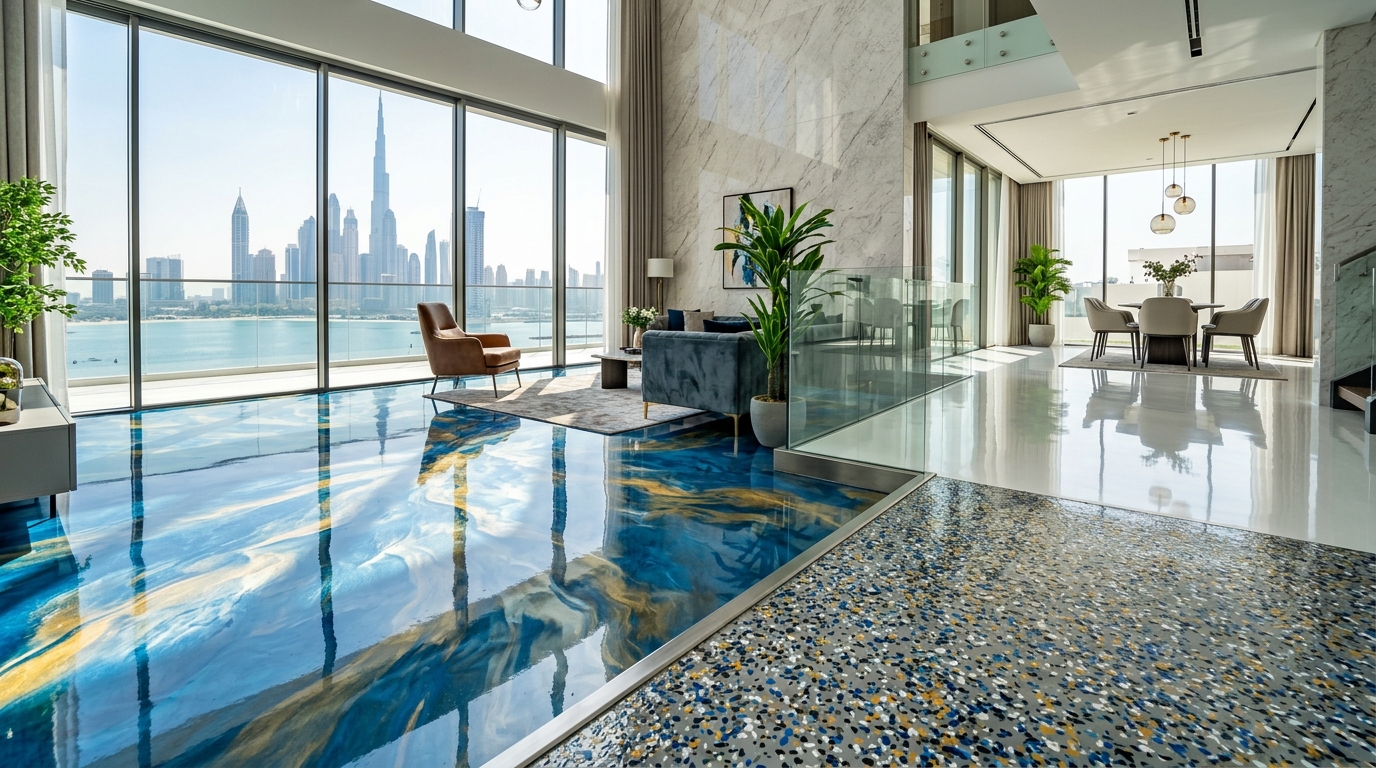
Metallic epoxy produces the most visually striking floor finish available a liquid-metal appearance with depth, movement, and gloss that photographs beautifully and genuinely impresses in person. I have installed it in penthouse apartments in Downtown Dubai, in retail showrooms on Sheikh Zayed Road, and in hotel lobby areas in DIFC. When it works, there is nothing like it.
When it is applied without the right expertise in Dubai’s climate, there is also nothing quite as disappointing. I have assessed metallic epoxy floors that had cured with visible trowel marks across the entire surface, no self-levelling effect, and clumped metallic pigments that looked like paint spatter rather than flowing metal. Every one of these failures had the same root cause: substrate temperature was above 32 degrees C when application began.
The Temperature Window Problem in Dubai
Metallic epoxy is highly sensitive to temperature during application. The self-levelling and pigment-flow effect that creates the characteristic appearance only works within a substrate temperature window of roughly 15 degrees C to 30 degrees C. Below 15 degrees C (which occurs in over-air-conditioned apartments set to 18 degrees C), pigments do not flow and blend. Above 30 degrees C substrate, the pot life of most metallic epoxy systems drops to under 12 minutes not enough time to apply and finish even a moderate-sized room correctly.
In practical Dubai terms during summer months, the application window is approximately 5:30am to 10am before the floor surface absorbs enough ambient heat to push substrate temperature above the threshold. The floor temperature must be measured with a contact thermometer, not estimated. For a 150 sqm apartment floor in Dubai summer, the planning is as important as the application skill.
Maintenance Requirement: Aliphatic PU Topcoat is Non-Negotiable
Even on indoor metallic epoxy floors near large windows, UV exposure from Dubai’s sunlight angle will cause metallic pigment oxidation and gloss loss without a UV-stable topcoat. We apply Sika Sikafloor-381 aliphatic PU over every metallic epoxy installation regardless of indoor/outdoor classification. The cost is AED 14–20 per sqm and it extends the visual quality window from approximately two years to six-plus.
Cost in Dubai (2026): AED 85–155 per sqm installed. Requires an experienced applicator do not accept a quote from a contractor who cannot show previous metallic epoxy projects.
Lifespan: 6–10 years with correct installation and annual maintenance clear coat.
6. Anti-Slip Epoxy A Safety Specification, Not an Optional Feature
Anti-slip treatment is not a separate epoxy chemistry it is any of the above systems modified with an aggregate broadcast during the wet topcoat stage. The most common aggregates are aluminium oxide (the most durable, hardest wearing), quartz sand (more economical, slightly softer), and silicon carbide (used in extreme industrial settings). The aggregate is broadcast onto the wet topcoat, allowed to embed, and then sealed with a clear topcoat that locks it in place.
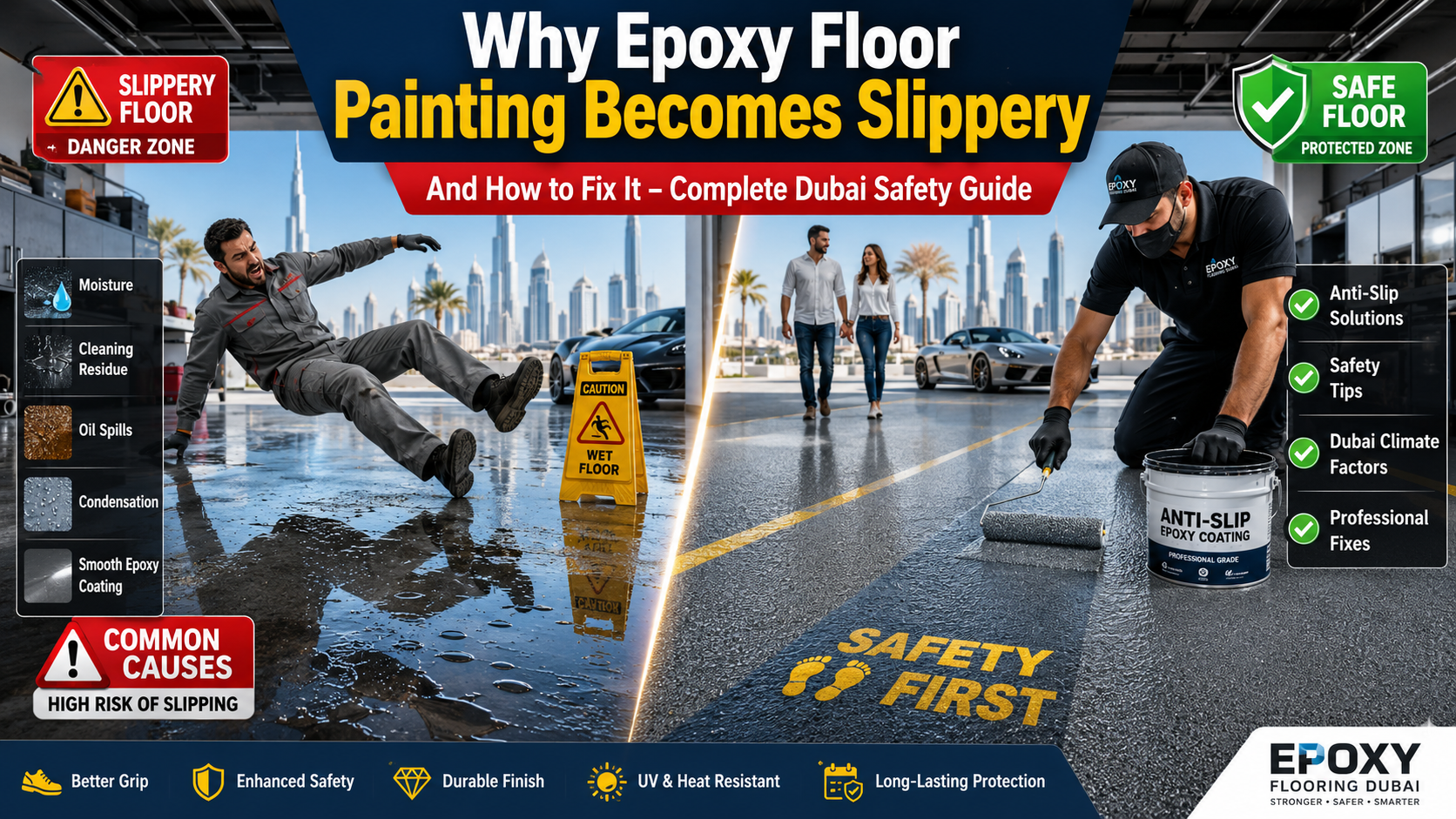
In Dubai, I specify anti-slip as standard on every kitchen, bathroom, pool surround, outdoor stair, external walkway, and commercial food-preparation floor regardless of whether the client has asked for it. The reason is direct: epoxy coatings have a dynamic coefficient of friction (DCOF) of approximately 0.2–0.3 when wet. Dubai Municipality guidelines for wet-area public floors specify a minimum of 0.42 DCOF. A slip on a wet epoxy floor near a pool or in a villa bathroom is not a theoretical risk.
Aggregate Selection for Dubai Conditions
- Aluminium oxide (80-120 grit) standard specification for pool decks, commercial kitchens, and heavy-use wet areas. DCOF above 0.65 when wet. Best abrasion resistance of any broadcast aggregate.
- Quartz broadcast (30-60 mesh) suitable for residential bathrooms, covered walkways, and outdoor stairs not exposed to continuous water. DCOF 0.55-0.65 wet. More comfortable underfoot than aluminium oxide.
- Fine quartz additive (mixed into topcoat) lightest anti-slip option for areas where aesthetics are a priority and foot traffic is moderate. DCOF 0.42-0.50 wet. Minimum acceptable for Dubai Municipality wet-area compliance.
Cost in Dubai (2026): AED 10–20 per sqm added to the base system cost. One of the highest value-per-dirham safety investments available in a villa or commercial floor project.
7. Self-Levelling Epoxy The Renovation Specialist
Self-levelling epoxy systems are higher-viscosity, lower-surface-tension formulations that flow under gravity and surface tension to create a seamless, flat finish. They are most valuable in renovation contexts where the existing floor has significant surface irregularities previous tile adhesive ghost lines, localised low spots, patched concrete sections, or uneven screeds.
On a villa renovation in Al Barsha Heights in 2024, the client wanted a decorative metallic floor over a concrete slab that had previously held 600mm x 600mm marble tiles. The tiler had used dot-and-dab adhesive, leaving a ghost grid of adhesive patches across the entire floor. Rather than attempting to grind these completely flat a process that would have taken three days and generated enormous dust we applied a 4mm self-levelling base layer that buried every imperfection in a single pour. The metallic decorative layer applied over it was flawless.
Technical Requirements for Self-Levelling in Dubai
- Substrate must be flat to within plus or minus 5mm over a 3-metre straight-edge before self-levelling is applied the system levels minor irregularities, not structural unevenness
- Maximum pour depth in a single layer is typically 6mm deeper applications require multiple pours with specified inter-coat timing
- Application temperature must be between 15 and 28 degrees C substrate above 28 degrees C, the working time shortens to under 20 minutes and self-levelling is compromised
- No foot traffic for minimum 24 hours after pour in Dubai conditions the 12-hour figure used in European technical data sheets does not account for Dubai humidity affecting cure rate
Cost in Dubai (2026): AED 55–88 per sqm installed (3–4mm pour depth, including primer).
Best use: Renovation projects with uneven substrates, large open-plan areas requiring seamless finish, base layer under decorative metallic or broadcast systems.
8. Epoxy Screed Heavy Industry Performance
Epoxy screed is not a coating it is a structural flooring system. Applied at 6–12mm thickness (versus 2–3mm for most coating systems), it replaces or overlays the existing concrete surface rather than simply coating it. This thickness provides compressive strengths of 60–80 MPa and point load capacities suitable for forklift traffic, heavy racking, and industrial process equipment.
In Dubai, this system is standard specification for JAFZA and Dubai Industrial City warehouse floors, food processing facilities, aircraft hangar floors, and any commercial kitchen large enough to have pallet movement. For residential use, it is occasionally specified in villa garages where a car lift or workshop equipment creates load points that standard coating systems cannot manage.
The higher thickness also means epoxy screed systems are more thermally stable than thin coatings the greater mass provides more resistance to rapid thermal cycling. For sun-exposed industrial floors in Dubai summer, this is a relevant advantage.
Cost in Dubai (2026): AED 75–130 per sqm installed depending on thickness specification and aggregate broadcast.
Best use: Warehouses, industrial floors, large commercial kitchens, aircraft hangars, any application with heavy vehicle or point loading.
Complete Cost & Performance Comparison All 8 Systems
The table below consolidates all eight systems for direct comparison. Prices reflect installed costs in Dubai in 2026 including surface preparation, primer, the specified system, and standard topcoat. Actual costs vary with floor size, substrate condition, access, and finish specification.
| System | Cost AED/sqm | Lifespan | Dubai Suitability | Best Use Case |
| 100% Solid Epoxy | 45–75 | 8–12 yrs | Excellent (all areas) | Garages, villas, warehouses, high-traffic floors |
| Water-Based Epoxy | 22–40 | 4–6 yrs | Good (indoors only) | Upper-floor apartments, AC offices, light-traffic interiors |
| Solvent-Based Epoxy | 38–65 | 6–10 yrs | Good (with ventilation) | Industrial, contaminated substrates, older concrete |
| Aliphatic PU Topcoat | 14–24 (add-on) | Adds 3–5 yrs UV | Essential outdoors | Over any sun-exposed or outdoor epoxy not optional |
| Metallic Epoxy | 85–155 | 6–10 yrs | Good (expert only) | Luxury interiors, showrooms, hotel lobbies |
| Anti-Slip Epoxy | add 10–20 | Same as base | Essential (wet areas) | Bathrooms, pool decks, kitchens, outdoor stairs |
| Self-Levelling | 55–88 | 8–12 yrs | Good | Renovation, uneven slabs, base layer for decorative systems |
| Epoxy Screed | 75–130 | 10–15 yrs | Excellent | Warehouses, industrial, heavy vehicle traffic |
Which Epoxy Brands Work in Dubai? A Contractor’s View
Product brand matters less than most homeowners think and more than many budget contractors admit. The major international brands all have UAE distribution and UAE-specific formulations designed for Gulf climate conditions. The problem is not that cheaper brands don’t make good products it is that cheaper contractors frequently substitute mid-range products from legitimate brands for the specified premium grade, and the client has no way to verify the difference on the day of installation.
Ask for the technical data sheet on any product being applied to your floor. A legitimate contractor specifying a legitimate product can produce this immediately. If they cannot, that is the answer to your question.
| Brand | Best Exterior Product | Best Interior Product | Notes for Dubai |
| Sika UAE | Sikafloor-2530 W (PU topcoat: Sikafloor-381) | Sikafloor-263 SL | Widest UAE technical support network. Moisture-tolerant systems are well-suited to Dubai slab conditions. |
| Mapei UAE | Mapefloor I 300 SL | Mapefloor I 300 W | Excellent self-levelling range. Mapefloor Finish 58W PU topcoat is one of the most UV-stable products tested in UAE conditions. |
| Fosroc UAE | Nitoflor FC130 | Nitoflor Hardseal | Strong industrial heritage. Nitoflor Deckcoat aliphatic PU performs consistently on Dubai rooftop parking decks. |
| Tremco (UAE) | Tremco Decothane Gamma | Tremco Deco-Floor | Good metallic epoxy range. Less widely distributed than Sika/Mapei but available through specialist distributors. |
When to Apply Epoxy in Dubai The Timing Most Guides Don’t Mention
Every epoxy manufacturer’s technical data sheet specifies an application temperature range. The typical window is 15 to 30 degrees C substrate temperature, with ambient relative humidity below 85% and substrate temperature at least 3 degrees C above the dew point. In Dubai, this creates a very specific seasonal and daily application window that most contractors either don’t know about or choose to ignore.
Best Season: October to April
This is the window in which Dubai’s ambient and substrate temperatures consistently fall within the safe application range for all major epoxy systems. November through March offers the most reliable conditions ambient temperatures of 18–28 degrees C, humidity typically 40–70%, and floor surface temperatures that remain manageable through the working day.
Summer Application (May to September) What It Actually Requires
Summer epoxy application in Dubai is possible but demands strict discipline. For exterior and garage floors, application must begin by 5:30am and finish before 10:00am after which substrate temperatures on exposed concrete typically exceed 35 degrees C in direct sun, compressing pot life and causing flash-dry failures. For interior air-conditioned spaces, the AC must be running and the space at temperature for at least 8 hours before application begins a cold AC applied immediately before work does not produce a cool substrate.
| The Single Most Important Pre-Application Step Before any epoxy application on any Dubai floor, measure substrate relative humidity with a calibrated pin-type or capacitance moisture meter. Maximum acceptable reading: 12% for most systems (8% for water-based). A floor that reads 16% and ‘feels dry to the touch’ is not dry. The moisture is inside the slab. Apply epoxy over it and you are guaranteed delamination within 12-18 months the product has not failed, the preparation has. |
Maintaining Your Dubai Epoxy Floor Annual Checklist
An epoxy floor without a maintenance routine will underperform its potential lifespan by 30–50% in Dubai’s environment. The maintenance requirements are not demanding they are consistent. These are the steps we give every client on project completion.
Daily and Weekly
- Sweep or vacuum before mopping desert silica particles are abrasive and scratch the topcoat when dragged across it wet
- Mop with a pH-neutral cleaner diluted to manufacturer’s specification. Avoid bleach, ammonia, and acid-based cleaners these attack the epoxy binder progressively
- Wipe cooking oil spills immediately in kitchens grease softens epoxy topcoats at Dubai’s elevated floor temperatures
Annual
- Inspect all perimeter edges and expansion joints in May before peak summer heat edge lifting, if caught early, can be re-bonded with a compatible primer and small pour
- Apply a maintenance clear coat every 2–3 years on high-traffic areas this sacrificial topcoat is a fraction of the cost of a full recoat and can add years to the system
- For outdoor systems with aliphatic PU topcoat, inspect annually for micro-chalking under UV exposure and plan recoat at year 5–6
Warning Signs to Act On Immediately
- Bubbling or blistering anywhere on the floor indicates moisture below. Stop use of the area and call a professional. Water trapped under epoxy will cause progressive and accelerating delamination
- Yellowing on interior floors UV-unstable topcoat. Recoat with aliphatic polyurethane before the discolouration affects the epoxy layer beneath
- Lifting or peeling at perimeter edges typically caused by differential expansion at the floor-wall junction. Requires flexible joint sealant, not epoxy fill
Frequently Asked Questions Dubai Epoxy Flooring
Does epoxy crack or peel in Dubai’s summer heat?
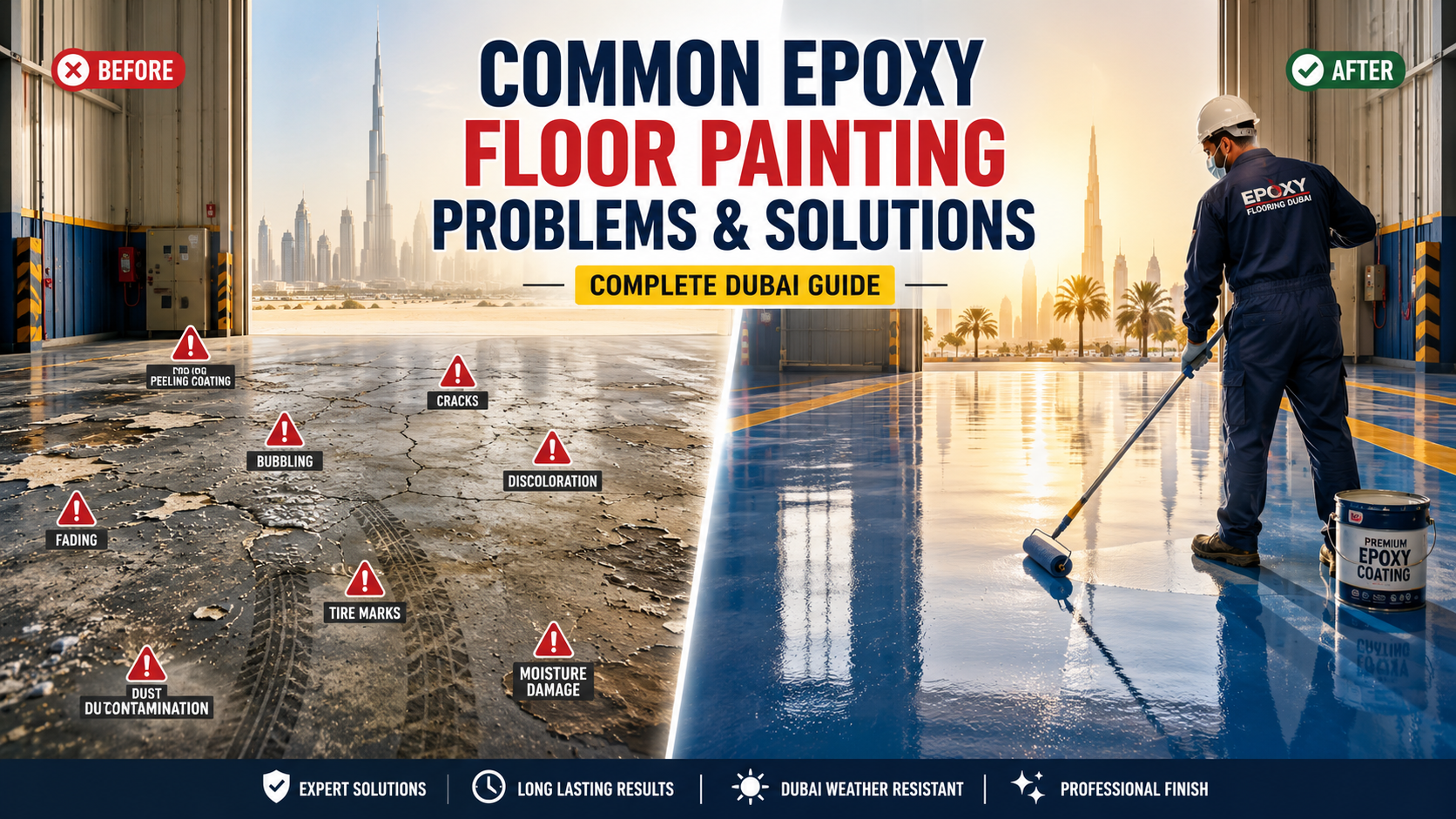
A correctly specified and professionally installed epoxy system does not crack or peel from heat alone. 100% solid epoxy remains stable up to approximately 80 degrees C surface temperature above Dubai’s typical maximum of 72–75 degrees C on exposed outdoor surfaces. What causes cracking and peeling is residual slab moisture, inadequate surface preparation, or the wrong system applied to a high-temperature environment (such as water-based epoxy on an outdoor garage floor). These are application failures, not product failures.
How long does epoxy flooring last in UAE conditions?
A properly installed 100% solid epoxy system on a correctly prepared indoor slab in Dubai typically lasts 8–12 years before any remedial work is needed. High-traffic garage floors with annual maintenance can reach 8–10 years before the topcoat needs refreshing. Outdoor systems with an aliphatic polyurethane topcoat need that topcoat renewed every 5–6 years, with the base system lasting considerably longer. Budget systems applied without proper prep typically fail within 12–24 months.
Which epoxy type is best for a Dubai villa garage?
100% solid epoxy with an anti-slip broadcast aggregate is the only system I specify for Dubai villa garages. The combination of direct sun exposure, vehicle traffic, and potential slab moisture from perimeter landscaping makes it the only system with the thermal stability and adhesion durability to perform reliably. A polyurethane topcoat should be added if any portion of the garage floor receives direct sunlight through the entry opening.
Can I apply epoxy over existing tiles in my Dubai villa?
Technically possible, but generally inadvisable in Dubai. Existing tiles have grout joints that will telegraph through thin epoxy films. More critically, Dubai tiles installed with dot-and-dab adhesive (common in villas built before 2010) often have hollow sections beneath. In summer thermal cycling, hollow tiles expand and contract at a different rate to solid sections, causing the tile to crack and the epoxy above it to delaminate. Full tile removal and direct concrete preparation almost always produces a better long-term result, even accounting for the additional cost.
How much does epoxy flooring cost in Dubai in 2026?
For a quality mid-specification installation: 100% solid epoxy costs AED 45–75 per sqm installed. Metallic epoxy runs AED 85–155 per sqm. A complete 4-bedroom villa garage (approximately 55–70 sqm) with 100% solid system, anti-slip broadcast, and aliphatic PU topcoat costs approximately AED 5,500–9,000. These prices include surface grinding, primer, the epoxy system, and topcoat. Quotes below AED 35 per sqm for a garage floor in Dubai are almost always cutting the surface preparation step, which is where most of the labour cost sits.
Is epoxy suitable for Dubai outdoor terraces?
Yes, with the correct specification. A standard epoxy alone will not survive a Dubai rooftop terrace UV exposure, thermal cycling, and water ponding from AC condensate will destroy it within 18–24 months. The correct system is: moisture-tolerant 100% solid epoxy primer and basecoat, anti-slip quartz broadcast, and a 150-micron aliphatic polyurethane topcoat. With this specification, we have terrace floors in Dubai Marina and JVC that have been performing without issues for six years.
What is the difference between aliphatic and aromatic polyurethane?
Aliphatic polyurethane is UV-stable and does not yellow when exposed to sunlight. It is the correct specification for any outdoor or sunlit surface in Dubai. Aromatic polyurethane is cheaper, not UV-stable, and yellows visibly within months of sun exposure. The two products look identical in the tin and cannot be distinguished by eye after application. The only protection against substitution is requesting the technical data sheet before work begins and confirming the product name and grade in writing on the specification.
Final Thoughts: What 14 Dubai Summers Have Taught Me
The floors I installed in my first years here that are still in excellent condition have one thing in common: the substrate was prepared correctly, the right system was chosen for the actual conditions, and the application happened in the right temperature window. Every floor I have ever been called in to assess a failure on has had at least one of those three elements missing.
Dubai’s environment is demanding but it is not unpredictable. The temperatures, the humidity range, the UV exposure these are known and measurable. A flooring contractor who has worked here for any length of time should be able to measure your substrate moisture, measure your floor surface temperature, look at which direction your floor faces, and tell you with confidence which system will perform and which will fail. If they cannot do that, they are guessing with your floor.
Ask the questions. Request the data sheets. Make the contractor show you their moisture meter reading before they start. A legitimate professional will welcome the questions they make the project specification clearer for everyone. The ones who find the questions uncomfortable are telling you something important about how they work.