Why Your Epoxy Floor Is Failing (And How to Fix It)
Epoxy flooring has become one of the most popular flooring solutions for homeowners, commercial property owners, and industrial facilities across Dubai. Known for its durability, glossy appearance, and long-lasting performance, Epoxy Floor Painting Dubai services are now widely used in villas, warehouses, garages, showrooms, and retail spaces. A professionally installed epoxy floor can withstand heavy traffic, resist stains, and maintain its attractive finish for many years.
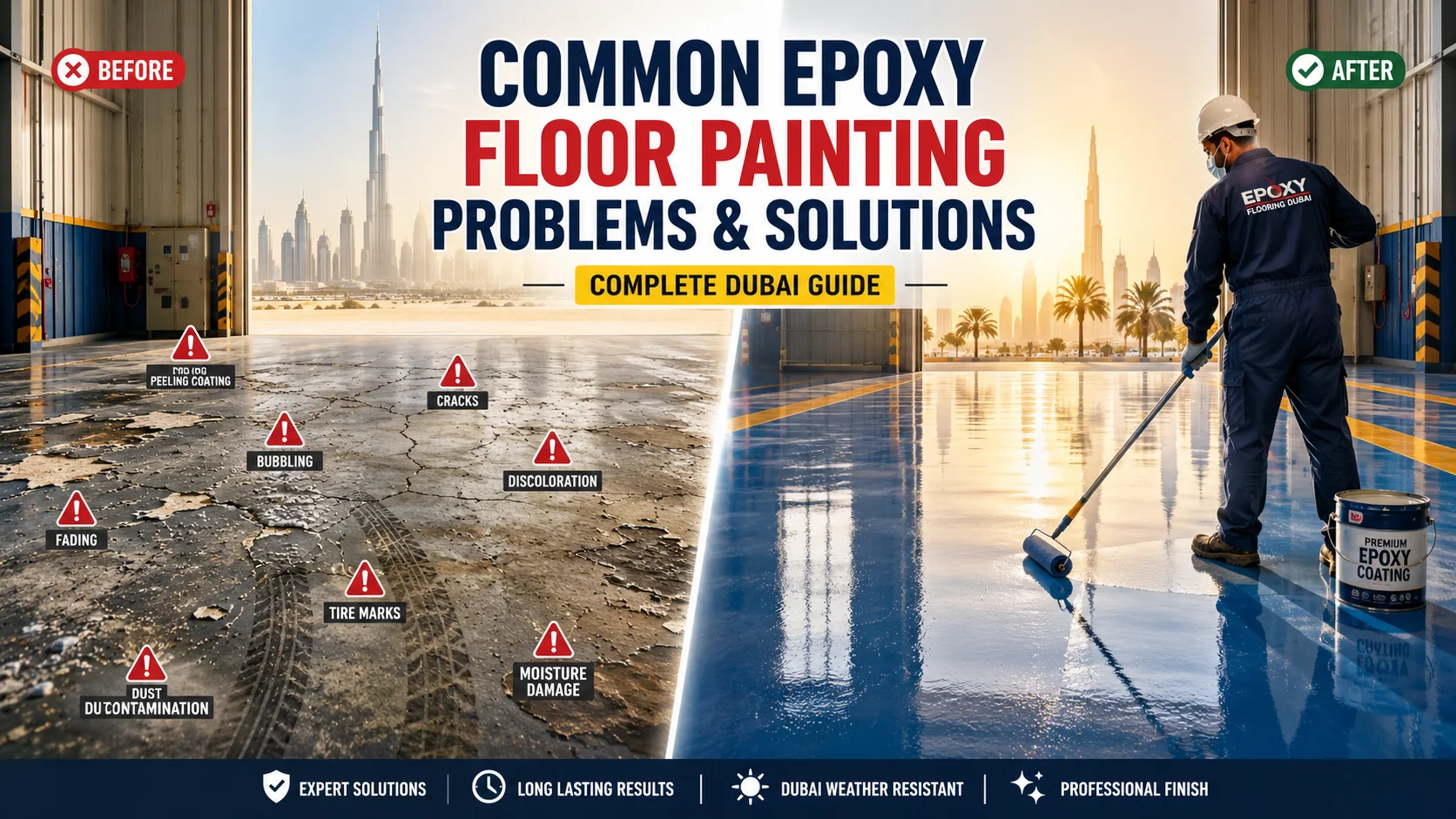
However, not every epoxy flooring project delivers the results property owners expect. While the floor may look flawless immediately after installation, problems can begin to appear within months if the wrong materials, poor workmanship, or inadequate surface preparation were involved. Peeling coatings, bubbling, discoloration, cracks, and moisture-related failures are some of the most common issues faced by property owners in Dubai’s challenging climate.
The harsh combination of extreme heat, humidity, dust, and temperature fluctuations can put significant stress on epoxy flooring systems. When installers fail to account for these environmental conditions, even premium flooring products can develop defects that reduce their lifespan and appearance. The good news is that most epoxy floor problems have identifiable causes and effective solutions.
In this comprehensive guide, we will explore the 11 most common epoxy flooring problems found in Dubai properties, explain why they occur, discuss repair costs, and provide practical prevention strategies. Whether you already have a damaged floor or are planning a new Epoxy Floor Painting Dubai project, this guide will help you make informed decisions and protect your investment for years to come.
Problem 1: Peeling and Flaking – The Most Common Failure
What it looks like: Sections of epoxy coating lift from the concrete, starting at edges or corners. In early stages, you might notice a slight gap. As it worsens, patches curl away, revealing bare concrete underneath. Eventually, large sections can peel off completely.
When it appears: Typically 3-6 months after installation, though severe failures can appear within weeks.
The Real Cause:
Peeling is responsible for approximately 65-70% of all epoxy failure complaints in Dubai. And in nearly 90% of peeling cases, the problem isn’t the epoxy it’s what happened before the epoxy was applied.
Poor surface preparation is the culprit. Concrete surfaces contain multiple contaminants that prevent epoxy adhesion:
- Dust and fine particles from construction or Dubai dust storms
- Oil residue from parking areas, garages, or machinery
- Old coatings (paint, sealers, curing compounds) that weren’t fully removed
- Moisture trapped in the concrete substrate
- Laitance (the chalky, weak layer on fresh concrete)
When epoxy is applied directly onto contaminated concrete, it sits on top of these contaminants rather than bonding to the concrete itself. The coating floats on the surface. Any stress—temperature changes, vibration, foot traffic—causes the epoxy to separate from the substrate.
Repair Cost: AED 8,000-14,000 for typical 800 sqft area
The repair process requires:
- Complete removal of failed coating (grinding)
- Deep cleaning and surface preparation (3-4 days)
- Moisture testing and barrier application if needed
- Complete reapplication of epoxy system
Timeline for Repair:
- Day 1-2: Removal and grinding
- Day 3-4: Cleaning, moisture testing, primer
- Day 5-6: Epoxy application
- Day 7-10: Curing and final inspection
Prevention Checklist:
✓ Demand mechanical grinding (60-80 mils depth)
✓ Require moisture testing (calcium chloride test)
✓ Insist on written prep timeline (minimum 3 days)
✓ Verify old coatings are completely removed
✓ Ask for before-and-after prep photos
✓ Get written warranty (should cover peeling for 5-7 years)
Problem 2: Bubbling and Blistering – The Hidden Moisture Menace
What it looks like: Small bubbles (1-5mm diameter) appear under the epoxy surface, usually within the first few weeks. They look like air pockets trapped under the coating. Unlike minor surface bumps, these blisters grow and spread over time.
When it appears: 2-8 weeks after installation
The Real Cause:
Concrete is porous and naturally absorbs moisture from the ground. When installers skip moisture testing, trapped water vapor remains in the concrete. As the sun heats the floor, this moisture transforms into vapor and seeks an escape route. Since epoxy is a vapor barrier, the moisture pushes upward and creates pressure pockets beneath the coating.
Think of it like steam escaping from sealed food—the pressure builds until it breaks through, creating bubbles.
In Dubai’s climate with high humidity (60-80% year-round) and coastal moisture, this problem is especially common in:
- Ground-level floors
- Basements or underground spaces
- Areas near water features or gardens
- Coastal villas and commercial properties
Moisture Test Standards:
Professional installers perform calcium chloride tests before application:
- Normal range: 3-5 lbs/1,000 sqft/24 hours (acceptable)
- Problem range: Above 5 lbs (requires moisture barrier)
- Extreme range: Above 10 lbs (not suitable for epoxy without extensive treatment)
Repair Cost: AED 5,000-10,000 for typical 800 sqft area
Repair involves:
- Removing bubbled sections
- Installing moisture barrier (epoxy or urethane-based)
- Grinding and reprepping affected areas
- Reapplication of full epoxy system over barrier
Prevention:
✓ Require moisture testing before any work begins
✓ Request calcium chloride test results in writing
✓ Ask if a moisture barrier is needed (and get pricing)
✓ Ensure 7-day minimum prep and moisture testing timeline
✓ Verify contractor has moisture meter on-site
Timeline for Development:
- Week 1-2: First bubbles appear in worst moisture areas
- Week 3-4: Bubbles expand and spread
- Week 5-8: Visible failure if untreated
Problem 3: Yellowing and UV Degradation – Dubai’s Sunlight Problem
What it looks like: The clear, glossy epoxy gradually takes on an amber or yellow tint. It’s barely noticeable at first, but becomes increasingly obvious. A floor that was crystal-clear in January looks aged and discolored by July.
When it appears: 4-6 months in direct sunlight (faster than most climates due to Dubai’s intense sun)
The Real Cause:
Standard epoxy formulations are aromatic, meaning they contain chemical compounds that degrade when exposed to UV rays. Unlike paint that sits on the surface, epoxy is transparent throughout its depth—so yellowing occurs throughout the coating, not just on top.
Dubai’s location near the equator intensifies this problem. The sun’s UV intensity is approximately 20-30% stronger than in northern climates. This accelerates degradation by 2-3 years compared to similar installations in temperate regions.
Yellowing Timeline in Dubai:
| Timeline | Appearance |
| Months 1-3 | No visible change |
| Months 4-6 | Slight amber tint in direct sunlight areas |
| Months 9-12 | Noticeable yellowing; stark contrast between shaded and sunny areas |
| Year 1-2 | Significant discoloration; floor appears 5-10 years old |
| Year 3+ | Uneven, aged appearance |
Why Some Floors Don’t Yellow:
Premium installations include UV-resistant topcoats—typically aliphatic polyurethane or aliphatic polyurea. These materials absorb UV rays before they reach the epoxy underneath, maintaining color for 8-15 years.
Repair Cost: AED 15,000-22,000 for complete refinishing
The failed epoxy must be stripped, and a fresh UV-resistant topcoat applied to the entire floor. Partial fixes don’t work—the entire surface must be treated uniformly for visual consistency.
Prevention:
✓ Always specify “UV-resistant polyurethane topcoat” in writing
✓ Upgrade to aliphatic polyurethane (lasts 50% longer than standard)
✓ Request the UV topcoat be documented with photos
✓ For outdoor or sun-exposed areas, insist on this addition
✓ Budget an extra AED 8,000-12,000 for UV protection
Problem 4: Cracks Appearing Through the Coating – Concrete Problems
What it looks like: Fine lines or cracks appear on the epoxy surface, often in patterns that match cracks in the concrete below. The epoxy itself isn’t cracking—the problem is underneath.
When it appears: Can appear immediately or develop over months as concrete stress increases
The Real Cause:
Concrete expands and contracts due to temperature changes. In Dubai, daily temperature swings of 20-30°C (often 50°C in afternoon, 15°C at night) create significant concrete movement.
Pre-existing cracks in the concrete substrate—cracks that weren’t repaired before epoxy application—eventually telegraph through the epoxy layer. The concrete moves, the epoxy stretches, and eventually visible cracks appear on the surface.
This is especially common in:
- Older concrete slabs with pre-existing damage
- Slabs affected by settling or movement
- Floors exposed to extreme temperature cycling
- Areas with inadequate or missing expansion joints
Repair Cost: AED 6,000-11,000 for typical cracks
Repair involves:
- Grinding out the crack area (2-3 inches wide)
- Cleaning and preparing the exposed crack
- Injecting polyurethane filler or epoxy into the crack
- Grinding flush with surrounding floor
- Reapplying epoxy to the repaired section
Prevention:
✓ Inspect concrete thoroughly before installation
✓ Repair all visible cracks with polyurethane injection
✓ Check for active cracks (may indicate deeper structural issues)
✓ Ensure proper expansion joints every 20-30 feet
✓ Request written inspection report of concrete condition
Problem 5: Slippery Surfaces – Safety Hazard
What it looks like: The glossy, smooth epoxy becomes dangerously slippery when wet or when cleaning products are present.
When it appears: Immediately noticeable, especially after wet cleaning
The Real Cause:
Epoxy’s main advantage—its smooth, glossy surface—becomes a liability in areas prone to moisture. Kitchens, bathrooms, garages, balconies, and commercial spaces all require slip resistance.
Budget contractors often ignore this entirely, prioritizing appearance over safety. Premium installations incorporate anti-slip additives (typically aluminum oxide grit) into the final topcoat.
High-Risk Areas in Dubai:
- Kitchens and food prep zones
- Bathrooms and wet areas
- Garage floors (wet from vehicle humidity)
- Balconies and outdoor areas
- Commercial kitchens and restaurants
- Pool deck areas
Repair Cost: AED 4,000-7,000 for anti-slip topcoat application
The existing glossy surface must be lightly sanded, and a new anti-slip topcoat (25-35 mils) applied with grit additives.
Prevention:
✓ Specify anti-slip topcoat in writing for wet areas
✓ Request samples showing texture and grip level
✓ Verify grit type (aluminum oxide is industry standard)
✓ Test slip resistance before final approval
✓ Budget AED 5,000-8,000 extra for anti-slip coating
Problem 6: Uneven Gloss and Patchy Appearance
What it looks like: Some areas of the floor appear glossy and shiny while others look dull. The finish is inconsistent, appearing as if different products or techniques were used on different sections.
When it appears: Usually visible within weeks of installation
The Real Cause:
Multiple factors cause uneven gloss:
- Uneven epoxy mixing – If the resin and hardener aren’t mixed thoroughly, some areas have different viscosity and cure differently
- Uneven application – Some sections receive more material (thicker, glossier) while others are thin (duller)
- Temperature-related curing – Epoxy cures faster in warm areas and slower in cool areas, creating visible differences in sheen
- Improper roller technique – Using the wrong roller type or applying inconsistent pressure creates uneven coating
- Contamination during application – Dust or debris settling on wet epoxy before curing creates dull spots
Repair Cost: AED 5,000-8,000
Affected areas must be lightly sanded and a fresh topcoat applied. For large areas, the entire floor may need refinishing.
Prevention:
✓ Verify contractor experience with large-scale applications
✓ Request photos of previous installations
✓ Ensure proper mixing equipment is used
✓ Maintain consistent environmental controls (temperature, humidity)
✓ Use dust containment during application
Problem 7: Hot Tire Pickup in Garages – Vehicle-Specific Issue
What it looks like: After a vehicle is parked, sections of epoxy coating stick to the hot tires and peel away when the vehicle moves. The problem is worst on hot days and after the vehicle has been driven.
When it appears: Usually within the first few months of vehicle use
The Real Cause:
After driving, vehicle tires reach temperatures of 45-60°C. When tires sit on low-quality epoxy, the heat softens the coating and creates adhesion between the tire and the epoxy. When the vehicle drives away, it pulls the epoxy coating with it.
This problem is specific to:
- Budget epoxy systems (insufficient cross-linking)
- Low-solids formulations (too soft when heated)
- Insufficient topcoat protection
- High-use garages with frequent temperature cycling
Professional garage epoxy uses high-performance systems specifically designed for vehicle contact. These formulations resist heat and maintain hardness even when warmed.
Repair Cost: AED 6,000-10,000 for localized repairs; full replacement AED 25,000-35,000
Prevention:
✓ Specify “garage-rated” or “traffic-rated” epoxy system
✓ Verify the system is rated for 50°C+ temperatures
✓ Request written confirmation of heat resistance
✓ Use higher-solids systems in garages (80%+ solids)
✓ Apply protective topcoat specifically for vehicles
Problem 8: Dust Contamination During Installation
What it looks like: The cured epoxy has visible particles, rough spots, or a grainy texture. Close inspection reveals dust embedded in the coating, creating an uneven, unfinished appearance.
When it appears: Immediately visible after curing
The Real Cause:
Dubai’s fine desert dust is relentless. Even with windows closed and doors sealed, dust particles settle on wet epoxy during the application process. Once cured, these particles are permanently embedded.
Professional installers manage this by:
- Thoroughly vacuuming and damp-wiping the work area
- Controlling air flow and blocking ventilation
- Applying epoxy during low-wind periods
- Using dust-containment barriers
Budget contractors often skip these precautions to save time and money.
Repair Cost: AED 4,000-7,000 to sand affected areas and reapply topcoat
Prevention:
✓ Schedule installation during low-wind seasons
✓ Verify dust containment barriers will be used
✓ Request work to stop if dust levels are high
✓ Confirm ventilation will be sealed during application
✓ Inspect the work before final approval while still slightly tacky
Problem 9: Moisture Damage Beneath the Floor
What it looks like: Sometimes visible problems don’t appear until significant damage has occurred underneath. The floor may feel soft in spots, sound hollow, or smell musty. In severe cases, adhesion fails suddenly.
When it appears: Can take 1-2+ years to become noticeable
The Real Cause:
Moisture rising through concrete gradually weakens the bond between the floor and the epoxy coating. If moisture barriers weren’t installed and moisture testing was skipped, water continues moving upward, creating a weak interface.
This problem is particularly common in:
- Ground-level or basement spaces
- Areas with high water tables
- Properties near the coast (salt water intrusion)
- Spaces without proper waterproofing
By the time you notice the problem, significant damage may have already occurred.
Repair Cost: AED 12,000-20,000+ (depends on extent of damage)
Repair involves:
- Complete epoxy removal
- Concrete drying period (can take weeks)
- Moisture barrier installation
- Full system reapplication
Prevention:
✓ Perform moisture testing before any work
✓ If tests show elevated moisture, install epoxy moisture barrier
✓ For ground-level floors, consider polyurethane over epoxy
✓ Ensure proper drainage around the building
✓ Get written documentation of all moisture testing
Problem 10: Scratches and Surface Wear
What it looks like: The glossy finish develops visible scratches and scuff marks from furniture, foot traffic, and daily use. Over time, heavily trafficked areas show wear patterns and lose their original shine.
When it appears: Gradual wear over months to years
The Real Cause:
Epoxy, while durable, isn’t scratch-proof. Thin epoxy coatings (under 100 mils) are especially vulnerable to scratching. Heavy furniture movement, sharp objects, and constant foot traffic all leave marks.
Premium thicker coatings (250+ mils) resist scratching far better because they have more material to wear through before damage becomes visible.
Repair Cost: AED 3,000-6,000 for localized repairs; full floor maintenance coat AED 8,000-12,000
Prevention:
✓ Use furniture pads under all heavy items
✓ Avoid dragging furniture directly on the floor
✓ Specify thicker epoxy coating (250+ mils)
✓ Schedule maintenance topcoat every 7-10 years
✓ Use protective mats in high-traffic areas
Problem 11: Loss of Shine Over Time
What it looks like: The original high-gloss appearance gradually diminishes. The floor looks dull, tired, and less attractive even though it hasn’t failed.
When it appears: After 3-7 years, depending on maintenance and foot traffic
The Real Cause:
Daily use—dust, cleaning products, foot traffic, UV exposure—gradually reduce the glossiness of the epoxy surface. This isn’t failure; it’s normal aging. The epoxy is still protecting the concrete and performing its function, but the aesthetic appeal diminishes.
Repair Cost: AED 8,000-12,000 for maintenance topcoat application
A professional cleaning followed by a protective topcoat (15-25 mils) can restore much of the original appearance without requiring a complete floor replacement.
Timeline:
- Year 1-3: Minimal gloss loss
- Year 3-5: Noticeable dulling
- Year 5-7: Significant gloss reduction
- Year 7+: May require maintenance topcoat
Prevention:
✓ Plan for maintenance topcoat every 7-10 years
✓ Clean regularly with appropriate epoxy cleaners
✓ Avoid harsh or abrasive cleaning products
✓ Budget AED 8,000-12,000 for future maintenance
Problem 12: Strong Odors During Installation
What it looks like: Noticeable chemical smell during application and curing, especially with solvent-based epoxy systems.
When it appears: During and immediately after application
The Real Cause:
Epoxy products release volatile organic compounds (VOCs) as they cure. Solvent-based systems produce stronger odors than water-based or low-VOC products.
In Dubai’s heat, VOC off-gassing occurs faster, intensifying the smell during the curing process.
Management:
✓ Request low-VOC epoxy product (reduces odor 50-70%)
✓ Ensure strong ventilation during application
✓ Plan installation when you can vacate the area
✓ Allow full curing (typically 7-14 days) before occupancy
✓ Odors disappear completely once curing is finished
How to Diagnose Your Epoxy Problem: Quick Checklist
| Problem | Early Signs | Timeline | Severity |
| Peeling | Edges lifting, visible gaps | 3-6 months | High |
| Bubbling | Small air pockets, 1-5mm | 2-8 weeks | Medium |
| Yellowing | Amber tint in sunlight | 4-12 months | Medium |
| Cracks | Fine lines in pattern | Immediate or months | Medium |
| Slipperiness | Slips when wet | Immediate | High (Safety) |
| Uneven gloss | Dull patches visible | Weeks | Low |
| Hot tire pickup | Epoxy stuck to tires | Months | High |
| Dust particles | Grainy, rough texture | Immediate | Low |
| Moisture damage | Soft spots, hollow sound | 1-2+ years | High |
| Scratches | Visible marks, scuffs | Gradual (months) | Low |
| Dulling | Less glossy appearance | 3-7 years | Low |
When to DIY vs When to Call a Professional
DIY-Suitable Situations:
None of the above problems are suitable for DIY repairs. All require specialized equipment, materials, and expertise.
- Grinding concrete requires industrial equipment
- Moisture testing requires specialized instruments
- Epoxy application demands precise conditions (temperature, humidity)
- Safety hazards exist (fumes, equipment)
Always Call a Professional For:
Any visible peeling or bubbling
Cracks or structural concerns
Moisture issues or moisture testing
Complete coating removal
Repairs covering more than 10% of floor area
Exception: Minor surface cleaning and maintenance can be DIY (vacuuming, damp mopping).
Repair Cost Summary Table
| Problem | Repair Cost (800 sqft) | Timeline |
| Peeling | AED 8,000-14,000 | 7-10 days |
| Bubbling | AED 5,000-10,000 | 5-7 days |
| Yellowing | AED 15,000-22,000 | 5-7 days |
| Cracks | AED 6,000-11,000 | 3-5 days |
| Slippery surface | AED 4,000-7,000 | 2-3 days |
| Uneven gloss | AED 5,000-8,000 | 2-3 days |
| Hot tire pickup | AED 6,000-10,000 | 3-5 days |
| Dust contamination | AED 4,000-7,000 | 2-3 days |
| Moisture damage | AED 12,000-20,000+ | 7-14 days |
| Scratches | AED 3,000-6,000 | 2-3 days |
| Maintenance topcoat | AED 8,000-12,000 | 3-5 days |
How to Prevent Most Epoxy Problems: The Checklist
✓ Choose experienced, certified installers (ask for references, not just credentials)
✓ Demand written moisture testing before any application
✓ Require mechanical surface grinding (not chemical etching)
✓ Insist on 5+ day minimum timeline (preparation takes time)
✓ Specify high-quality epoxy products by brand and solid content (80%+)
✓ Request UV-resistant topcoat for any sun-exposed areas
✓ Include anti-slip additives in kitchens, bathrooms, garages
✓ Get written warranty covering 5-7 years minimum
✓ Request progress photos documenting each step
✓ Verify crack repair before epoxy application
✓ Plan for maintenance topcoat every 7-10 years (budget AED 8,000-12,000)
Frequently Asked Questions
Q: How long does epoxy flooring actually last in Dubai?
A: Professional epoxy lasts 10-15 years with proper maintenance. Budget epoxy typically fails within 2-5 years. The difference is materials, preparation, and installation technique. Premium installations cost 2.5x more upfront but cost 3-4x less per year of service.
Q: Can you apply epoxy over an existing failed floor?
A: No. Failed epoxy must be completely removed, which requires grinding and can cost AED 8,000-12,000 alone. The concrete must then be properly prepared, which means you’re essentially starting from scratch. This is why getting it right the first time is critical.
Q: What’s the minimum I should spend on epoxy flooring?
A: For professional installation in Dubai:
- Ground level: AED 50,000-70,000 for 800 sqft
- With UV topcoat: Add AED 8,000-12,000
- With anti-slip coating: Add AED 5,000-8,000
- With moisture barrier: Add AED 5,000-8,000
Below AED 40,000 for 800 sqft almost certainly involves shortcuts.
Q: How long before I can use the floor after installation?
A: Wait times depend on the product:
- Light foot traffic: 3-7 days
- Vehicle traffic: 7-14 days
- Full cure strength: 14-28 days
Extended wait times aren’t the contractor being slow—they’re allowing proper curing. Rushing this causes adhesion problems.
Q: Is epoxy better than polished concrete?
A: For most applications, yes. Epoxy provides:
- Better appearance (glossy or matte options)
- Superior durability (10-15 years vs 5-7 for polished concrete)
- Easier maintenance
- Chemical resistance
Polished concrete is cheaper initially but requires more maintenance and doesn’t last as long.
Q: Can epoxy be applied in summer heat?
A: Yes, but professional contractors work carefully in Dubai heat:
- Early morning application (before 10 AM)
- Temperature control measures
- Extended curing time
- Some contractors pause June-August for major installations
Extreme heat (above 50°C) can affect curing, so contractors plan accordingly.
What to Do Right Now If You Have an Epoxy Problem
Step 1: Identify your problem using the checklist above
Step 2: Document with photos (close-ups and wide angles)
Step 3: Get a free professional inspection
Step 4: Request written quote detailing:
- Cause of problem
- Repair approach
- Materials to be used
- Timeline
- Warranty on repairs
Step 5: Ask about warranty on your original installation (you may have claim coverage)
Final Thoughts
Epoxy flooring failures don’t happen because epoxy is a poor choice. They happen because important steps were skipped, inferior materials were used, or the wrong system was selected for Dubai’s climate.
A professionally installed epoxy system with proper preparation, high-quality materials, UV protection where needed, and anti-slip additives for safety can withstand 10-15 years of Dubai’s intense heat, dust, humidity, and daily use.
By understanding these common problems and their solutions, you can:
- Avoid costly failures if installing new epoxy
- Identify issues early and address them before they worsen
- Make informed decisions about repairs
- Budget appropriately for maintenance
Your epoxy floor should be an investment in durability and appearance—not a source of frustration.
Ready to Fix or Install Your Epoxy Floor Right?
Don’t learn expensive lessons the hard way. Get a professional epoxy inspection and consultation today.
A certified epoxy specialist can:
- Diagnose existing problems accurately
- Provide repair cost estimates
- Recommend solutions tailored to your floor
- Document everything in writing
Get Your Free Professional Floor Assessment – No obligation, no pressure. Just expert guidance to help you make the right decision.
Contact a certified epoxy contractor today. Your floor will thank you.