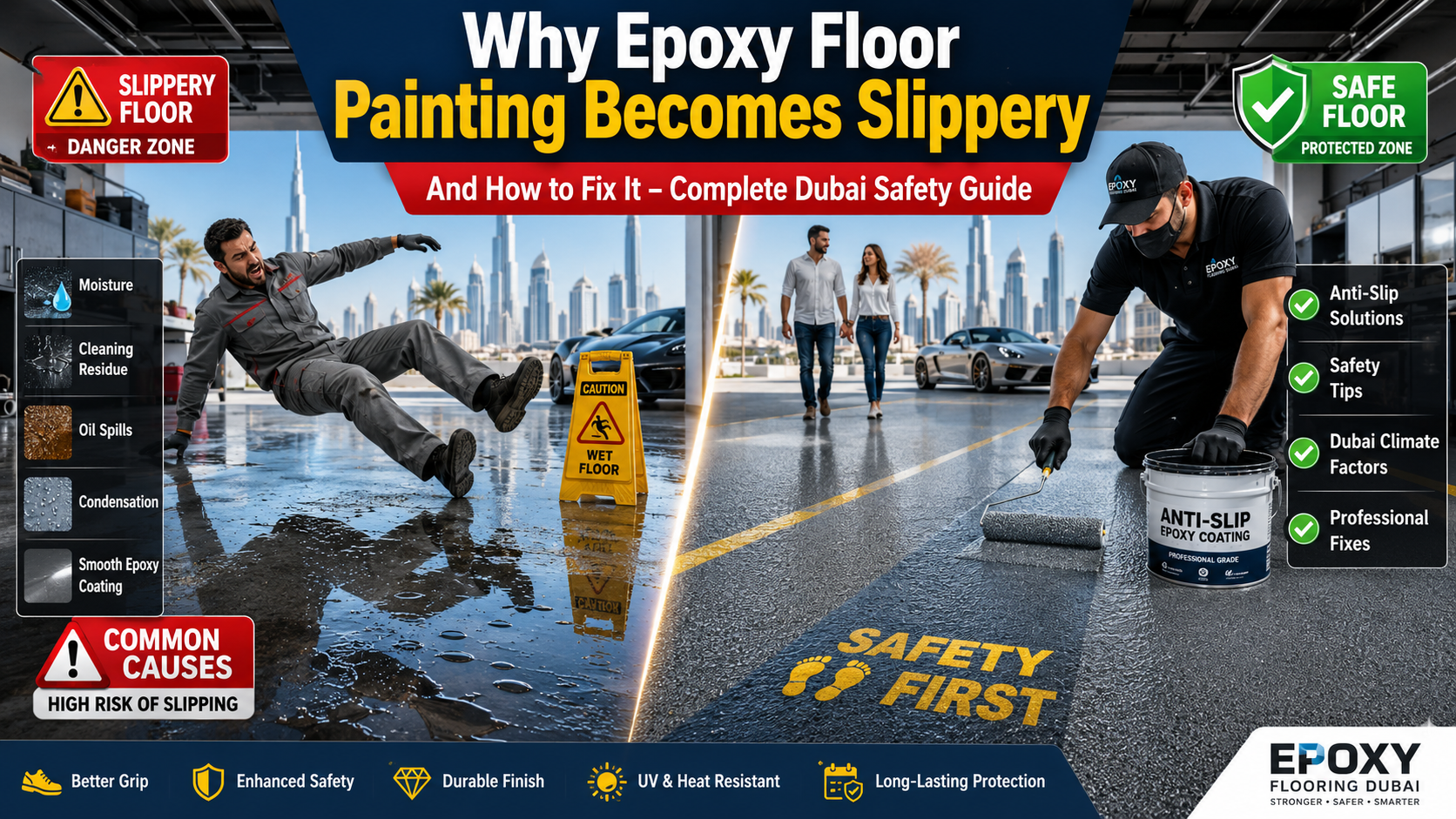
The Hidden Safety Risk Most Epoxy Installations Miss
A freshly installed epoxy floor in your Dubai villa looks stunning. It’s glossy, modern, and impressive. The contractor leaves satisfied. You show off the beautiful finish to friends. Life is good.
Then, three months later, someone nearly falls in the kitchen.
It happened so fast—one moment they’re walking normally, the next their feet slide unexpectedly on the floor. In that split second, they grab the counter to catch themselves. Lucky this time. But you realize the danger: your beautiful new epoxy floor has become a slip hazard.
This scenario plays out in thousands of Dubai homes annually. The irony is painful: a flooring solution chosen for its durability, appearance, and long-term value through epoxy floor painting Dubai services has unexpectedly created a safety concern that many homeowners were never warned about during installation.
The good news? This problem is completely preventable and fixable.
The bad news? Most contractors don’t mention slip hazards upfront, many homeowners don’t know solutions exist, and some don’t understand the legal liability implications of a slippery floor.
This comprehensive guide explains exactly why epoxy floors become slippery, what safety standards apply in Dubai, all available solutions with specific costs, and how to ensure your epoxy floor is both beautiful and safe.
Why Epoxy Floors Are Naturally Slippery: The Physics Behind the Problem
The Glossy Finish Problem
The reason people love epoxy flooring—its smooth, reflective surface—is the same reason it becomes slippery.
When a new epoxy floor cures, it creates a coating with minimal surface texture. This smooth finish has a high coefficient of friction (COF) when dry, meaning it grips your shoes reasonably well. The Coefficient of Friction is measured on a scale where:
- COF 0.50 or lower = Slippery/hazardous when wet
- COF 0.50-0.60 = Marginally safe when wet
- COF 0.60-0.80 = Good grip when wet
- COF 0.80+ = Excellent grip even when wet
A standard glossy epoxy floor typically measures COF 0.40-0.50 when dry and 0.30-0.40 when wet. This is dangerously low.
To understand the impact, compare it to other surfaces:
- Rough concrete: COF 0.65-0.85 (safe)
- Polished marble: COF 0.35-0.45 (slippery, similar to epoxy)
- Textured tile: COF 0.70-0.90 (very safe)
- Rubber flooring: COF 0.75-1.0 (safest)
The reality: Glossy epoxy has worse slip resistance than marble both are dangerously slippery when wet.
How Water Creates a Slip Hazard
Water is the major culprit that transforms a safe dry floor into a hazard.
When water covers an epoxy surface, it creates a thin liquid layer between your shoe and the floor. This eliminates direct contact, removing all friction. Instead of your shoe gripping the textured surface, you’re essentially sliding on a microscopic water film.
In Dubai homes, this happens in:
High-Risk Water Areas:
- Kitchens near sinks and dishwashers
- Bathrooms and shower areas
- Garages and car wash zones
- Pool deck areas and balconies
- Laundry rooms
- Entryways during rain (rare but serious)
- Areas near outdoor water features
- Commercial kitchen floors
Research from the American Podiatric Medical Association shows that wet floor incidents account for 8-10% of all emergency room visits in developed countries. A significant portion involve epoxy or polished surfaces.
Dubai’s Specific Climate Creates Additional Slip Hazards
Dubai’s unique environment creates slip risks that temperate climates don’t face.
High Humidity Impact: Dubai’s average humidity is 60-70%, spiking to 85-95% during certain months near the coast. High humidity doesn’t just add moisture—it creates condensation on cooler floor surfaces.
During early morning hours or in air-conditioned areas, invisible moisture forms on epoxy floors. People don’t see it. They walk normally. Then suddenly, their feet slip. Many slip-and-fall accidents occur with no visible water present—just microscopic condensation reducing friction.
Temperature Cycling: Dubai’s 40°C+ summer heat dropping to 15°C at night creates massive concrete expansion and contraction. As concrete moves, it stresses epoxy coatings. Microcracks develop. These tiny fissures collect moisture and dust, further reducing slip resistance over time.
Salt Water Exposure (Coastal Villas): Properties near the coast face salt water spray and mist. Salt deposits on epoxy surfaces create a slick layer that accelerates moisture buildup. Coastal villa owners report significantly higher slip incidents than inland properties.
The Real Culprits: Why Contractors Install Slippery Epoxy in the First Place
Budget Pressure and Cost Cutting
The primary reason most epoxy installations are slippery is simple: anti-slip solutions cost extra, and budget contractors skip them to appear cheaper.
When a contractor quotes AED 25,000 for your 800 sqft floor versus a competitor’s AED 40,000, the difference isn’t just materials. It includes skipped steps like:
- Professional moisture testing (costs AED 500-1,000)
- Premium UV topcoat (costs AED 8,000-12,000)
- Anti-slip additives (costs AED 3,000-10,000)
- Extended surface preparation (costs 2-3 extra days)
Most homeowners choose the cheaper option and never realize what they’re missing. By the time safety issues emerge, the contractor has already been paid and moved on to the next job.
Lack of Safety Communication
Many contractors don’t proactively discuss slip hazards because:
- It’s not legally required in all cases (though this is changing)
- They assume homeowners know glossy floors are slippery
- They want to avoid the conversation about additional costs
- They don’t understand liability implications themselves
This is particularly problematic in Dubai, where safety regulations are still catching up to international standards.
Wrong Product Selection
Not all epoxy products are created equal. Some formulations prioritize:
- Appearance (high gloss, dramatic colors)
- Cost (cheapest materials available)
- Environmental resistance (UV protection, chemical resistance)
- Safety (slip resistance, anti-microbial properties)
Budget epoxy systems typically prioritize appearance and cost. They use aromatic resins (which look glossy but yellow in sunlight) and skip performance enhancements.
Professional systems prioritize performance and safety. They use aliphatic resins (more expensive, stay clear longer) and include slip-resistant formulations.
The Safety Problem: Why Slippery Epoxy Creates Liability
This is critical information that most homeowners never hear.
Legal Liability in Dubai
While UAE safety regulations are less stringent than Western countries, property owners have legal responsibility to maintain “reasonably safe” conditions. A documented slip-and-fall incident on your property—especially if someone is injured—can result in:
Financial Liability:
- Medical expense coverage (hospital, emergency room)
- Lost wages compensation
- Disability claims
- In serious cases, civil lawsuits
Legal Consequences:
- Criminal negligence charges (if someone is seriously injured)
- Insurance claim denials (if inadequate maintenance is proven)
- Fines from building authority
A simple slip that causes a broken hip in an elderly relative or guest can result in hundreds of thousands of AED in liability. Many homeowner insurance policies specifically exclude claims caused by known slip hazards that weren’t addressed.
ADA and International Accessibility Standards
While the UAE doesn’t strictly enforce ADA (Americans with Disabilities Act), international standards establish slip resistance minimums:
ASTM D2047 Standard (American Testing Standard):
- Minimum safe wet COF: 0.50 (epoxy typically 0.30-0.40)
- Commercial kitchens: 0.60+ required
- Hospital/medical facilities: 0.80+ required
NFSI (National Floor Safety Institute):
- Slip-resistant certification: COF 0.50 or higher when wet
Standard glossy epoxy fails these standards by 30-40%.
If someone is injured on your slippery epoxy floor and you have no documentation of anti-slip measures, you’re admitting negligence.
Insurance Implications
Many Dubai property insurance policies require:
- Documentation of “safe conditions”
- Records of maintenance procedures
- Evidence of hazard mitigation
If you file a claim for a slip-and-fall incident and have no anti-slip measures in place, insurers may refuse coverage by claiming “negligent maintenance.”
The Dust Problem: Dubai’s Unique Slipperiness Challenge
Fine Desert Dust Acts Like Ball Bearings
Most people think dust makes floors less slippery—rough dust should add friction, right?
Actually, the opposite is true in Dubai.
Dubai’s fine desert dust is extremely fine (often 5-10 microns diameter). When this dust settles on a glossy epoxy surface, the particles don’t add grip. Instead, they act like microscopic ball bearings, reducing friction even further.
The scenario:
- Floor is clean after sweeping: COF 0.40 (marginal)
- Dust accumulates for 2-3 days: COF 0.30 (hazardous)
- After a dust storm: COF 0.20-0.25 (extremely dangerous)
A floor that feels reasonably safe immediately after cleaning becomes hazardous within days during dusty periods (which is frequent in Dubai).
This means relying on “regular cleaning” as your safety strategy isn’t enough. The floor is only safe for a few hours after cleaning, then degrades.
Oil and Chemical Residue
In kitchens and garages, oil and chemical residue accumulate on glossy epoxy. These oily films further reduce friction:
- Cooking oil splatters in kitchens
- Vehicle fluids in garages and driveways
- Soap residue from cleaning products
Impact: A surface already at COF 0.30 drops to 0.15-0.20 when oil is present. This is extremely slippery—worse than walking on ice.
Problem 1: Water and Wet Conditions – The Primary Slip Cause
When Water Creates Maximum Hazard
Water increases slip risk differently depending on conditions:
Kitchen Spills and Splashes:
- Immediate risk: Very high
- Duration: Minutes to hours
- Visibility: Often visible
- Frequency in average home: Daily
Bathroom Moisture:
- Immediate risk: High
- Duration: Hours after shower (moisture lingers)
- Visibility: Often invisible (just humid)
- Frequency: Multiple times daily
Pool and Patio Areas:
- Immediate risk: Extreme
- Duration: Hours/days depending on sun
- Visibility: Usually visible
- Frequency: Continuous during pool season
Cleaning After Wet Mopping:
- Immediate risk: Critical
- Duration: 1-2 hours until dry
- Visibility: Obvious
- Frequency: Weekly (but creates high-risk period)
Coefficient of Friction When Wet
These are realistic measurements for different scenarios:
| Scenario | COF Rating | Safety Level |
| Dry glossy epoxy | 0.40-0.50 | Acceptable |
| Wet glossy epoxy | 0.25-0.35 | HAZARDOUS |
| Wet with thin water film | 0.15-0.20 | EXTREMELY HAZARDOUS |
| Wet with oil present | 0.10-0.15 | DANGEROUS |
| Anti-slip epoxy (dry) | 0.50-0.60 | Safe |
| Anti-slip epoxy (wet) | 0.45-0.55 | Safe |
The reality: Your beautiful glossy epoxy is more dangerous wet than dry concrete is in normal conditions.
Prevention:
✓ Specify anti-slip topcoat during installation (cost: AED 5,000-10,000)
✓ Place non-slip mats in high-moisture areas
✓ Use dehumidifiers in humid areas
✓ Clean spills immediately (within minutes)
✓ Use moisture-absorbent mats near water sources
Problem 2: Condensation – The Invisible Hazard
Why Condensation Forms on Epoxy
Condensation occurs when warm, humid air hits a cooler surface. In Dubai’s coastal climate with high humidity and air conditioning, this happens frequently.
Typical scenarios:
- Early morning: AC-cooled floor + warm outdoor air = condensation
- After pool use: Water evaporation + cooler floor surface = condensation
- Basement or ground-level spaces: Cooler concrete + humid air = condensation
- Ventilation systems: Cold air meeting warm space = condensation
The problem: Condensation is often invisible. People don’t see the moisture. They walk normally. Then suddenly their feet slip.
Research shows that 40-50% of slip-and-fall accidents occur on floors with no visible water—just microscopic moisture from condensation.
How to Detect Condensation Risk
Signs your floor has condensation problems:
- Floor feels slightly cool to the touch in morning
- Faint moisture visible under bright light
- Humidity levels above 70%
- Slipping incidents without visible spills
- Metallic components (door handles, railings) feeling damp
Prevention:
✓ Install dehumidifiers in high-humidity areas (maintains 50-60% humidity)
✓ Improve ventilation (air circulation prevents moisture buildup)
✓ Use moisture-absorbent materials near condensation-prone areas
✓ Apply anti-slip topcoat (maintains grip even when damp)
✓ Monitor humidity levels (invest in hygrometer)
Problem 3: Dust, Sand, and Debris – The Slick Film Effect
Why Fine Dust Reduces Friction
Dubai dust isn’t like dust elsewhere. It’s extremely fine particles from desert sand. When it accumulates on glossy epoxy:
- Particles settle into micro-valleys of the surface
- Creates a slick film that reduces friction
- Acts like microscopic ball bearings that roll under your feet
- Gets worse as more dust accumulates (daily in dusty season)
Real-world impact:
- Clean floor after sweeping: COF 0.40 (marginal)
- After 3 days of normal dust: COF 0.32 (hazardous)
- After dust storm: COF 0.18-0.22 (extremely dangerous)
Ironically, areas that seem cleanest (regularly swept) can be most dangerous if the underlying floor is slippery.
Oil and Chemical Residue Compounds the Problem
In kitchens and garages, dust combines with oil, grease, and chemical residues:
- Kitchen dust mixed with cooking oil particles
- Garage dust mixed with vehicle fluids
- General dust mixed with soap residue from cleaning
This combination creates an especially slick film. A measurement that might be COF 0.30 with just dust becomes 0.10-0.15 when oil is present.
Prevention:
✓ Specify textured or anti-slip coating (dust won’t eliminate grip)
✓ Vacuum daily in kitchen and high-traffic areas
✓ Use HEPA filters to reduce airborne dust
✓ Install door mats to trap dust at entries
✓ Consider air purifiers for high-dust areas
✓ Schedule professional cleaning monthly (removes embedded dust)
Problem 4: Humidity and Coastal Salt Exposure
High Humidity Creates Slip Hazards
Dubai’s humidity averages 60-70% year-round, climbing to 85-95% in summer near the coast.
High humidity doesn’t just feel uncomfortable—it physically reduces friction on glossy surfaces:
Humidity Impact on COF:
- 40% humidity (dry): COF 0.42
- 60% humidity (normal): COF 0.38
- 80% humidity (high): COF 0.32
- 95% humidity (coastal): COF 0.25-0.28
Even without visible water, high humidity alone reduces your safety margin by 30-40%.
Salt Water Exposure for Coastal Properties
Properties within 500m of the coast face additional risks from salt spray and salt water mist:
Salt deposits on epoxy:
- Create a crystalline layer that’s extremely slippery
- Attract moisture (hygroscopic properties)
- Accelerate degradation of epoxy coating
- Reduce COF by additional 10-20%
Coastal villa owners report slip incidents 2-3x more frequently than inland properties with identical epoxy installations.
Prevention for Coastal Properties:
✓ Apply UV-resistant, salt-resistant topcoat (marine-grade epoxy)
✓ Specify anti-slip coating (critical for coastal areas)
✓ Install weather barriers (covered walkways, canopies)
✓ Increase cleaning frequency (weekly instead of bi-weekly)
✓ Use commercial-grade epoxy (rated for marine environments)
✓ Plan for topcoat replacement every 5-7 years (vs 8-10 normally)
The Solutions: Anti-Slip Options with Complete Cost Breakdowns
Solution 1: Silica Sand Anti-Slip Additive
How it works: Fine silica sand particles are mixed into the epoxy topcoat, creating microscopic texture.
Specifications:
- Grit size: 100-200 microns
- Particle concentration: 15-25% by volume
- Applied thickness: 50-75 mils
- Slip resistance: COF 0.50-0.60 (wet)
Cost Breakdown for 800 sqft (typical villa):
| Cost Component | Amount |
| Material cost (epoxy + sand) | AED 2,000-3,000 |
| Labor (2-3 days) | AED 1,500-2,000 |
| Equipment rental | AED 500-800 |
| Total cost | AED 4,000-5,800 |
For new installation: Add AED 3,500-5,000
For retrofit (existing floor): Add AED 4,500-6,500 (includes light grinding)
Durability: 5-8 years with proper maintenance
Appearance:
- Slightly less glossy than plain epoxy
- Visible texture when light hits surface
- Light gray or colored sand option available
- Still looks professional and modern
Best for:
- Kitchens and wet areas
- Budget-conscious homeowners
- Areas where ultimate safety is less critical
- Residential spaces
Maintenance:
- Regular vacuuming (dust accumulates)
- Avoid harsh scrubbing (damages sand particles)
- Topcoat refresh every 5-8 years
Solution 2: Aluminum Oxide Grit Anti-Slip Coating
How it works: Harder aluminum oxide particles provide superior slip resistance to silica sand.
Specifications:
- Grit size: 150-250 microns
- Hardness: Much higher than silica sand
- Applied thickness: 50-75 mils
- Slip resistance: COF 0.55-0.65 (wet)
Cost Breakdown for 800 sqft:
| Cost Component | Amount |
| Material cost | AED 3,500-4,500 |
| Labor (2-3 days) | AED 1,500-2,000 |
| Equipment | AED 500-800 |
| Total cost | AED 5,500-7,300 |
For new installation: Add AED 5,000-7,000
For retrofit: Add AED 6,000-8,000
Durability: 8-12 years
Appearance:
- More durable texture visible
- Good gloss retention
- Professional industrial look
- Available in colored options
Best for:
- Commercial kitchens
- High-traffic commercial spaces
- Industrial facilities
- Areas requiring maximum durability
- Places with frequent moisture
Maintenance:
- Regular vacuuming
- Avoid abrasive cleaning
- Professional cleaning recommended quarterly
- Topcoat refresh every 8-12 years
Solution 3: Polymer Grit Additives
How it works: Synthetic polymer particles that are less visible but effective for slip resistance.
Specifications:
- Particle size: Smaller than sand/aluminum oxide
- Applied thickness: 40-60 mils
- Slip resistance: COF 0.50-0.62 (wet)
- Appearance impact: Minimal (mostly invisible)
Cost Breakdown for 800 sqft:
| Cost Component | Amount |
| Material cost | AED 2,500-3,500 |
| Labor (2-3 days) | AED 1,500-2,000 |
| Equipment | AED 500-800 |
| Total cost | AED 4,500-6,300 |
For new installation: Add AED 4,000-6,000
For retrofit: Add AED 5,000-7,000
Durability: 7-10 years
Appearance:
- Nearly invisible texture
- Maintains high gloss
- Looks almost identical to plain epoxy
- Best visual appearance of all options
Best for:
- Upscale residential spaces
- Commercial showrooms
- Balconies and patios
- When aesthetics are important
- Spaces where texture isn’t acceptable
Maintenance:
- Standard cleaning (similar to glossy epoxy)
- Avoid harsh chemicals
- Topcoat refresh every 7-10 years
Solution 4: Textured Epoxy Finish
How it works: Special formulation creates visible texture during application—doesn’t use additives, just different application technique.
Specifications:
- Thickness: 150-250 mils total
- Texture depth: 2-4mm visible
- Slip resistance: COF 0.60-0.75 (wet)
- Appearance: Distinctive, obviously textured
Cost Breakdown for 800 sqft:
| Cost Component | Amount |
| Material cost (special epoxy) | AED 4,500-6,000 |
| Labor (3-4 days—more complex) | AED 2,000-3,000 |
| Equipment | AED 600-900 |
| Total cost | AED 7,100-9,900 |
For new installation: Add AED 6,500-9,000
For retrofit: Add AED 8,000-11,000
Durability: 10-15 years (longest-lasting option)
Appearance:
- Obvious texture, clearly visible
- Available in multiple texture patterns
- Eliminates glossy look
- Professional industrial or commercial appearance
- Not suitable for high-gloss aesthetic preference
Best for:
- Commercial kitchen floors
- Warehouse facilities
- Industrial spaces
- High-slip-risk environments
- Long-term safety priority over appearance
Maintenance:
- Standard vacuuming
- Cleaning products must be safe for texture
- Longest intervals between topcoat refreshes
- Easiest to maintain slip resistance over time
Solution 5: Decorative Anti-Slip Aggregates (Premium Option)
How it works: Colored decorative stones mixed with anti-slip properties—provides both aesthetics and safety.
Specifications:
- Aggregate size: 2-4mm visible particles
- Available colors: 20+ options
- Slip resistance: COF 0.60-0.70 (wet)
- Applied thickness: 100-150 mils
Cost Breakdown for 800 sqft:
| Cost Component | Amount |
| Material cost (decorative) | AED 5,500-7,500 |
| Labor (3-4 days—complex) | AED 2,000-3,000 |
| Equipment | AED 600-900 |
| Total cost | AED 8,100-11,400 |
For new installation: Add AED 7,500-11,000
For retrofit: Add AED 9,000-13,000
Durability: 10-15 years
Appearance:
- Stylish, decorative appearance
- Colored stones add visual interest
- Available in themed designs
- Premium, upscale look
- Unique floor appearance
Best for:
- Luxury homes wanting safety AND aesthetics
- Commercial spaces (showrooms, hotels)
- Spaces prioritizing both appearance and function
- Customers willing to invest in quality
Maintenance:
- Vacuum regularly
- Avoid harsh chemicals
- Requires professional cleaning
- Topcoat refresh every 10-15 years
Complete Anti-Slip Comparison Table
| Option | Cost | Durability | Slip Resistance (COF) | Appearance | Best For |
| Silica Sand | AED 4-6k | 5-8 yrs | 0.50-0.60 | Slightly textured | Budget-conscious |
| Aluminum Oxide | AED 5.5-7.5k | 8-12 yrs | 0.55-0.65 | Moderate texture | High-traffic areas |
| Polymer Grit | AED 4.5-6.5k | 7-10 yrs | 0.50-0.62 | Nearly invisible | Luxury/aesthetic focus |
| Textured Finish | AED 7-10k | 10-15 yrs | 0.60-0.75 | Obvious texture | Commercial/industrial |
| Decorative Aggregate | AED 8-11.5k | 10-15 yrs | 0.60-0.70 | Stylish, decorative | Luxury + safety |
Emergency Solutions: Temporary Slip Prevention
If your existing floor is already slippery and you need quick solutions:
Temporary Fix 1: Non-Slip Grip Tape
Cost: AED 500-1,500 per area
Installation: DIY
Duration: 6-12 months
Effectiveness: Very effective (COF 0.70-0.80)
Best for: Specific high-risk zones (stair edges, kitchen corner, bathroom entry)
Application:
- Clean and dry floor thoroughly
- Cut tape to size
- Press firmly in place
- Reapply as needed
Disadvantages:
- Visible, cosmetically unattractive
- Edges curl over time
- Need frequent replacement
- Not a permanent solution
Temporary Fix 2: Non-Slip Mats and Rugs
Cost: AED 300-2,000 per area
Installation: Just place it
Duration: Indefinite
Effectiveness: Good (keeps moisture off floor)
Best for: Kitchen, bathroom, pool entry, high-traffic paths
Types:
- Rubber-backed mats (best grip)
- Washable non-slip rugs
- Entrance floor mats
- Drain mats for bathrooms
Advantages:
- Attractive options available
- Easy to clean and replace
- Moveable and adjustable
- Protects epoxy from wear
Disadvantages:
- Not a floor-wide solution
- Creates trip hazard at edges
- Requires regular washing
- Temporary, not permanent
Temporary Fix 3: Floor Sealant Spray (Not Recommended)
Cost: AED 800-2,000
Duration: 2-4 weeks
Effectiveness: Poor (temporary only)
Why not recommended:
- Requires constant reapplication
- Degrades quickly with foot traffic
- Not compatible with all epoxy types
- Professional application difficult
- Very short-term solution
Emergency Procedure Until Professional Repair
If your floor is dangerously slippery and professional repair isn’t immediately available:
- Place warning signs at entry points (“Caution: Slippery Floor”)
- Install non-slip mats in all high-moisture areas
- Increase cleaning frequency (reduce dust/oil buildup)
- Improve ventilation (reduce humidity/condensation)
- Use moisture-absorbent materials (kitchens, bathrooms)
- Restrict access to most hazardous areas if possible
- Schedule professional repair (don’t delay)
DIY vs Professional: When to Call an Expert
When Professional Installation Is Essential
Do NOT attempt DIY for:
- Full floor anti-slip coating application – Requires specialized equipment, environmental controls, and expertise
- Removing failed epoxy – Demands industrial grinding equipment, dust control, and hazmat procedures
- Moisture testing – Needs calibrated instruments and professional interpretation
- Ground-level or moisture-prone floors – Risk of coating failure if prep is wrong
- Any floor larger than 50 sqft – Professional efficiency and quality guarantee
- Safety-critical areas (commercial kitchens, facilities with liability) – Professional warranty required
When DIY Is Possible (But Not Recommended)
Theoretically DIY-feasible:
- Installing non-slip tape on small areas
- Placing non-slip mats
- Regular cleaning and maintenance
- Temporary safety measures while awaiting professional repair
Reality: Even these are better handled professionally because:
- Application technique affects durability
- Wrong product selection causes problems
- Poor execution wastes money
- Professional warranty provides protection
Professional Installation Advantages
Why hiring a professional is worth it:
- Equipment access – Professional grinders, environmental controls, diagnostic tools you don’t own
- Materials quality – Access to premium products, bulk pricing passes to you
- Technique expertise – 10+ years experience applying coatings in Dubai’s climate
- Environmental control – Proper dust management, humidity/temperature control
- Speed – Completed in 3-5 days vs weeks of part-time DIY
- Warranty – 5-7 year written guarantee on work (DIY has no protection)
- Insurance – Professional liability coverage protects you
- Compliance – Proper documentation for insurance/legal requirements
- Failure prevention – 95% success rate vs 50% for DIY attempts
- Peace of mind – Expert handles everything, you don’t worry
Cost Comparison: DIY vs Professional
| Scenario | DIY Cost | Professional Cost | Professional Advantage |
| Anti-slip tape (small area) | AED 400-800 | AED 1,500-2,500 | Precision, durability |
| Complete anti-slip retrofit (800 sqft) | AED 6,000-12,000 (often fails) | AED 8,000-11,000 (guaranteed) | Success rate, warranty |
| Fixing failed DIY job | AED 8,000-12,000 | Already paid once | Lesson learned |
Maintenance Schedule: Keeping Anti-Slip Floors Safe
Monthly Maintenance
- Vacuum or sweep high-traffic areas (removes dust/debris)
- Check for spills and clean immediately
- Inspect texture for damage (especially textured or aggregate coatings)
- Monitor humidity (aim for 40-60% in most areas)
Quarterly (Every 3 Months)
- Professional cleaning (especially commercial areas or high-dust environments)
- Test slip resistance by walking on wet floor (if slipping occurs, deeper maintenance needed)
- Check for chemical residue (particularly in kitchens/garages)
- Inspect for cracks or damage requiring repair
Annual Maintenance
- Deep professional clean with epoxy-safe products
- Humidity/moisture assessment (test condensation risk)
- Coat inspection for wear patterns or degradation
- Dust storm season preparation (additional dust barrier measures)
Every 5-10 Years (Depending on Coating Type)
- Topcoat refresh if gloss is reduced (costs AED 8,000-12,000 for 800 sqft)
- Full coating assessment by professional
- Reapplication if wear visible (cheaper than ignoring until complete failure)
Professional Maintenance Agreement
Recommended: Contract with professional epoxy company for:
- Quarterly cleaning (AED 1,500-3,000)
- Annual inspection (AED 500-1,000)
- Maintenance topcoat every 7-10 years (AED 8,000-12,000)
- 24/7 emergency repair access
Annual maintenance cost: AED 8,000-16,000 (prevents exponentially more expensive repairs)
ADA and International Safety Standards
Required Standards for Different Applications
Residential Homes:
- Minimum COF 0.50 (wet) recommended
- No legal mandate in UAE, but best practice
- Protects you from liability
Commercial Spaces:
- Minimum COF 0.60 (wet) required in many jurisdictions
- Food service/kitchens: COF 0.80+ required
- Medical facilities: COF 0.80+ required
Industrial Facilities:
- Minimum COF 0.70 (wet) standard
- Chemical/wet areas: 0.90+
Dubai-Specific Standards
UAE building codes are evolving. While not explicitly mandating slip resistance, the following apply:
- Dubai Municipality regulations require “reasonably safe” conditions
- Hotel and commercial standards increasingly require anti-slip floors
- Kitchen regulations for food preparation areas specify slip-resistant surfaces
- Accessibility requirements for public facilities demand minimum grip standards
Getting documentation of your floor’s COF rating protects you legally:
✓ Request COF testing from installer
✓ Get measurement certificate in writing
✓ File with property records
✓ Update homeowner insurance documents
Frequently Asked Questions
Q: Can I add anti-slip coating to my existing glossy epoxy floor?
A: Yes, but the process involves:
- Light grinding/sanding to roughen surface (AED 1,000-2,000)
- Cleaning and moisture testing
- Application of anti-slip topcoat (AED 5,000-10,000 depending on type)
- 7-14 day curing period
Cost: AED 6,000-12,000 for 800 sqft
Time: 3-5 days
Success rate: 95%+ if done professionally
Budget consideration: This is cheaper than a full floor replacement but not free. Many people wish they’d chosen anti-slip during initial installation.
Q: How much does anti-slip coating cost during new installation vs retrofit?
A: During new installation, anti-slip additives cost AED 3,500-8,000 extra because:
- Materials are mixed with base epoxy
- Applied in single process
- No extra surface prep needed
As a retrofit, costs are AED 1,500-3,000 higher because:
- Existing floor must be prepped
- Grinding required to receive new coat
- Additional labor for surface preparation
Bottom line: Choose anti-slip during initial installation—it’s 25-30% cheaper than retrofitting.
Q: Which anti-slip option lasts longest?
A: Textured epoxy finishes and decorative aggregates (10-15 years) last longest because:
- Applied as complete system, not just topcoat
- Thicker total coating (150-250 mils vs 50-75 mils for additives)
- Less reliant on maintenance
- More chemically durable
Trade-off: Visible texture reduces glossiness. If aesthetics are critical, polymer grit (7-10 years) is best compromise.
Q: Is anti-slip epoxy harder to clean?
A: Slightly. Comparison by type:
| Type | Cleaning Difficulty | Recommendation |
| Silica sand | Moderate (dust collects) | Vacuum frequently |
| Aluminum oxide | Moderate-High | Professional cleaning quarterly |
| Polymer grit | Easy (similar to glossy) | Standard cleaning |
| Textured finish | Moderate (texture traps dust) | Professional cleaning 2x yearly |
| Decorative aggregate | Moderate-High | Professional cleaning 2x yearly |
Reality: Anti-slip cleaning is slightly more effort, but worth it for safety. Budget AED 1,500-3,000 annual for professional cleaning.
Q: Does anti-slip coating yellow or degrade like glossy epoxy?
A: Anti-slip coatings are more resistant to yellowing because:
- Sand/grit additives don’t yellow (they’re mineral)
- Polymer and aluminum oxide don’t degrade from UV
- Only the binder epoxy yellows
Result: Anti-slip floors maintain color 40-50% longer than glossy epoxy in sunlight.
Tip: Request UV-resistant epoxy base under anti-slip topcoat for maximum durability.
Q: What’s the difference between anti-slip coating and non-slip coating?
A: These terms are often used interchangeably, but technically:
- Anti-slip: Additive mixed into epoxy topcoat (microscopic texture)
- Non-slip: Separate coating/tape applied over epoxy (macroscopic grip)
For permanent solutions, anti-slip coating is superior. Non-slip tape/mats are temporary measures.
Q: Can I apply anti-slip coating myself?
A: Technically possible but not recommended because:
- Requires precise mixing ratios (small errors reduce grip)
- Environmental conditions critical (temperature, humidity, air quality)
- Uneven application creates inconsistent slip resistance
- Professional warranty unavailable
- Materials expensive if you make mistakes
Reality: Professional application costs AED 5,000-10,000. DIY costs AED 3,000-5,000 in materials. If you mess up (50% chance for untrained people), you’re out AED 3,000-5,000 AND still need professional repair (AED 8,000-12,000). Total: AED 11,000-17,000. Better to pay professional AED 6,000-10,000 upfront with 95% success guarantee.
Q: How do I know if my current epoxy floor is dangerously slippery?
A: Test with this simple procedure:
- Wet the floor with water
- Walk on it in socks (or test-shoe)
- If you slip or feel unsteady: COF below 0.50 (dangerous)
- If you feel safe: Likely above 0.50 (acceptable)
Professional test: Request COF measurement with portable friction meter (costs AED 300-500, provides exact rating)
If testing shows COF below 0.50 when wet, professional anti-slip coating is strongly recommended.
What to Do Right Now: Action Plan for Slippery Floors
If You Already Have a Slippery Floor
Step 1: Assess Current Risk (This Week)
- Test slip resistance (wet floor walking test)
- Document any slip incidents (dates, people affected)
- Note high-risk areas (kitchen, bathroom, balcony)
- Take photos of problem areas
Step 2: Implement Emergency Measures (This Week)
- Place warning signs
- Install non-slip mats in highest-risk areas
- Improve cleaning frequency
- Increase ventilation/dehumidification
Step 3: Get Professional Assessment (Within 2 Weeks)
- Contact 2-3 professional epoxy contractors
- Request slip resistance testing (COF measurement)
- Get written quotes for anti-slip options
- Ask about warranty and guarantees
Step 4: Schedule Remediation (Within 4 Weeks)
- Choose anti-slip option (based on budget and appearance preference)
- Sign contract with clear timeline
- Confirm environmental conditions will be controlled
- Schedule work for least disruptive time
If You’re Planning New Epoxy Installation
During Planning Phase:
- Specify anti-slip coating in writing from the start
- Request cost estimates for different anti-slip options
- Document your choice in contract
- Get written warranty covering slip resistance
Before Installation:
- Verify contractor will perform moisture testing
- Confirm environmental controls (temperature, humidity)
- Ensure anti-slip materials specified in contract
- Schedule verification inspection after curing
After Installation:
- Request COF testing certificate
- Document results in property records
- File with homeowner insurance
- Schedule maintenance plan
Final Thoughts: Safety and Beauty Can Coexist
The reality is uncomfortable: standard glossy epoxy flooring is slippery. Uncomfortably slippery. Dangerously slippery when wet.
But here’s the good news: This problem is completely preventable.
You don’t have to choose between a beautiful floor and a safe floor. Anti-slip solutions exist for every budget, aesthetic, and application:
- Budget-conscious: Silica sand additive (AED 4,000-6,000 retrofit)
- Best balance: Aluminum oxide grit (AED 5,500-7,500 retrofit)
- Maximum aesthetics: Polymer grit (appears nearly invisible)
- Industrial/commercial: Textured finish (most durable and safest)
- Luxury + safety: Decorative aggregates (expensive but beautiful)
The cost difference between choosing anti-slip during installation (AED 3,500-8,000) versus retrofitting later (AED 6,000-12,000) means it’s worth specifying upfront.
Most importantly: Don’t ignore slipperiness. Every month your floor remains dangerously slippery is a month you’re exposed to liability from slip-and-fall incidents.
A simple fix today prevents expensive problems tomorrow—medical costs, insurance claims, legal liability, and guilt if someone is injured on your property.
Your epoxy floor should enhance your space—not endanger it.