The Truth About Budget vs Professional Epoxy in Dubai’s Extreme Climate
Walking into two epoxy-coated floors on the same day, you might not see much difference. Both shine with that sleek, modern gloss. Both feel smooth under your feet. Both photograph beautifully and create a strong first impression.
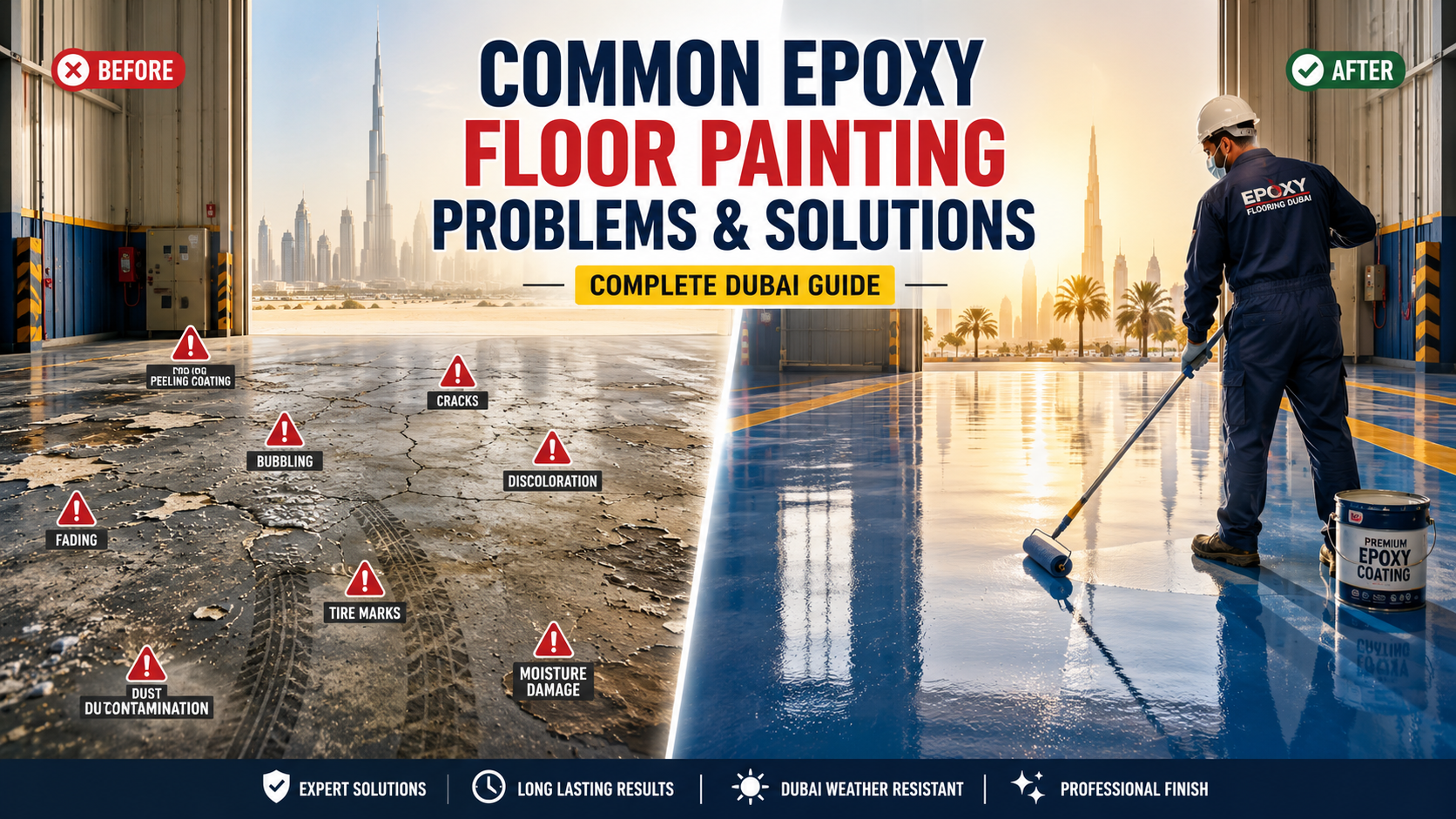
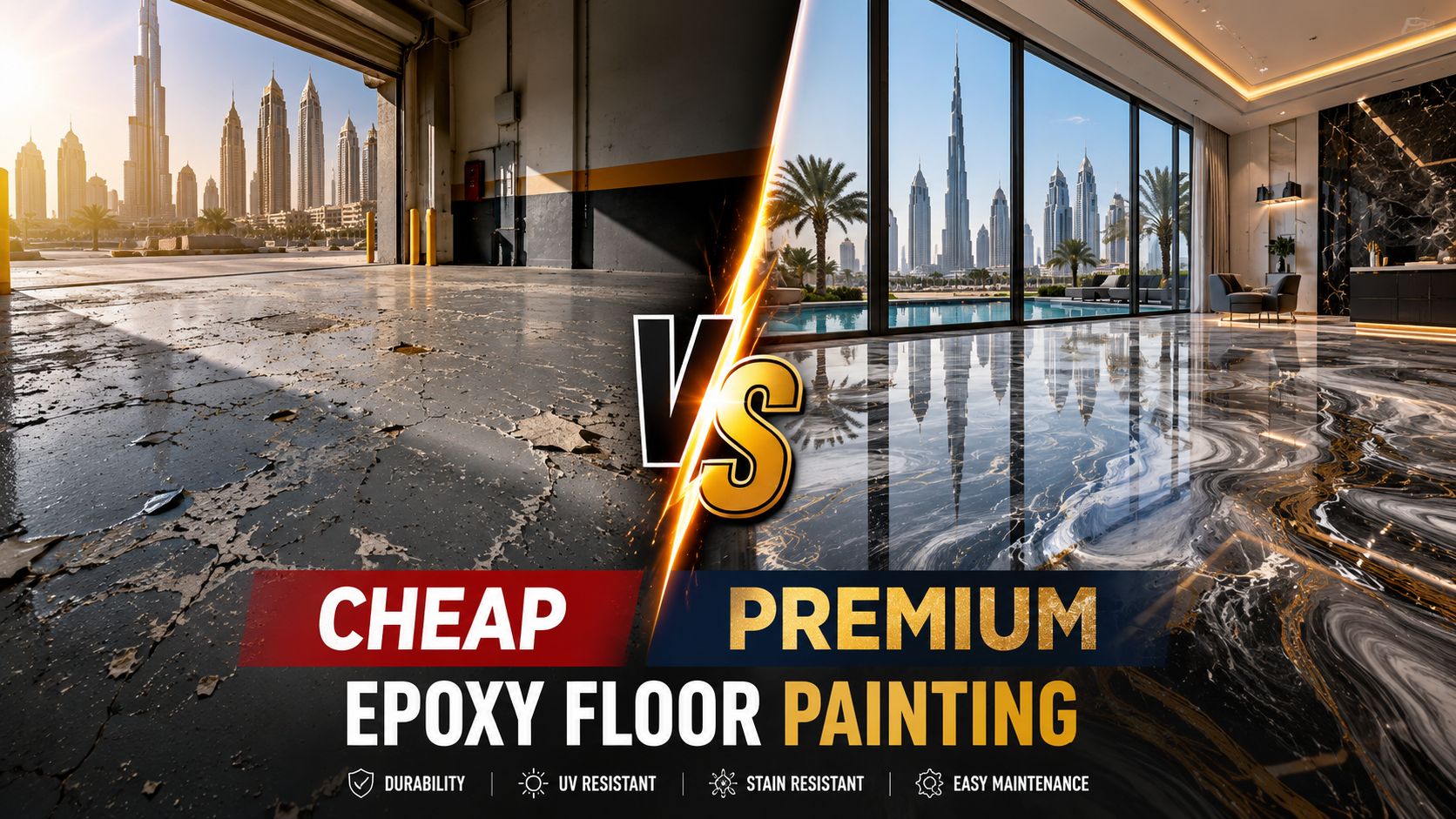
But here’s the catch: in Dubai’s scorching heat, heavy foot traffic, and dusty environment, a cheap epoxy job often starts telling a very different story within months. The glossy finish begins to fade, small cracks appear, and peeling starts around the edges. What seemed like a cost-saving decision can quickly turn into an expensive repair project.
Meanwhile, a premium Epoxy Floor Painting Dubai installation completed just a few buildings away continues to look as impressive as the day it was finished. The surface remains glossy, resistant to stains, and capable of handling Dubai’s harsh climate without losing its appeal.
The difference isn’t luck—it’s the quality of materials, surface preparation, application techniques, and contractor expertise. When investing in Epoxy Floor Painting Dubai, understanding what separates a budget coating from a premium flooring system can save you thousands of dirhams and ensure your floor delivers long-term performance instead of short-term disappointment.
Where Most Cheap Epoxy Jobs Fail: Surface Preparation
If there’s one thing that separates a AED 25,000 epoxy job from a AED 55,000 one, it’s what happens before the epoxy ever touches your concrete.
The Professional Approach:
A certified epoxy contractor will spend 40-50% of the project timeline on preparation. This isn’t wasted effort it’s the foundation of durability. Here’s what happens:
- Deep concrete cleaning – Industrial-grade degreasing to remove oil, salt, and accumulated grime from Dubai’s dust storms
- Mechanical grinding – Diamond grinders profile the concrete to 60-80 mils depth, creating microscopic texture
- Crack repair – Polyurethane injection into any hairline cracks to prevent moisture penetration
- Moisture testing – Calcium chloride tests verify concrete moisture won’t cause adhesion failure
- Primer application – Epoxy primer bonds to the concrete at a molecular level
What Cheap Contractors Do:
They skip steps. A “quick wash” with a pressure washer, maybe a light sweep, and then epoxy goes down. Sometimes they’ll tell you “modern epoxy doesn’t need all that prep.” That’s false. What they mean is “we don’t want to spend 3 days preparing your floor.”
The result? 60-70% of cheap epoxy jobs fail within 3 years with peeling, bubbling, or delamination. And once it starts peeling, the entire coating must be removed grinding it all off costs AED 8,000-12,000 alone.
Material Quality: The Hidden Difference
Not all epoxy is created equal, and this is where manufacturers make strategic choices that affect your wallet.
Solid Content Levels
Professional epoxy systems use high-solids formulations containing 80-90% solids. When applied at the proper thickness (250-300 mils/microns), you get a hard, resilient surface.
Budget epoxy often uses low-solids or diluted systems at 40-50% solids. Even when applied, they create thin coatings of only 30-50 mils. The result is a surface that feels less durable because it is.
Real-world impact: A high-solids epoxy creates a layer tough enough to withstand impact, furniture movement, and thermal cycling. Low-solids epoxy scuffs easily and shows wear within months.
UV Resistance: Critical in Dubai
Here’s something most cheap epoxy installations get wrong: they don’t account for Dubai’s intense UV exposure.
Standard clear epoxy will yellow within 6-12 months under direct sunlight. You’ll notice a slight discoloration at first, then it becomes obvious. The floor looks aged and neglected even though nothing structural changed.
Professional epoxy systems include UV-stabilized topcoats, typically polyurethane or aliphatic polyurea. These coatings protect the epoxy underneath and maintain clarity and color for 8-10+ years.
When you drive past a parking garage or warehouse with yellowed, cloudy epoxy floors, you’re looking at a cheap installation that skipped this step.
Thickness and Durability: Why Numbers Matter
The thickness of an epoxy coating directly determines how long it will perform.
Comparing Real Thicknesses
| Coating Type | Thickness (Mils) | Expected Lifespan in Dubai |
| Budget Epoxy | 30-50 mils | 2-4 years |
| Mid-Range Epoxy | 80-120 mils | 5-7 years |
| Professional Epoxy | 250-350 mils | 10-15+ years |
A mil is 1/1000th of an inch tiny, but critical.
Professional epoxy installations typically apply multiple coats:
- Primer coat: 50-75 mils
- Base epoxy coat 1: 75-100 mils
- Base epoxy coat 2: 75-100 mils
- UV-resistant topcoat: 25-50 mils
This builds to 225-325 mils total a substantial protective layer.
Cheap jobs? Often just one or two thin coats, totaling 40-60 mils. It looks fine initially because the sheen is high and the color is even. But once foot traffic begins, the thin coating starts wearing through.
Real Cost Comparison: Short-Term vs Long-Term
This is where the “cheap” option stops being a bargain.
Scenario 1: Budget Epoxy
- Initial cost: AED 20,000 (AED 25 per square foot for 800 sqft)
- Year 2-3: Peeling appears in high-traffic areas. Spot repairs cost AED 3,000-5,000
- Year 4: Major failure. Complete removal and reapplication: AED 22,000-28,000
- Total cost over 5 years: AED 45,000-53,000
Scenario 2: Premium Epoxy
- Initial cost: AED 55,000 (AED 68 per square foot)
- Year 3-5: Maintenance wash and minor touch-ups: AED 1,000-2,000
- Year 10+: Still performing. A refresh topcoat may be optional: AED 8,000-12,000
- Total cost over 10 years: AED 64,000-69,000
The reality: Premium epoxy costs 2.7x less per year of service.
How Dubai’s Climate Accelerates Cheap Epoxy Failure
Dubai isn’t a forgiving testing ground for budget flooring.
Temperature swings: Summer temperatures reach 45-50°C (113-122°F). Concrete expands. Winter sees drops to 10-15°C (50-59°F). The constant cycling stresses thin, inflexible coatings.
Humidity: Coastal humidity averages 60-70%, with spikes to 90%+ near the Persian Gulf. This moisture seeps into improperly prepared concrete and causes adhesion failure from underneath even if the surface looks perfect.
Dust storms: Fine dust particles penetrate cheap epoxy coatings, creating micro-scratches and dulling the finish within months.
Heavy use: Dubai’s commercial and industrial spaces operate 24/7. Forklifts, carts, foot traffic all accelerate wear on thin coatings.
A premium epoxy system’s thicker, more flexible coating withstands these stresses. A cheap system breaks down rapidly.
Why Appearance Deceives (And How It Changes Over Time)
On day one, cheap and premium epoxy both look excellent. The difference emerges gradually:
Months 1-3: Both maintain their original appearance. No visible difference.
Months 4-6: Cheap epoxy begins showing fine scratches and scuffs. Loses some glossiness. Premium coating remains mirror-like.
Months 9-12: Cheap epoxy shows visible dullness, possible surface crazing (fine cracks), and early discoloration in sun-exposed areas. Premium coating still looks fresh.
Year 2: Cheap epoxy may show peeling at transitions, heavy discoloration, and significant wear patterns. Premium coating maintains integrity.
Year 3+: Cheap epoxy likely requires full replacement. Premium coating still outperforms.
Slip Resistance and Safety: The Often-Forgotten Element
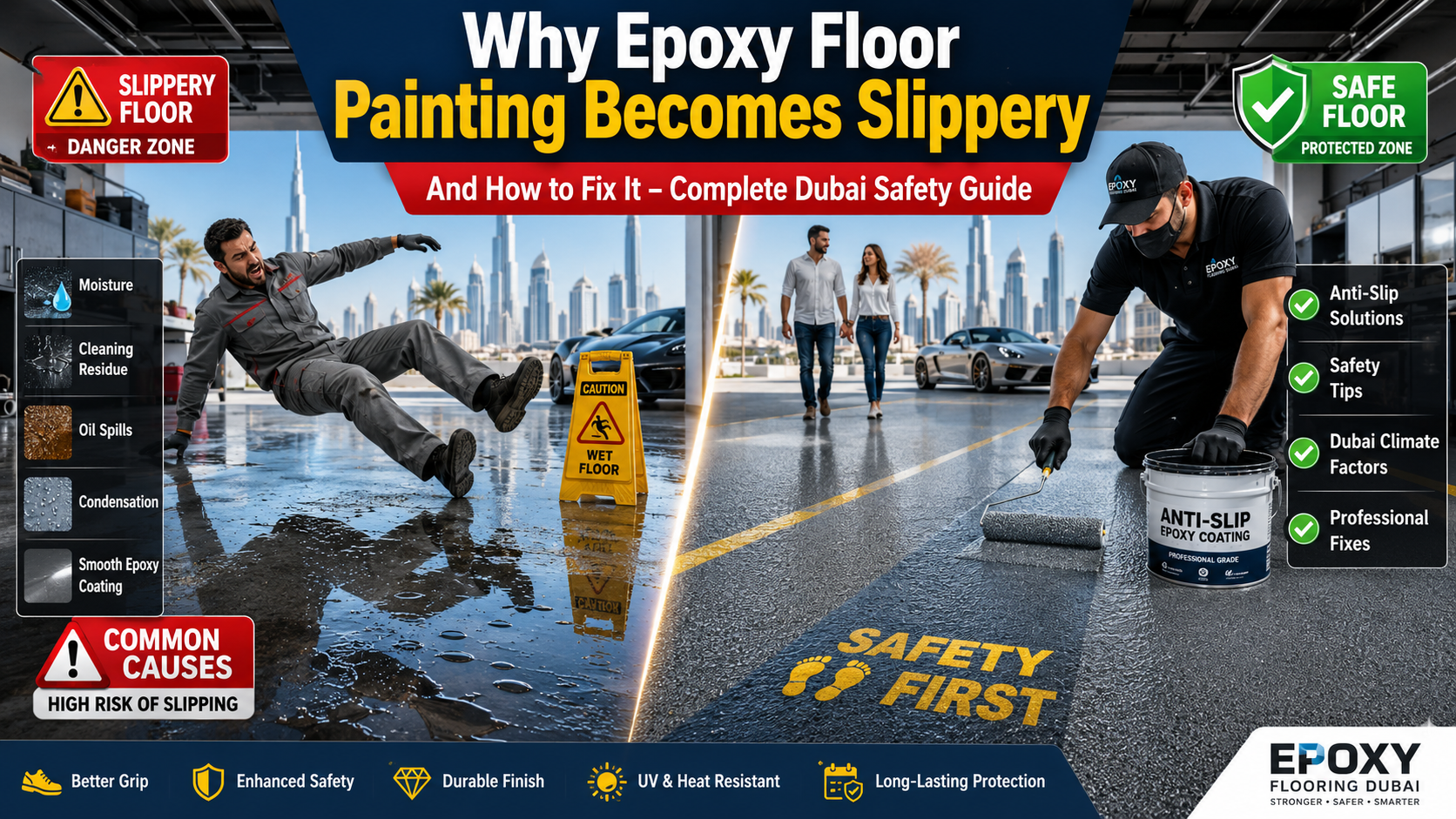
Glossy epoxy is beautiful but dangerous when wet.
Many budget installers focus entirely on aesthetics and skip safety considerations. A polished epoxy floor becomes treacherously slippery in:
- Kitchens and food preparation areas
- Bathrooms and showers
- Balconies during rain
- Commercial kitchens with spill-prone operations
Professional installations address this by incorporating anti-slip additives tailored to the application:
- Coarse aggregate (like aluminum oxide) for maximum grip in wet areas
- Grit-impregnated topcoats for heavy-traffic commercial spaces
- Textured finishes that maintain slip resistance while preserving visual appeal
The result is a floor that’s both beautiful and safe and this detail is often absent from budget quotes.
Application Process: Where Shortcuts Show Up
Here’s what a professional epoxy installation actually involves:
Professional Timeline: 5-7 Days
- Days 1-2: Surface preparation (cleaning, grinding, moisture testing)
- Day 3: Primer application and curing (8-12 hours)
- Day 4: First epoxy coat and curing (12-16 hours)
- Day 5: Second epoxy coat and curing (12-16 hours)
- Days 6-7: UV topcoat application, final curing, and inspection
Budget Timeline: 2-3 Days
- Day 1: Light cleaning and quick epoxy application
- Day 2: Second coat (if applied at all)
- Day 3: Declared “complete” but curing may not be finished
Rushing these steps is where problems begin. Improper curing traps moisture. Thin coats don’t build durability. Skipped primers mean poor adhesion.
Red Flags: How to Spot a Cheap Installation Before You Pay
Before hiring a contractor, ask these five specific questions:
1. “What epoxy system do you use?”
- Professional answer: Specific brand (Jotun, Nullus, PPG, etc.), solid content percentage, thickness specifications
- Red flag: “It’s all the same,” “We use a good epoxy,” or vague responses
2. “Will you mechanically grind the concrete?”
- Professional answer: Yes, with specific grit size and depth targets (60-80 mils)
- Red flag: “Not necessary,” “We use chemical etching instead,” or cost-cutting language
3. “What’s your preparation process?”
- Professional answer: Detailed steps including cleaning, grinding, crack repair, moisture testing, and primer
- Red flag: “We clean it and get started” or any process under 2 days for typical floors
4. “Will you apply a UV-resistant topcoat?”
- Professional answer: Yes, with polyurethane or aliphatic polyurea, applied at 25-50 mils
- Red flag: “You don’t need it,” “The epoxy won’t yellow,” or “It costs extra” (shouldn’t be optional)
5. “What warranty do you offer?”
- Professional answer: 5-10 years written warranty on materials and workmanship
- Red flag: No written warranty, “1-year only,” or warranties that exclude normal wear
Real Examples: What You’re Actually Getting
Budget Installation (AED 20,000-30,000)
Typical scenario: Small contractor with limited equipment, using economy epoxy brand, single primer coat, two thin topcoats, no UV protection, preparation rushed to 1-2 days.
Expected lifespan: 2-3 years before visible failures.
Common issues by year 2-3: Peeling edges, yellow discoloration, dull appearance, visible footprints.
Professional Installation (AED 50,000-70,000)
Typical scenario: Certified applicator with industrial equipment, using premium brands (Jotun, Epodex), multi-coat system with UV topcoat, comprehensive 4-5 day preparation, moisture barrier if needed, written 7-year warranty.
Expected lifespan: 10-15 years with minimal maintenance.
Common characteristics: Consistent sheen, maintained color, minimal dust attraction, easy cleaning, visible durability.
Maintenance: A Hidden Cost in Budget Systems
Premium epoxy requires minimal maintenance. A quarterly cleaning with mild soap and water keeps it pristine.
Budget epoxy demands constant attention. Dull spots reappear quickly. Stains set more easily. Dust clings to the surface. Cleaning can’t restore the original appearance.
Maintenance cost over 5 years:
- Premium: AED 500-1,000 (occasional professional cleaning)
- Budget: AED 2,000-4,000 (frequent cleaning, spot repairs, touch-ups)
This ongoing cost is what budget installers don’t mention during the sales pitch.
Frequently Asked Questions
Q: Can I save money with a DIY epoxy kit from a hardware store?
A: You can purchase a kit for AED 1,500-3,000. However, you’ll likely face the same preparation mistakes that plague cheap contractors insufficient surface prep, improper application thickness, inadequate curing time. Most DIY jobs fail within 1-2 years. Professional installation costs 10-15x more but lasts 5-10x longer. The math favors hiring a professional.
Q: What’s the cheapest professional epoxy I should consider?
A: In Dubai, professional epoxy below AED 40,000 for standard 800-1,000 sqft areas is likely cutting corners. Below AED 35,000 per 800 sqft almost certainly involves:
- Low-solids epoxy
- Skipped preparation steps
- No UV topcoat
- Limited or no warranty
Budget AED 50,000-65,000 for genuine professional work.
Q: Can you apply epoxy over existing cheap epoxy that’s failing?
A: Not directly. Failed epoxy must be mechanically removed (grinding), which costs AED 8,000-12,000. Then the concrete must be properly prepared as if new. You’re essentially replacing the entire floor so you might as well do it right the first time.
Q: How long does professional epoxy installation take?
A: Typically 5-7 working days for standard residential/light commercial spaces. This includes surface prep (40-50% of time), primer, multiple epoxy coats, UV topcoat, and proper curing between each stage. Contractors who promise completion in 2-3 days are compressing the process dangerously.
Q: Will epoxy work in my garage if I park a car on it daily?
A: Yes, but choose premium epoxy rated for heavy loads. Professional systems handle vehicle weight when properly installed (250+ mils thickness). Budget epoxy will show tire marks and traffic wear patterns within months.
Q: What about epoxy for outdoor spaces?
A: Outdoor epoxy in Dubai faces extreme UV exposure and temperature cycling. UV-resistant topcoats are non-negotiable. A professional should specify aliphatic polyurea topcoats, which resist yellowing far better than standard polyurethane. Budget outdoor epoxy will discolor significantly within 12-18 months.
The Bottom Line: Cheap Epoxy Isn’t a Bargain
Cheap epoxy flooring and professional epoxy flooring aren’t simply different price points for the same product. They’re fundamentally different systems:
- Different materials (low-solids vs high-solids)
- Different processes (rushed vs methodical)
- Different durability (2-5 years vs 10-15 years)
- Different performance (quick degradation vs long-term reliability)
In Dubai’s harsh climate, the difference becomes obvious quickly. A cheap job fails. A professional installation thrives.
The investment in professional epoxy flooring delivers:
- Longevity (10+ years vs 2-3 years)
- Lower total cost (AED 6,500/year vs AED 10,600/year)
- Better appearance (maintained gloss and color)
- Reduced maintenance (minimal vs constant upkeep)
- Safety (proper slip resistance)
- Peace of mind (written warranty)