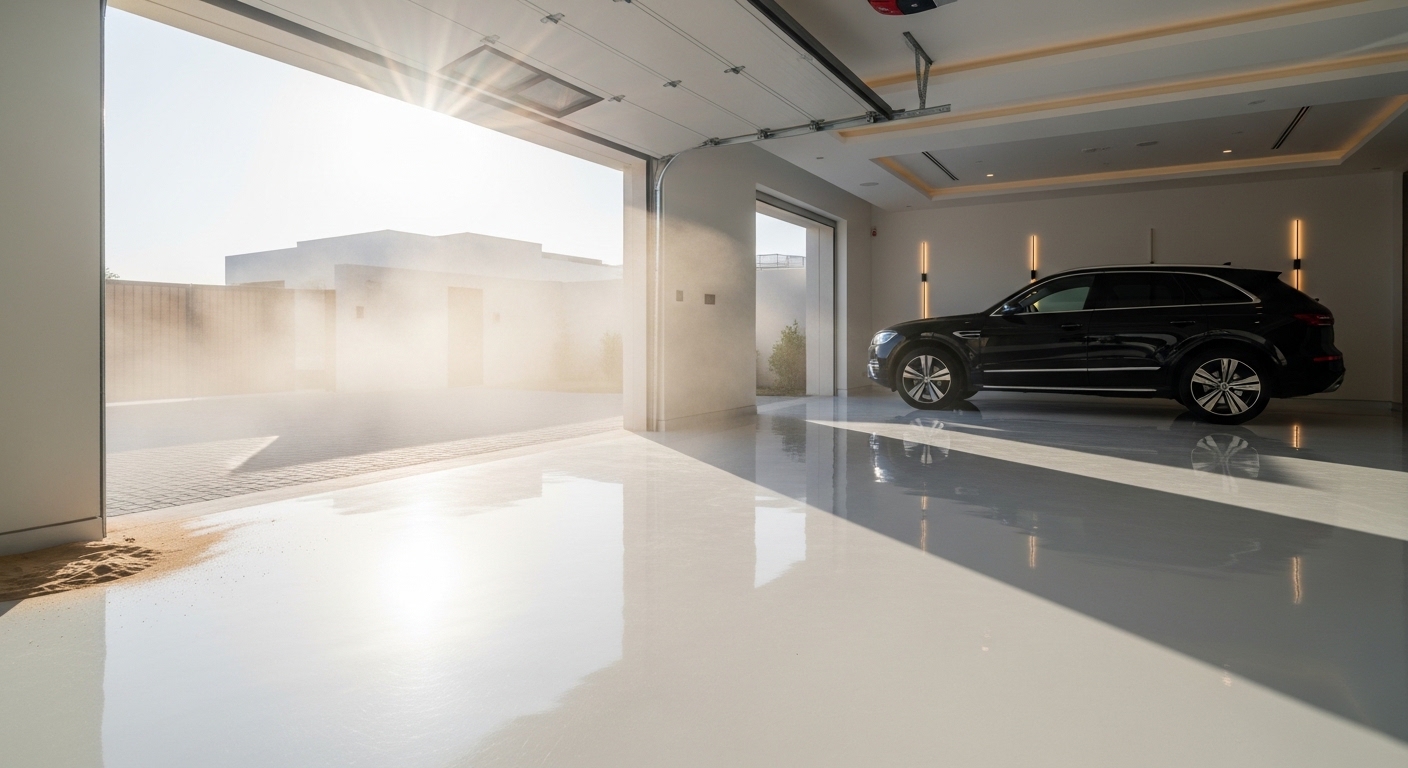
The Question Every Dubai Homeowner Asks First
When someone is seriously considering epoxy flooring for their villa, garage, or commercial space in Dubai, the lifespan question always comes up early. And it should. You are making a decision that involves real money, real disruption to your home, and a floor you will live with for years. You deserve a specific, honest answer not a vague range followed by “it depends.”
So here is the direct answer first, before anything else. A professionally installed epoxy floor coating in Dubai lasts between 12 and 20 years in most residential applications when the installation is done correctly. In a high-traffic commercial environment a busy restaurant kitchen, a warehouse with forklift activity, a retail space with constant footfall expect 8 to 12 years before a topcoat refresh is needed. In a lightly used utility room or low-traffic storage area, a quality epoxy installation can look excellent well beyond the 20-year mark.
These are not optimistic marketing figures. They reflect what professional contractors consistently observe across completed projects in the UAE, and they are significantly more positive than the numbers published in many online guides because those guides typically describe inadequately installed floors rather than professionally executed ones.
The figures also come with an important qualifier that changes the entire economics of the conversation. Epoxy flooring does not simply wear out and get replaced the way carpet, vinyl, or tile does. When it eventually shows wear, it gets recoated. A professional topcoat refresh applied over the existing floor without any demolition or removal costs a fraction of the original installation and restores the floor to new condition. The total lifespan of an epoxy floor system, accounting for recoating, is realistically measured in decades rather than years.
Why Dubai’s Climate Is Genuinely Demanding Specific Factors, Not Generalities
Most articles about epoxy in Dubai mention that the climate is tough and then list heat, dust, and humidity in a single sentence. That is not useful. Here is what actually happens, specifically, and why it matters for epoxy lifespan.
Thermal Cycling Between Interior and Exterior Conditions
Dubai’s summer outdoor temperatures exceed 45°C regularly. Un-shaded concrete surfaces a garage slab, a driveway, a rooftop terrace can reach surface temperatures of 55 to 60°C by mid-morning in July and August. Meanwhile, air-conditioned interior spaces are maintained at 20 to 24°C. This creates a significant and continuous thermal differential, particularly in transitional spaces like villa garages where the slab is partially exposed and partially shaded.
Concrete expands as it heats and contracts as it cools. Any coating system applied to concrete experiences this movement with every thermal cycle. An epoxy coating that is properly bonded to the concrete substrate through correct mechanical preparation moves with the slab and handles this cycling without delaminating. An epoxy coating that is poorly bonded, or applied over a contaminated or improperly prepared slab, is stressed by every thermal cycle and will eventually peel away from the surface. In Dubai’s climate, thermal cycling is more aggressive than in temperate countries, which means the margin for error in preparation is smaller.
UV Radiation Intensity
Dubai receives some of the highest UV radiation levels in the world. This is relevant to epoxy lifespan in a very specific and important way that most guides handle incorrectly. Standard epoxy resins including premium professional-grade products are not UV-stable. When exposed to direct sunlight, the UV radiation breaks down the epoxy polymer structure through a process called photodegradation, causing the surface to yellow, chalk, and lose its gloss. In Dubai’s solar environment, this degradation on an outdoor surface can become visible within three to six months of application.
This is not a quality problem it is a chemistry problem. Spending more money on standard epoxy does not prevent UV yellowing. The solution is specifying a different topcoat chemistry: a polyaspartic coating or an aliphatic polyurethane, both of which are specifically formulated to resist UV degradation. With a UV-stable topcoat over the epoxy base, outdoor surfaces in Dubai perform well for years. Without it, they visibly degrade within months. This single specification decision has more impact on the outdoor lifespan of an epoxy floor than any other variable.
For interior spaces living rooms, kitchens, bedrooms, and garages with UV-filtered glass doors UV degradation is not a meaningful concern because direct sunlight does not reach the floor surface.
Desert Dust and Its Abrasive Effect
Dubai’s fine desert sand is silica-based and mildly abrasive. It settles on every horizontal surface during normal conditions and in significantly larger volumes after shamal sandstorm events. On an epoxy floor, the long-term effect of this dust depends almost entirely on maintenance habits.
If the floor is swept dry before any wet cleaning removing the abrasive sand particles before they are pushed around under a wet mop the surface maintains its gloss for many years. If the floor is mopped without sweeping first, the sandy grit is dragged across the surface under friction with every pass. Over months and years, this gradually dulls a gloss finish in a way that is invisible day-to-day but cumulative and irreversible without recoating. This is the most common maintenance mistake on Dubai epoxy floors, and it costs years of lifespan purely through habit rather than any material failure.
Coastal Moisture Vapour
Properties within several kilometres of Dubai’s coastline the Marina, JBR, Jumeirah, the Palm, creek-adjacent developments and buildings with older or lower-quality concrete foundations face a risk that barely exists in inland or temperate-climate installations. Moisture vapour migrates upward through concrete slabs from groundwater below, driven by a pressure differential between the humid ground and the drier indoor environment above.
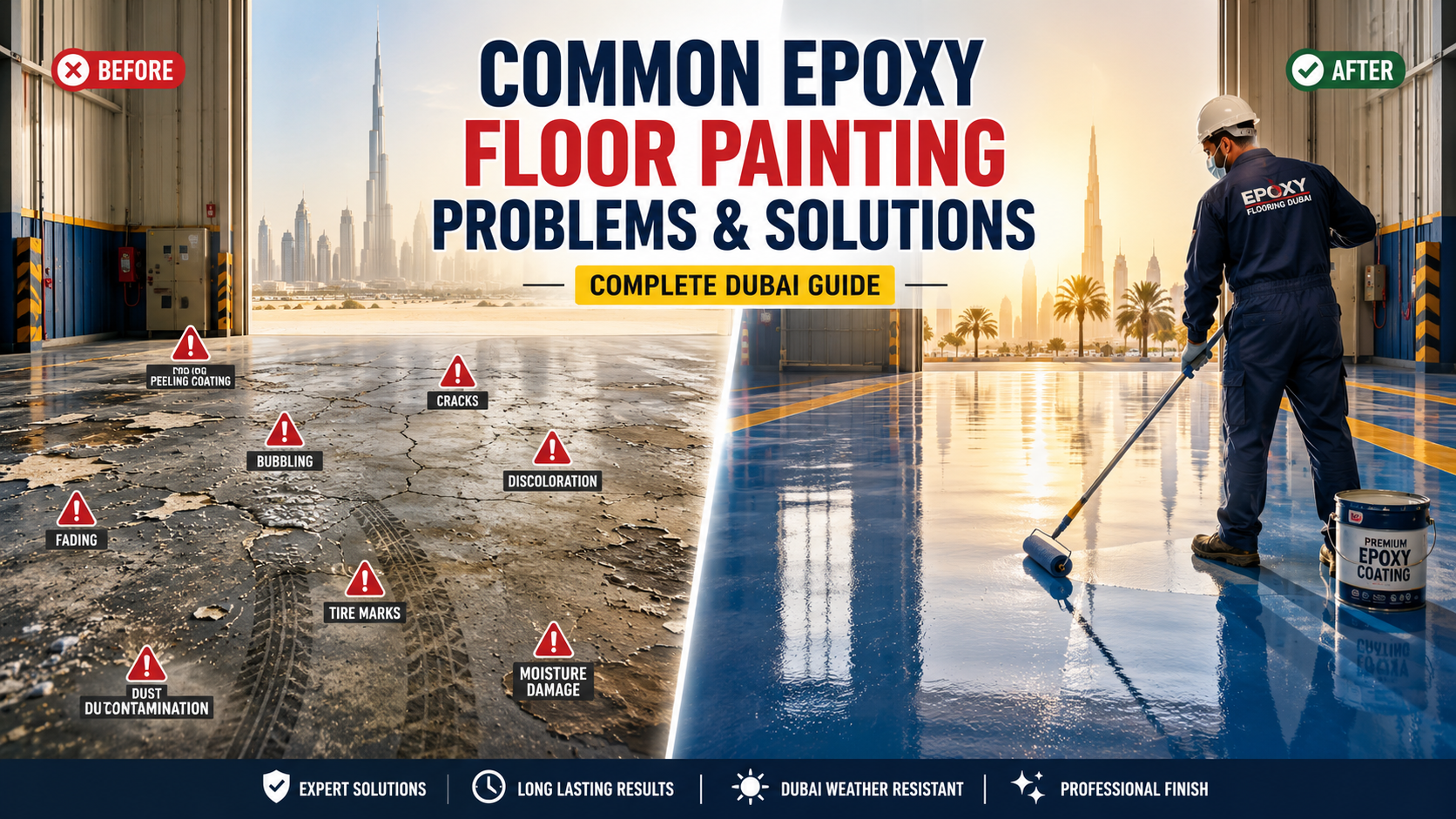
If epoxy is applied over a slab with elevated moisture vapour emission without a moisture-tolerant primer or vapour barrier product, the water vapour pressure eventually overcomes the adhesive bond between the coating and the substrate. The result is bubbling, blistering, and delamination that develops gradually and cannot be repaired without stripping the entire coating and starting again. In coastal Dubai properties, this is one of the most common causes of premature epoxy failure and one of the most completely preventable ones, because a simple test before installation identifies the risk entirely.
The Variables That Determine Where Your Floor Falls in the Lifespan Range
Understanding that epoxy can last 12 to 20 years is only useful if you understand what pushes a specific installation toward the high end or the low end of that range. Here are the real determining variables, in order of their actual importance.
Surface Preparation the Single Most Important Factor
Industry professionals consistently identify inadequate surface preparation as the cause of 70 to 80 percent of all premature epoxy failures. This figure is worth sitting with for a moment. The majority of epoxy floors that fail early do not fail because the epoxy product was poor or because the climate was too demanding. They fail because the concrete substrate was not properly prepared before the coating was applied.
Proper surface preparation for an epoxy installation in Dubai involves several specific steps that cannot be shortened. The concrete surface must be mechanically abraded through diamond grinding or shot-blasting to remove any existing coatings, curing compounds from the original concrete pour, construction release agents, oil contamination from garage use, or mineral deposits from moisture migration. This mechanical abrasion also creates the surface profile that allows the epoxy to mechanically key into the concrete pores and form the chemical bond that gives it its durability. Grinding takes time, generates concrete dust, and requires professional equipment. It is also the step that cheap contractors are most likely to rush or skip entirely, because it adds time and cost to a job without being visible in the finished result.
After grinding, the surface must be degreased where any oil contamination exists, and any cracks, chips, or damaged areas must be filled and repaired with compatible materials. A penetrating primer coat is then applied, which serves two purposes it seals the concrete surface against outgassing and further moisture ingress, and it promotes adhesion of the subsequent coating layers.
An installation that receives thorough mechanical preparation on a clean, dry, properly primed substrate will routinely reach 15 years and beyond in Dubai conditions. An installation where the contractor cleaned the floor with a mop and applied coating the same afternoon is likely to show delamination within 12 to 24 months, regardless of the quality of the epoxy product applied on top.
Coating Thickness and System Specification
The thickness of the epoxy system has a direct relationship with its durability and longevity. A thin single-coat application sometimes called a coating at 0.2 to 0.3 millimetres provides basic protection and a decorative finish, but has limited impact resistance and will show wear relatively quickly under vehicle traffic or heavy use. A full build-up system primer coat, base coat, broadcast aggregate or decorative layer, and clear polyurethane or polyaspartic topcoat typically runs from 2 to 4 millimetres in total and provides the kind of durability that justifies the 15 to 20 year lifespan figure.
The topcoat specification is particularly important because the topcoat is the layer that actually faces daily wear, UV exposure, chemical contact, and cleaning. A polyurethane topcoat is harder and more abrasion-resistant than a standard epoxy clear coat. A polyaspartic topcoat is UV-stable and cures faster. The right topcoat choice depends on the application indoors or outdoors, residential or commercial, aesthetic priority or functional priority and this decision should be part of the specification discussion before any work begins.
The Quality of the Epoxy Product Itself
Professional-grade, commercial epoxy systems from reputable manufacturers genuinely perform better and last longer than budget materials. This is not simply a marketing claim it reflects measurable differences in resin purity, hardener chemistry, and the consistency of the two-component ratio that determines the quality of the cross-linked polymer network in the cured floor.
However, product quality is the third most important variable, not the first. The best epoxy product on the market will fail early if applied over an improperly prepared substrate. The relationship between preparation quality and product quality is not additive it is sequential. Preparation must be correct first. Then product quality determines performance within an already sound system.
The Type of Space and Its Use
A villa garage floor in Dubai experiences a very different stress profile than a bedroom floor in the same villa. The garage floor endures vehicle weight particularly relevant in the UAE where large SUVs and heavy vehicles are common hot tyre contact during summer when rubber compound becomes slightly tacky, oil and chemical drips, grit and sand tracked in from outside, and cleaning with strong degreasers. A bedroom floor experiences foot traffic, the occasional dragged piece of furniture, and regular sweeping and mopping.
The same correctly installed epoxy system will last significantly longer in the bedroom than in the garage not because the garage application fails, but because the stress differential naturally produces different wear rates. Understanding this helps set realistic expectations per space rather than applying a single lifespan figure to every area of a property.
Maintenance Quality Over Time
A quality epoxy floor maintained correctly will last years longer than the same floor maintained carelessly. The habits that extend lifespan in Dubai specifically are dry-sweeping before mopping to remove abrasive desert sand, using pH-neutral floor cleaners rather than acidic descaling products or vinegar-based cleaners that gradually degrade the topcoat chemistry, avoiding steam mops which can soften and blister certain topcoat formulations, and addressing any minor edge lifting or surface damage promptly before it spreads into a larger delamination zone.
None of these habits are demanding. The total time investment in maintaining an epoxy floor correctly in a Dubai home is minimal compared to the maintenance that a tiled floor with grout lines requires. The difference is that the habits matter consistently particularly the sweep-before-mop protocol in a city where fine desert sand is a constant presence.
Realistic Lifespan Figures by Application Type
Here are honest, specific lifespan figures by application, reflecting what professionally installed systems deliver in Dubai conditions with reasonable maintenance.
Villa garage with vehicle use: 12 to 15 years before topcoat refresh is recommended. With excellent maintenance and a quality system, some installations reach 18 years in good condition.
Open-plan villa living area or kitchen: 15 to 20 years before any significant wear is visible on the topcoat surface. These are lower-stress environments and a quality system performs extremely well over a long period.
Commercial kitchen or restaurant: 8 to 12 years before a topcoat refresh is needed. The combination of constant foot traffic, hot water cleaning, chemical sanitisers, and dropped equipment creates a demanding environment that accelerates surface wear more than residential use.
Warehouse or industrial facility with forklift traffic: 5 to 10 years depending on traffic intensity, load weight, and whether the correct system thickness was specified. A standard residential coating system is not appropriate for these environments a mortar system with significant build-up thickness is the correct specification.
Outdoor terrace or driveway with UV-stable topcoat: 8 to 15 years depending on UV exposure, traffic, and maintenance. Without a UV-stable topcoat, visible degradation begins within months this is a specification issue, not a lifespan range.
Utility room or low-traffic storage area: 20 years and beyond with basic maintenance. These are the easiest environments for any floor coating system.
The Recoating Option Why Epoxy Lifespan Is Different from Other Flooring
This is the point that most guides either mention in passing or miss entirely, and it completely changes how you should think about epoxy lifespan economics.
When carpet wears out, you rip it up and install new carpet. When tiles crack or grout fails beyond repair, you remove the tiles often a destructive process and lay new ones. When vinyl peels or lifts, you strip it and start again. All of these replacement processes involve demolition waste, significant disruption, and a cost that is essentially equivalent to the original installation.
Epoxy flooring works completely differently. When the topcoat of an epoxy floor shows wear dullness, minor scratching, loss of gloss after many years of service, a professional contractor lightly abrades the existing surface with diamond pads to create adhesion and applies a fresh topcoat over the existing floor. The process takes one to two days. There is no demolition, no waste going to landfill, minimal disruption, and the cost is a fraction of the original installation. The result is a floor that looks and performs like a new installation.
This means the relevant economic comparison is not just between the upfront cost of epoxy and the upfront cost of tile. It is between the total cost over 20 years including all maintenance, repairs, re-grouting, and eventual replacement for tiles, versus the original installation plus one or two topcoat refreshes for epoxy. Calculated over that horizon, epoxy consistently delivers lower total cost in any high-use application.
In terms of AED figures for Dubai, a topcoat refresh on an existing well-bonded epoxy floor typically costs between AED 25 and AED 50 per square metre depending on the topcoat product and the condition of the existing surface. Compare this to the original installation cost of AED 65 to 100 per square metre for a flake system or AED 80 to 130 per square metre for a self-levelling system, and the economics of recoating become immediately clear.
What Shortens Epoxy Lifespan Specific Causes, Not Vague Warnings
Poor surface preparation is the leading cause and has been covered above. Beyond that, these are the specific failure causes that shorten epoxy lifespan in Dubai properties.
Moisture vapour under the slab that was not tested or addressed. This causes progressive bubbling and delamination from below and is particularly common in ground-floor and basement slabs in coastal Dubai locations. The prevention is a moisture vapour emission test before application and a moisture-tolerant primer specification where the reading is elevated.
Applying the coating during summer without temperature and humidity controls. When concrete surface temperatures exceed around 35°C, the pot life of mixed epoxy drops significantly. The coating may begin to cure before it has fully levelled, creating surface defects and a weaker bond. Professional contractors manage this through early morning scheduling, temporary shading, or working only in climate-controlled interior spaces during peak UAE summer months.
Using acidic cleaning products on the cured floor. Tile descalers, vinegar-based cleaners, citrus degreasers, and some limescale removers that are commonly used in UAE households for hard water deposits will gradually break down an epoxy topcoat through chemical attack. The degradation is not immediate or dramatic it is slow and cumulative, typically showing as progressive dullness and micro-etching of the surface over one to two years of regular use. Using pH-neutral cleaners entirely prevents this.
Loading the floor before full cure. Epoxy reaches light foot traffic strength within approximately 24 hours of application. Full chemical cure takes 7 full days. Parking a vehicle on a garage floor on day two or three, placing heavy racking immediately, or dragging furniture across the surface before the week is complete can permanently indent or mark the surface before it has reached its designed hardness. This is particularly relevant in Dubai’s summer heat where cure chemistry behaves differently from standard international guidelines.
Using epoxy paint instead of a professional coating system. If a hardware store epoxy paint was applied rather than a professional two-component system, the thin film it creates will wear, peel, and yellow much faster than any lifespan figure for professional epoxy applies. The 12 to 20 year residential lifespan described throughout this article assumes a professional two-component epoxy coating system. It does not apply to single-component epoxy paints, regardless of how they are marketed.
How to Maximise the Lifespan of Your Epoxy Floor in Dubai
Dry-sweep or dust-mop every day or after any sandstorm event, always before introducing any moisture. This single habit protects the gloss surface from the gradual abrasion of silica-rich desert sand more than any other maintenance measure.
Use only pH-neutral floor cleaners for all wet mopping. Warm water with a small amount of pH-neutral cleaner is sufficient for all regular maintenance. If you are unsure whether a product is pH-neutral, check the label or contact the manufacturer most reputable cleaning product brands state the pH clearly.
Never use a steam mop on an epoxy floor. The concentrated heat delivered to a localised surface area can soften and blister topcoat formulations, particularly on thinner coating systems. This damage is irreversible without recoating.
Wipe spills promptly. Epoxy resists staining extremely well, but certain substances battery acid, strong solvents, some industrial chemicals can attack the topcoat with prolonged contact. In a residential setting this is rarely a dramatic risk, but prompt clean-up is always the correct habit.
Use felt pads under furniture legs and appliances. Point-load pressure from furniture feet on a gloss epoxy surface can cause scratching that accumulates into visible marks over time. Felt pads eliminate this entirely.
Have the floor professionally inspected every few years in a high-use application. A contractor who installed your floor can assess whether any edge lifting, micro-cracking, or topcoat wear is developing and address it before it becomes a larger delamination issue. Early intervention consistently extends lifespan and reduces eventual recoating cost.
When the topcoat shows wear, recoat rather than replace. Do not wait for the floor to reach a state of serious failure before acting. A topcoat refresh applied over a floor that is still fundamentally sound is a straightforward, low-cost operation. Waiting until delamination has spread means removing and recoating larger areas, or in severe cases stripping and replacing the entire system a significantly more expensive outcome.
Signs That Your Epoxy Floor Needs Professional Attention
Progressive dullness that does not respond to cleaning. If the floor looks clean but no longer has its original sheen, the topcoat is wearing thin. This is the earliest and most actionable warning sign a topcoat refresh at this stage is simple and inexpensive.
Small areas of edge lifting or bubbling. If the coating is lifting at walls, door thresholds, or in isolated spots on the floor, this indicates a localised adhesion failure. Addressed early, these areas can be cut back and repaired. Left alone, they spread as moisture, cleaning water, and foot traffic work their way under the lifting edge.
Surface micro-cracking visible in raking light. Fine hairline cracks in the surface coating visible when light strikes the floor at a low angle indicate that the topcoat is under stress, often from substrate movement or impact over time. These should be assessed by a professional to determine whether the substrate itself has moved or whether the cracks are confined to the surface layer.
Yellowing on interior surfaces not explained by sun exposure. If an interior epoxy floor that receives no direct sunlight is developing a yellow tint, this may indicate that a non-UV-stable topcoat was applied in a space that receives more indirect UV than anticipated, or that certain cleaning chemicals have been reacting with the topcoat over time. A professional assessment will identify the cause and recommend the correct remediation.
Persistent staining that does not clean off. Epoxy’s chemical resistance is high but not absolute. If certain substances have been left in prolonged contact with the surface, the topcoat may have been locally degraded. Spot repair and topcoat refresh in affected areas is usually sufficient.
Frequently Asked Questions
Is 5 to 8 years a realistic lifespan for a Dubai garage epoxy floor?
This figure appears in several online guides and is significantly pessimistic for a professionally installed system. A 5 to 8 year lifespan typically describes a floor that was installed with inadequate surface preparation, applied with a thin coating system, or maintained poorly. A professionally installed flake or solid-colour epoxy system in a Dubai villa garage with proper mechanical surface preparation, an appropriate coating thickness, and a polyurethane or polyaspartic topcoat should deliver 12 to 15 years of good service before any topcoat refresh is needed, and in many cases significantly longer. If you are being quoted a product with a claimed lifespan at the lower end of this range, ask the contractor specifically what surface preparation process they use and what the total dry film thickness of their system is.
Does epoxy flooring last longer indoors or outdoors in Dubai?
With the correct specification, both can be long-lasting. The critical variable outdoors is UV stability. Standard epoxy without a UV-stable topcoat will degrade visibly on any outdoor surface in Dubai within months this is not a longevity question, it is a specification error. With a polyaspartic or aliphatic polyurethane topcoat, an outdoor Dubai epoxy floor can last 8 to 15 years depending on traffic and maintenance. Indoors, away from direct UV exposure, a quality system typically outlasts outdoor applications because the stress environment is lower. The comparison is not really indoor versus outdoor it is correctly specified versus incorrectly specified.
How much does a topcoat recoat cost in Dubai?
A professional topcoat refresh on an existing well-bonded epoxy floor typically costs between AED 25 and AED 50 per square metre in Dubai, depending on the topcoat product used, the size of the area, and the condition of the existing surface. For a 60 square metre villa garage, this represents a total cost of AED 1,500 to AED 3,000 compared to AED 3,900 to AED 6,000 for a complete new installation. The economic case for recoating at the right time rather than waiting for full system failure is straightforward.
Can I make my existing epoxy floor last longer without recoating?
Up to a point, yes. Consistent correct maintenance dry-sweeping before mopping, pH-neutral cleaners, no steam mops, prompt spill clean-up will meaningfully extend the useful life of the topcoat compared to careless maintenance. However, there is a natural limit to what maintenance can achieve once the topcoat has physically worn thin. At that stage, a professional recoat is the correct intervention. Think of maintenance as extending the interval between recoats rather than eliminating the need for them entirely.
How do I know if my epoxy floor was installed correctly and whether the lifespan figures in this article apply to my floor?
The most reliable indicators are what you observed or can find out about the installation process. If the contractor spent significant time on mechanical surface preparation grinding the concrete, which generates dust and noise that is a positive sign. If the floor was coated on the same day it was cleaned, or if preparation involved nothing more than mopping and light sanding, the installation is at higher risk of early failure. If the floor has been in place for more than two years and shows no edge lifting, bubbling, or delamination, that is generally a good sign that the initial adhesion was sound. If you are unsure, a professional contractor can assess the existing floor and give you an honest estimate of its remaining lifespan and what, if anything, should be done to extend it.