
The complete, honest answer for Dubai villa owners and homeowners covering every room, every epoxy type, real costs in AED, and exactly what professionals know that most guides never tell you.
Epoxy flooring is absolutely suitable for homes and in Dubai’s climate, it often outperforms tiles in practical terms across garages, kitchens, living areas, hallways, and outdoor spaces. The “garages only” idea is outdated by at least a decade. Modern epoxy systems come in finishes that belong in luxury villa interiors just as naturally as they do on a workshop floor. Whether it is right for your specific room depends on the type of epoxy chosen, how it is installed, and what you actually need from the floor. This guide walks you through all of it.
What This Guide Covers
- Where the Garage Myth Came From
- Types of Epoxy for Home Use
- Room-by-Room Guide
- How Dubai’s Climate Affects Things
- Real Costs in AED
- Comfort and Safety at Home
- Honest Pros and Cons
- Mistakes That Ruin Home Installations
- How to Choose the Right Contractor
- FAQs
01 Where the “Garages Only” Idea Actually Came From
The reputation of epoxy as purely an industrial or garage product is not entirely unfair it is just outdated. In its early commercial applications from the 1950s through to the 1990s, epoxy floor painting was primarily developed and marketed for factories, warehouses, aircraft hangars, and food processing facilities. The priority was chemical resistance and the ability to withstand forklift traffic, not how something looked in a living room.
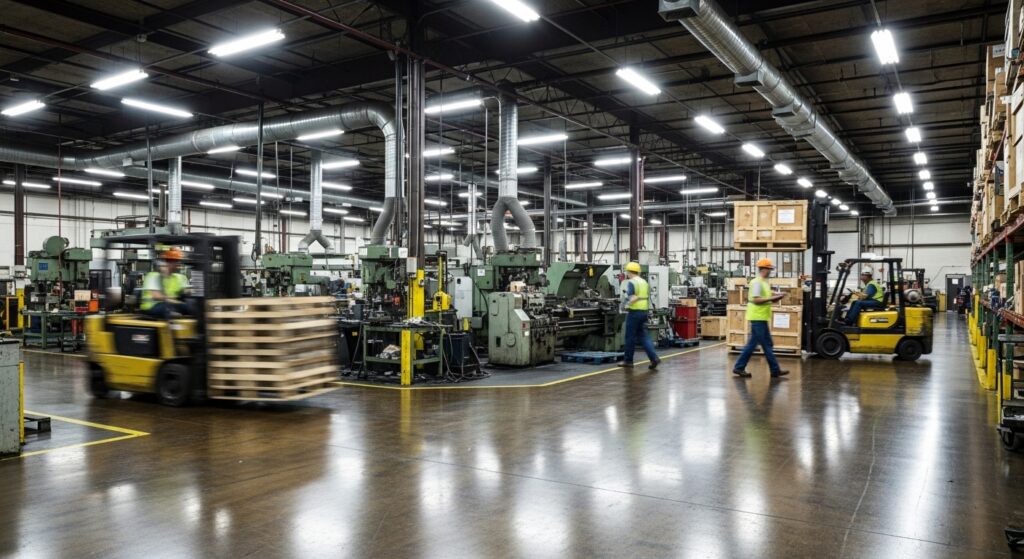
As epoxy became more widely used in vehicle workshops and residential garages through the 2000s, the association deepened. The typical image was a grey or beige garage floor with vinyl flakes functional, practical, unremarkable. For a long time, that really was most of what the residential market saw.
What changed things was the development of self-levelling systems, metallic pigment technology, and improved topcoat formulations through the 2010s. Suddenly epoxy could produce a liquid-marble 3D finish that looked better than most tiles. Interior designers and architects started specifying it in commercial lobbies, luxury retail spaces, and high-end restaurant fit-outs. It then crossed into premium residential projects and in Dubai, where architectural ambition runs high and open-plan villa living suits seamless floors beautifully, it found a genuinely enthusiastic market.
Today, searching for epoxy floor painting Dubai returns as many villa living room and kitchen projects as it does garage applications. The product has evolved completely. The perception simply has not kept up.
The Real Question
The question was never really “is epoxy for homes or garages?” it was always “which type of epoxy suits which space, and is it correctly specified and installed?” Get those two things right, and epoxy works beautifully across almost every area of a home.
02 The Types of Epoxy Used in Homes and Which Suits Which Space
One of the biggest gaps in most articles on this topic is the treatment of epoxy as a single uniform product. It is not. The type of system chosen completely changes the look, feel, and performance of the finished floor. Here are the main types used in residential applications across Dubai and what each one actually delivers.
Best for: Living rooms, open-plan areas, hallways
Self-Levelling Epoxy
Flows across the prepared concrete surface and settles into a perfectly smooth, seamless finish. This is the system behind the sleek, contemporary floors you see in modern Dubai villa interiors and boutique retail spaces. Available in an enormous range of colours and in both gloss and satin finishes. It is the residential workhorse of the epoxy world — clean, minimal, and genuinely beautiful when done well. Thickness typically ranges from 2 to 3mm.
Best for: Luxury villa interiors, feature rooms, showrooms
Metallic Epoxy
Metallic pigment powders are introduced into the epoxy base to create swirling, 3D marble-like and liquid-metal effects. No two metallic epoxy floors look identical — the patterns emerge organically during application. This system has moved firmly into the luxury residential category in Dubai and is now regularly specified as a centrepiece of high-end villa interiors. It is among the more expensive residential options but delivers a visual impact that no tile can replicate. Pairs exceptionally well with the large open-plan layouts common in Dubai Hills, Emirates Hills, and Palm Jumeirah villas.
Best for: Garages, utility rooms, basements, gym spaces
Decorative Flake (Chip) System
Coloured vinyl flakes or chips are broadcast into the wet epoxy base coat, creating a textured, multi-tone finish. This is the most widely used system in Dubai villa garages because it hides tyre marks, oil stains, and concrete imperfections extremely well. The texture improves slip resistance naturally. Available in dozens of colour blends to match a villa’s exterior palette. More forgiving during installation than self-levelling or metallic systems, and very durable under vehicle traffic. Thickness typically 2 to 3mm with a clear polyurethane topcoat.
Best for: Kitchens, entrances, pool surrounds, wet areas
Quartz-Filled Epoxy
Quartz sand aggregate is blended into or broadcast onto the epoxy system to create maximum slip resistance and surface hardness. The result is a textured, non-reflective finish that is the most slip-resistant of any epoxy system. Common in commercial kitchens across Dubai where food safety regulations require safe, cleanable surfaces. Also widely used in villa entrances, building lobbies, pool surrounds, and any area that sees regular water exposure. Not the most aesthetically refined option, but functionally exceptional.
Best for: Outdoor driveways, terraces, pool decks
Polyaspartic / UV-Stable System
Strictly speaking, polyaspartic is a separate chemistry from epoxy, but it is often used as a topcoat over an epoxy base — or as a complete system — specifically for outdoor and UV-exposed applications. Standard epoxy resins yellow and chalk under direct UAE sunlight within months. Polyaspartic coatings are UV-stable, meaning they hold their colour and gloss outdoors indefinitely. For any Dubai villa driveway, terrace, or outdoor entertaining area, this specification is not optional — it is the correct and professional approach.
03 Room-by-Room: Where Epoxy Works in a Dubai Home
Rather than generalisations, here is specific guidance for every main area of a Dubai villa or apartment — with honest assessments of where epoxy excels, where it works with the right specification, and where a different choice might genuinely serve you better.
Villa Garage
Excellent — Clear First Choice
Oil resistance, tyre mark resistance, heat stability, easy cleaning after sandstorm dust events, and visual upgrade from bare grey concrete. Flake or solid-colour epoxy is the professional standard here. Flake System
Kitchen
Excellent — Highly Recommended
Seamless, non-porous surface resists cooking oil, food spills, and cleaning chemicals. No grout lines to harbour bacteria. Particularly suited to open-plan villas where kitchen flows into living area. Self-Levelling or Quartz
Open-Plan Living Area
Excellent — Popular Choice
Self-levelling and metallic epoxy systems create a stunning architectural finish. Seamless floors make spaces feel larger — particularly relevant in large Dubai villa floor plans. Metallic or Self-Levelling
Hallways & Entrances
Excellent — Ideal
High foot traffic, dust from outside, and the need for easy mopping all make epoxy the practical winner here. Anti-slip quartz finish for villa entrances where wet footwear is common. Quartz or Self-Levelling
Bedroom
Good — With Consideration
Works well and is increasingly used in contemporary Dubai villas. The main consideration is underfoot softness — a bedside rug addresses this easily. Satin or matte finish suits the more intimate scale of a bedroom. Self-Levelling (Matte)
Bathroom
Good — Specify Correctly
Epoxy works in bathrooms but requires careful moisture management and an anti-slip finish. A quartz-filled topcoat is essential for wet shower areas. Many Dubai homeowners still prefer tiles here for traditional aesthetic reasons. Quartz Anti-Slip
Utility / Storage Rooms
Excellent — Practical Choice
High utility, easy to clean, resists damp and chemical spills from cleaning products. One of the most cost-effective applications — protects the concrete and keeps the space hygienic with minimal investment. Solid Colour
Outdoor Patio / Driveway
Yes — But Specify UV Topcoat
Standard epoxy will yellow under Dubai’s direct sunlight within months. Always specify a polyaspartic or UV-stable topcoat for any outdoor surface. With the right specification, outdoor epoxy is durable and beautiful. Polyaspartic UV System
Pool Surrounds
Good — Anti-Slip Essential
Quartz-filled anti-slip epoxy with a UV-stable topcoat works well around Dubai villa pools. Resists pool chemicals, handles constant water exposure, and stays cooler underfoot than dark natural stone. Quartz + Polyaspartic
04 How Dubai’s Climate Specifically Affects Epoxy in a Home
Most guides about epoxy flooring are written for temperate climates — the UK, the US east coast, parts of Australia. The UAE is a fundamentally different environment, and some of what applies there does not apply here. Here is what actually matters for Dubai residential properties.
Interior Heat and Thermal Cycling
Dubai’s summer sees outdoor temperatures above 45°C while interior spaces are air-conditioned to around 20–24°C. This means concrete slabs experience a continuous thermal cycle — warming when the AC is off or when external walls heat up, cooling when it runs. A correctly installed epoxy system with proper adhesion handles this movement well. A poorly prepared or thin system will eventually delaminate along the bond line. This is one reason why proper mechanical surface preparation is not negotiable on a Dubai project.
Desert Dust and Sand
Fine silica-rich desert sand finds its way into every Dubai home, regardless of how well sealed the building is. After shamal events — the seasonal sandstorms — a visible layer settles on all horizontal surfaces. For epoxy floors, this matters in two ways. First, the seamless surface means sand sits on top rather than embedding in grout lines, making it easier to remove. Second, if you mop a sandy floor while the sand is still dry, you drag abrasive particles across the surface under wet friction — which over years can dull a gloss finish. Always dry-sweep or dust-mop before introducing any water.
Coastal Moisture Vapour
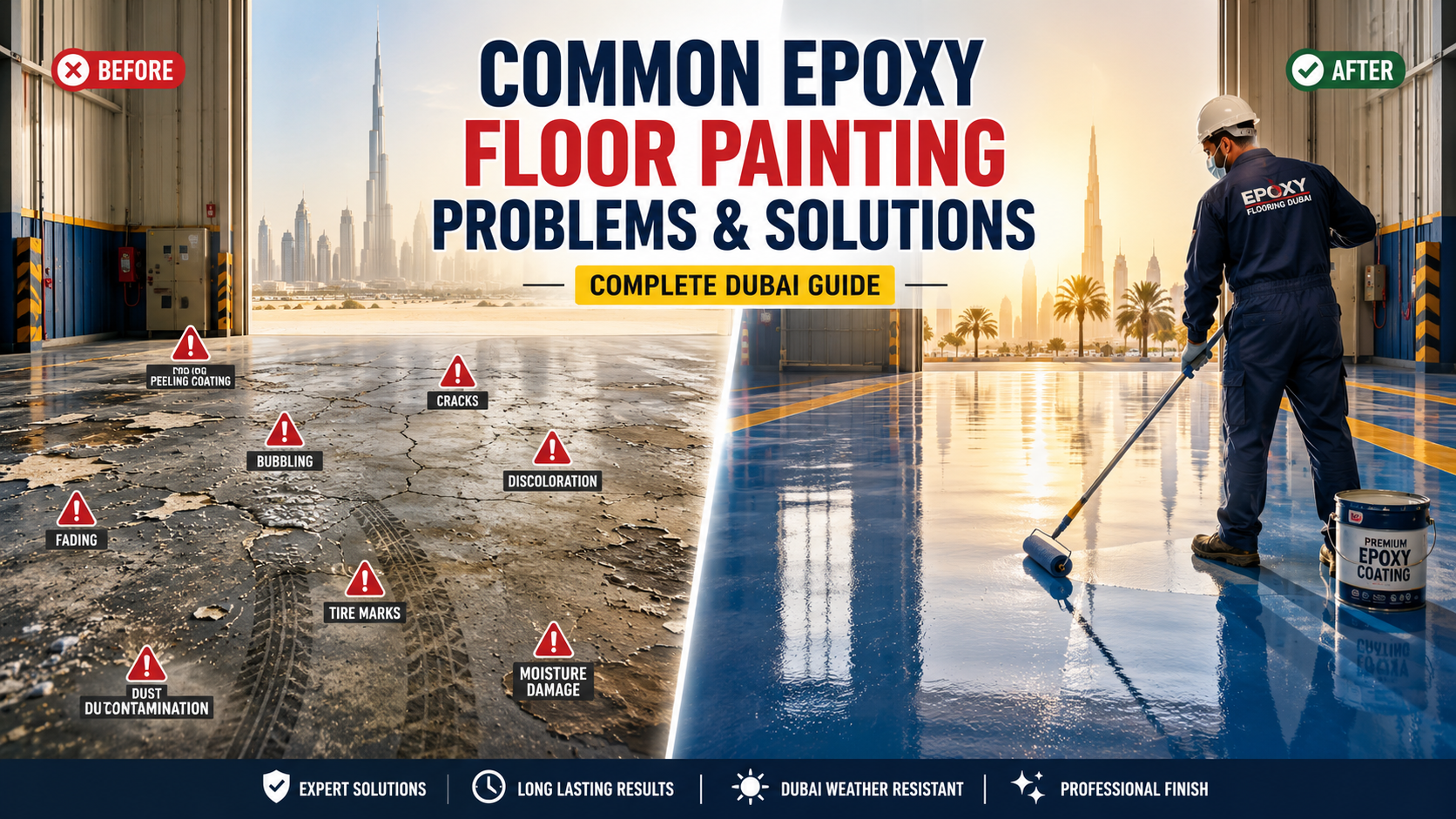
Properties near Dubai’s coastline — Marina, JBR, Jumeirah, the Palm — and buildings with older or lower-quality foundations can have elevated moisture vapour emission from the concrete slab. This is groundwater vapour migrating upward through the concrete under pressure. If epoxy is applied over a slab with high moisture vapour emission without the correct primer or moisture barrier, the coating will eventually develop bubbles and peel from below — even if everything else was done perfectly. A moisture vapour emission test before any epoxy application on a ground-floor or basement slab in Dubai is always worth requesting.
Outdoor UV Exposure
Dubai receives some of the highest UV radiation levels in the world. Standard epoxy resins are not formulated to handle this. For any outdoor surface — driveway, terrace, villa entrance, pool surround — a UV-stable polyaspartic topcoat must be part of the specification. This is not a premium upgrade. It is the minimum correct specification for outdoor use in the UAE. Any contractor who quotes standard epoxy for an outdoor Dubai surface without mentioning this is either inexperienced or cutting costs at your expense.
Summer Installation Scheduling
In a Dubai summer, un-shaded concrete surface temperatures can exceed 55–60°C by mid-morning. At those temperatures, mixed epoxy begins to cure before it has fully levelled, resulting in an uneven finish and shortened working time. Professional contractors schedule summer epoxy applications for early morning (before 7am for exposed surfaces), use temporary shading structures, or work in climate-controlled interior spaces only. If a contractor never mentions temperature management for a summer Dubai project, ask them directly how they handle it.
05 What Does Epoxy Flooring Actually Cost in Dubai?
Pricing is the question most guides avoid answering specifically, which leaves homeowners guessing. Here are realistic current market rates for Dubai residential epoxy projects, inclusive of surface preparation, materials, and professional labour.
Solid Colour
AED 40–65
per sq. metre
Utility rooms, storage areas, basic garage applications
Flake System
AED 65–100
per sq. metre
Villa garages, basements, gym rooms — most popular residential system
Self-Levelling
AED 80–130
per sq. metre
Living rooms, kitchens, hallways — smooth seamless residential finish
Metallic / 3D
AED 120–200
per sq. metre
Feature rooms, luxury villa interiors, showrooms
Quartz Anti-Slip
AED 75–120
per sq. metre
Kitchens, entrances, pool surrounds, wet areas
Polyaspartic Outdoor
AED 110–170
per sq. metre
Driveways, terraces, pool decks — UV-stable specification
These prices include proper surface preparation, which accounts for a significant portion of the total job cost and should never be reduced to save money. If a quote is substantially below these ranges, the most likely explanation is thinner materials, inferior products, or inadequate surface preparation — all of which result in earlier failure.
For context on long-term value: a 60 sqm villa garage finished with a quality flake epoxy system at AED 75 per sqm represents AED 4,500 in total. That same floor, maintained correctly, should serve well for 12 to 15 years. The equivalent in annual cost is around AED 300 to 375 per year — for a floor that never needs re-grouting, never cracks under tyre weight, and requires nothing beyond a weekly sweep and occasional mop.
06 Comfort, Warmth, and Safety — the Honest Picture
These are the questions most homeowners ask when considering epoxy for a bedroom or family living area, and they deserve an honest answer rather than marketing reassurance.
Is Epoxy Hard Underfoot?
Yes — epoxy over concrete is hard, in the same way that tile over concrete is hard. If you are accustomed to standing on thick carpet or cork flooring, the transition to any hard floor system will be noticeable. However, for most Dubai residents who already live on tiled floors, the difference in underfoot feel between epoxy and tile is minimal. The surface is smooth rather than textured, which some people find more comfortable than the grout ridges common in older tile installations. Area rugs in seating areas and beside beds address any comfort concerns immediately and are a natural design choice regardless of the floor underneath.
Is Epoxy Cooler or Warmer?
In Dubai’s context this is actually an advantage. Epoxy floors tend to feel slightly cool underfoot in air-conditioned interiors, which most residents find pleasant during the long summer months. In winter, which in Dubai means mild rather than cold, an epoxy floor at room temperature is entirely comfortable. The surface does not retain heat the way dark natural stone can, which is an additional benefit in sun-exposed areas.
Is Epoxy Slippery at Home?
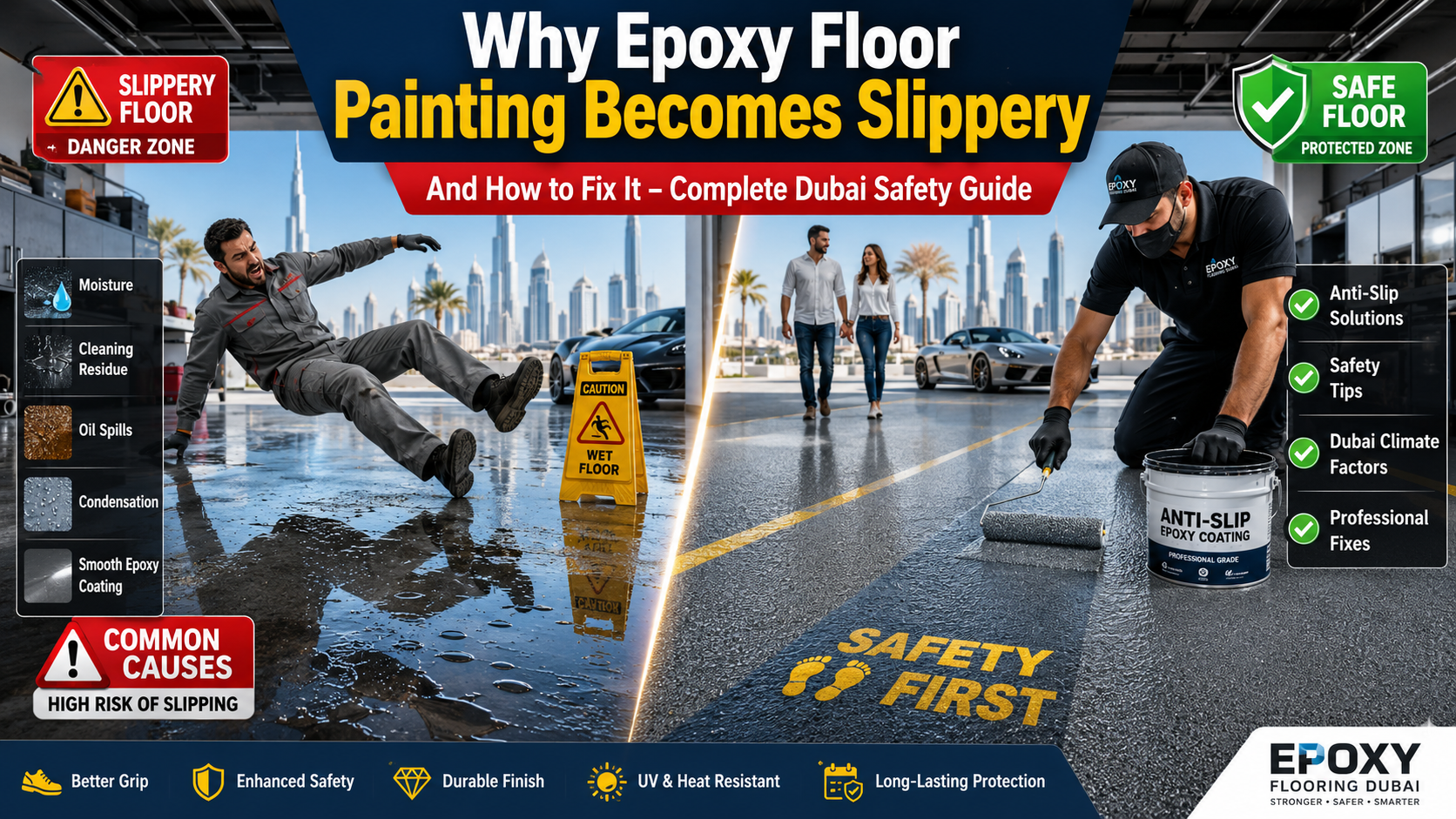
A smooth, high-gloss epoxy finish is slippery when wet — similar to polished marble or high-gloss porcelain tiles. In a living room or bedroom that stays dry, this is not a meaningful concern. In a kitchen, bathroom, entrance, or any area where wet footwear or spills are common, an anti-slip specification is essential. Fine aluminium oxide or quartz aggregate is broadcast into the final topcoat to provide excellent wet grip without significantly changing the visual finish. Any professional contractor offering epoxy floor painting Dubai services should discuss slip resistance ratings with you as a standard part of the specification process — it is not an afterthought.
07 Honest Pros and Cons for Residential Use Specifically
This is not the same pros and cons list as you would use for an industrial warehouse. Here is the residential-specific picture for Dubai homeowners.
Genuine Advantages for Homes
- Seamless finish — no grout lines ever to clean or re-grout
- Makes open-plan living spaces feel larger and more cohesive
- Metallic and self-levelling systems rival high-end natural stone aesthetically
- Handles Dubai’s desert dust far better than tiled grout lines
- Chemical resistant — cleaning products, spills, pet accidents
- Can be recoated to refresh appearance without demolition
- Lower long-term maintenance cost than tiles
- Wide range of finishes from matte to ultra-gloss
- Hygienic — ideal for families with children or allergy concerns
- Excellent in open-plan kitchen-living layouts increasingly common in Dubai villas
Genuine Limitations to Know
- Hard underfoot — no softer than tile, not suitable as a carpet replacement
- Standard epoxy yellows outdoors without UV-stable topcoat
- Strong fumes during installation — ventilation and vacant space required
- Cannot be applied to damp slabs or freshly poured concrete
- Moisture vapour from coastal slabs can cause bubbling if not tested first
- Full vehicle cure time is 7 days — garage use must be planned around this
- Gloss finishes show footprints and dust more visibly than matte tiles
- Requires professional installation — poor prep causes early failure
- Not the traditional aesthetic preferred for bedrooms and bathrooms by all tastes
08 Installation Mistakes That Ruin Home Epoxy Floors
Understanding what goes wrong in residential installations helps you ask the right questions before work begins — and protects your investment.
Applying Over Contaminated Concrete Without Testing
Concrete in older Dubai villas often has invisible contamination — construction release agents, previous coating residue, oil from garage use, or mineral salts from moisture migration. Any of these will prevent proper epoxy adhesion. A degreasing treatment and mechanical grinding is not optional — it is the foundation the entire system depends on. Skipping or rushing this step is the single most common cause of epoxy delamination within the first year.
Not Testing for Moisture Vapour Before Application
Ground floor and basement slabs in coastal Dubai properties are at particular risk. Moisture vapour migrating upward through the concrete creates hydraulic pressure beneath the epoxy coating. The result is bubbling and lifting that cannot be repaired without removing the entire coating and starting again. A simple plastic sheet test or professional MVE test takes a few hours and costs almost nothing relative to the job. Any contractor who dismisses this concern on a ground-floor Dubai property without testing should be asked to justify why.
Using Epoxy Paint Instead of Proper Coating System
Hardware store epoxy paint and professional two-component epoxy coating are completely different products. Epoxy paint cures by evaporation and creates a thin film. Professional epoxy coating cures by chemical reaction and creates a thick, hard polymer layer. Many Dubai homeowners have applied what they thought was “epoxy” only to find it peeling within months. If a quote involves paint rollers and a single-component product from a retail store, it is not a professional epoxy floor installation.
Applying Standard Epoxy to Outdoor Surfaces
This is worth repeating because it is genuinely common and genuinely costly. Standard epoxy resin has no UV stability. Applied to a Dubai driveway, terrace, or pool surround, it will visibly yellow and chalk under direct sunlight — sometimes within three to six months. The floor then needs to be stripped and recoated with the correct UV-stable system. Always specify a polyaspartic or aliphatic polyurethane topcoat for any outdoor or partially sun-exposed surface from the start.
Loading the Floor Before Full Cure
Epoxy reaches light foot traffic strength within 24 hours. Full chemical cure — the point at which the floor has reached its maximum hardness and chemical resistance — takes 7 full days. Parking a vehicle on a garage floor on day two, or placing heavy furniture on a living room floor on day three, can permanently mark or indent the coating surface. The curing period should be scheduled as part of the project plan, not treated as an inconvenience.
Choosing a Contractor Based on Price Alone
In Dubai’s competitive contracting market, the lowest quote almost invariably represents a compromise — thinner coating, inferior materials, inadequate surface preparation, or inexperienced labour. Epoxy floor installation requires genuine skill, particularly the surface preparation phase and the application of self-levelling or metallic systems. A floor that fails at 18 months costs more in removal and replacement than a professionally installed system that lasts 15 years. The correct question is not “who is cheapest?” but “what exactly is included in each quote and what products are being used?”
09 How to Choose the Right Epoxy Contractor in Dubai
The quality of the contractor matters more for epoxy than for almost any other home improvement — because with epoxy, the outcome is almost entirely determined by the application process rather than the product alone. Here is what to look for specifically in the Dubai market.
Ask for examples of completed residential projects — specifically interior home applications, not just garages. Any professional contractor with genuine residential experience will have photos of living rooms, kitchens, and villa interiors, not only workshop floors. If their portfolio is exclusively industrial or garage work, they may not have the finesse required for interior residential applications.
Ask specifically what surface preparation process they use. The answer should include mechanical grinding or shot-blasting, degreasing, crack and chip repair, and a primer coat. If the answer is limited to “we clean the floor and apply the coating,” that is insufficient for a lasting result in Dubai’s climate.
Ask what brand and product they are using. Professional contractors use commercial-grade two-component systems from reputable manufacturers. If the answer involves vague references to “epoxy paint” or unnamed products, ask for the technical data sheet of the material before agreeing to proceed.
Ask how they handle moisture vapour testing — especially for ground-floor applications in Dubai. A contractor who dismisses this question without any explanation is either inexperienced or indifferent to the risk.
Ask about the topcoat specification for any outdoor area. The correct answer is a polyaspartic or UV-stable aliphatic product. If the answer is a standard epoxy clear coat for an outdoor surface, that is the wrong specification for the UAE.
Finally, ask whether the quote includes a warranty and what it covers. A professional contractor who stands behind their work will offer a clear warranty on materials and workmanship. Vague verbal assurances are not the same thing.
10 Frequently Asked Questions
Can epoxy flooring be used in a villa bedroom in Dubai?
Yes, and it is increasingly common in contemporary Dubai villa projects. The main practical consideration is underfoot softness — epoxy over concrete is hard, which some people find less comfortable in a bedroom than carpet or wood-effect flooring. This is easily addressed with a bedside rug or area rug, which is a natural design choice regardless of the floor type. A matte or satin self-levelling epoxy in a warm neutral tone works particularly well in a bedroom, creating a calm, minimal aesthetic without the cold industrial association some people imagine.
The other consideration is that gloss finishes show footprints and fine dust more visibly in a bedroom than in a high-traffic area where regular cleaning is automatic. A satin or low-sheen finish avoids this without sacrificing any of the practical benefits.
How long does epoxy flooring last in a Dubai home — and does the climate shorten its lifespan?
In a Dubai residential interior — living room, kitchen, hallway, or garage — a professionally installed epoxy system should last 12 to 20 years before any significant wear is visible, depending on traffic levels and maintenance quality. The UAE climate does not shorten the lifespan of interior epoxy when the installation is done correctly. The variables that matter most are surface preparation quality, coating thickness, and whether the floor is maintained with pH-neutral cleaners rather than acidic or abrasive products.
For outdoor surfaces, the lifespan question changes entirely if the wrong product is specified. Standard epoxy outdoors in Dubai may look worn within 12 months. A correctly specified polyaspartic or UV-stable system outdoors will match or exceed the interior lifespan. The product specification makes the entire difference for outdoor applications in the UAE.
Is epoxy flooring safe for homes with young children or elderly residents?
Yes, with the right finish specification. The primary safety consideration for families is slip resistance — a smooth high-gloss epoxy floor is slippery when wet, which is a concern in kitchens and bathrooms. This is addressed during installation by incorporating an anti-slip aggregate into the topcoat. The result is a floor with excellent wet grip that still looks clean and professional. For bathrooms, quartz-filled anti-slip epoxy is the standard specification.
Once fully cured — which takes approximately 7 days — epoxy is chemically inert, non-toxic, and safe for any occupants. The strong chemical odours present during installation require the area to be vacated and ventilated, but once cured, there are no ongoing emission or safety concerns. The seamless surface with no grout lines is actually a hygiene advantage in a home with young children, as there are no joints where bacteria, mould, or food debris can accumulate.
Can I apply epoxy over my existing villa tiles without removing them?
Technically possible, but not generally recommended by professional contractors in Dubai. For epoxy to bond properly, it needs a mechanically prepared substrate with sufficient surface profile. Tiles — particularly glazed ceramic or polished porcelain — provide a poor bonding surface, and if any tiles are even slightly hollow or loose beneath, the epoxy will eventually fail in those areas as the tile below flexes independently of the epoxy above.
If your existing tiles are fully bonded, in excellent condition, and properly prepared with grinding equipment that opens the surface, some contractors will proceed over tiles. More commonly, the professional recommendation is to remove the tiles and apply epoxy directly to the concrete slab, which gives a guaranteed substrate and a longer-lasting result. The additional cost of tile removal is typically recovered within the first few years of avoiding the re-application cost that over-tile installations frequently require.
How disruptive is an epoxy installation in an occupied Dubai villa?
The disruption is manageable with good planning. Surface preparation (grinding and degreasing) generates concrete dust and requires the area to be completely cleared of furniture and belongings. Application generates strong chemical odours that require ventilation and an unoccupied space during the coating process and for several hours afterward. The coated area is unavailable for light foot traffic for at least 24 hours, and for full use — including vehicle parking in a garage — for 7 days.
Most professional contractors in Dubai approach occupied villas by working in phases — completing one area and allowing it to cure before moving to the next. A garage or utility room can typically be completed with minimal disruption to daily living. Interior living areas require more planning, and many villa owners schedule them around a short absence or holiday period. A professional contractor will give you a phased timeline and clear daily schedule before work begins so there are no surprises.
What maintenance does an epoxy floor in a Dubai home actually need?
Genuinely very little, which is one of its real advantages over tiles in a dusty city like Dubai. Daily or every-other-day dry sweeping or dust mopping removes the fine desert sand before it can be ground into the surface underfoot. Mopping once or twice a week with warm water and a pH-neutral floor cleaner keeps the surface looking new. Avoid acidic cleaners — common in UAE households for limescale — as they can gradually degrade the topcoat. Avoid steam mops, which can soften certain topcoat formulations.
After shamal sandstorm events, always dry-sweep before any wet cleaning — dragging wet sandy grit across a gloss floor under friction is the most common cause of gradual surface dulling in Dubai homes. Protective felt pads under furniture legs prevent point-load scratching. When the floor eventually begins to show wear after many years, a professional topcoat recoat — applied over the existing floor without any demolition — restores it to new condition at a fraction of the original installation cost.
Is epoxy flooring worth the cost for a Dubai villa compared to just retiling?
For most high-use areas in a Dubai villa — garage, kitchen, hallways, open-plan living — the answer over a 10 to 15 year horizon is yes. The comparison is not just upfront cost but total cost of ownership including re-grouting, grout cleaning, cracked tile replacement, and the time and disruption of periodic tile work. Epoxy requires none of these. Its recoatable nature also means that when it eventually shows wear, refreshing it is far less expensive and disruptive than a tile replacement project.
For bedrooms and bathrooms where design variety matters most and traffic levels are lower, the case is more balanced. Quality porcelain tiles in those spaces will perform reliably for many years with minimal maintenance, and the aesthetic range available in the tile market is genuinely wider for traditional or varied design preferences. The right answer depends on the specific space, your design priorities, and how you weigh upfront cost against long-term maintenance — which is exactly why a room-by-room assessment rather than a blanket decision is always the more useful approach.