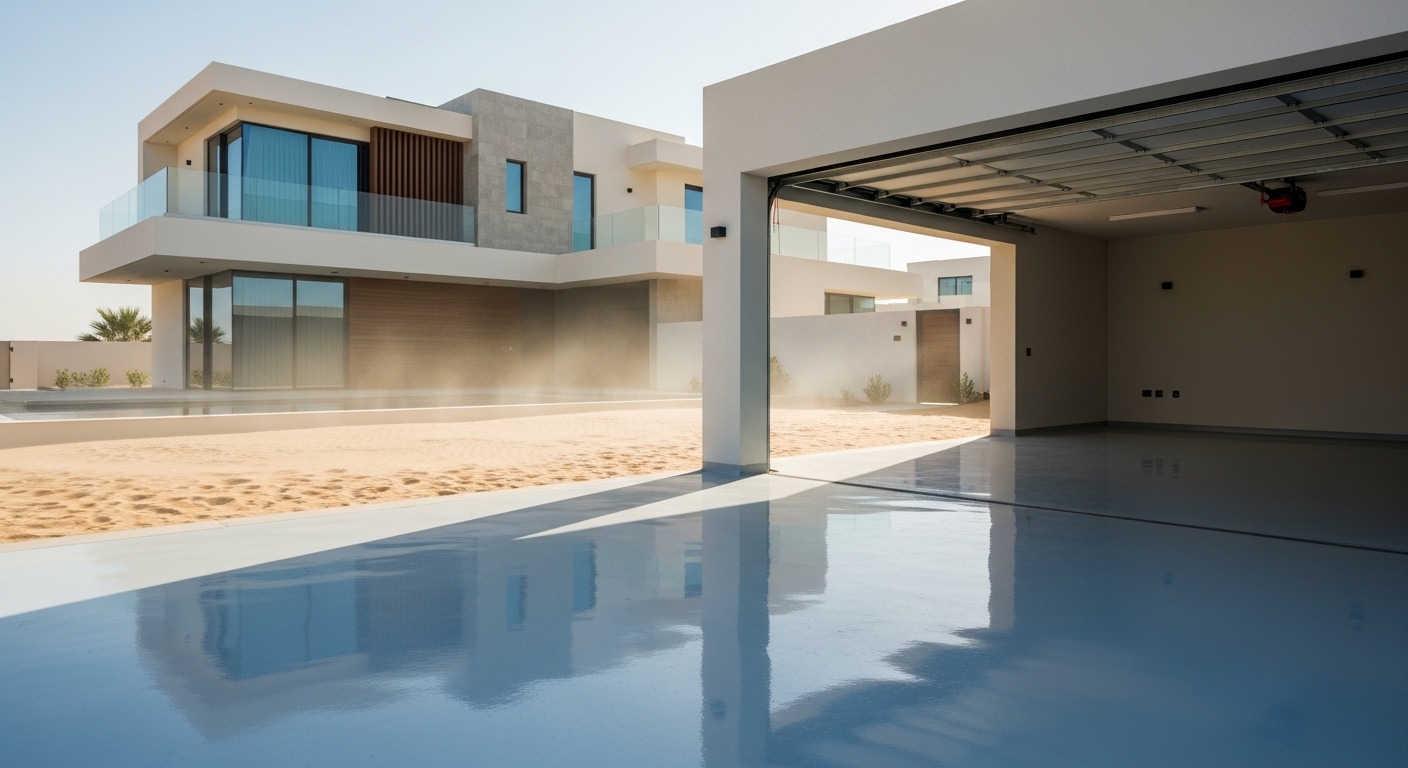
Why Epoxy Flooring is Perfect for Dubai Weather
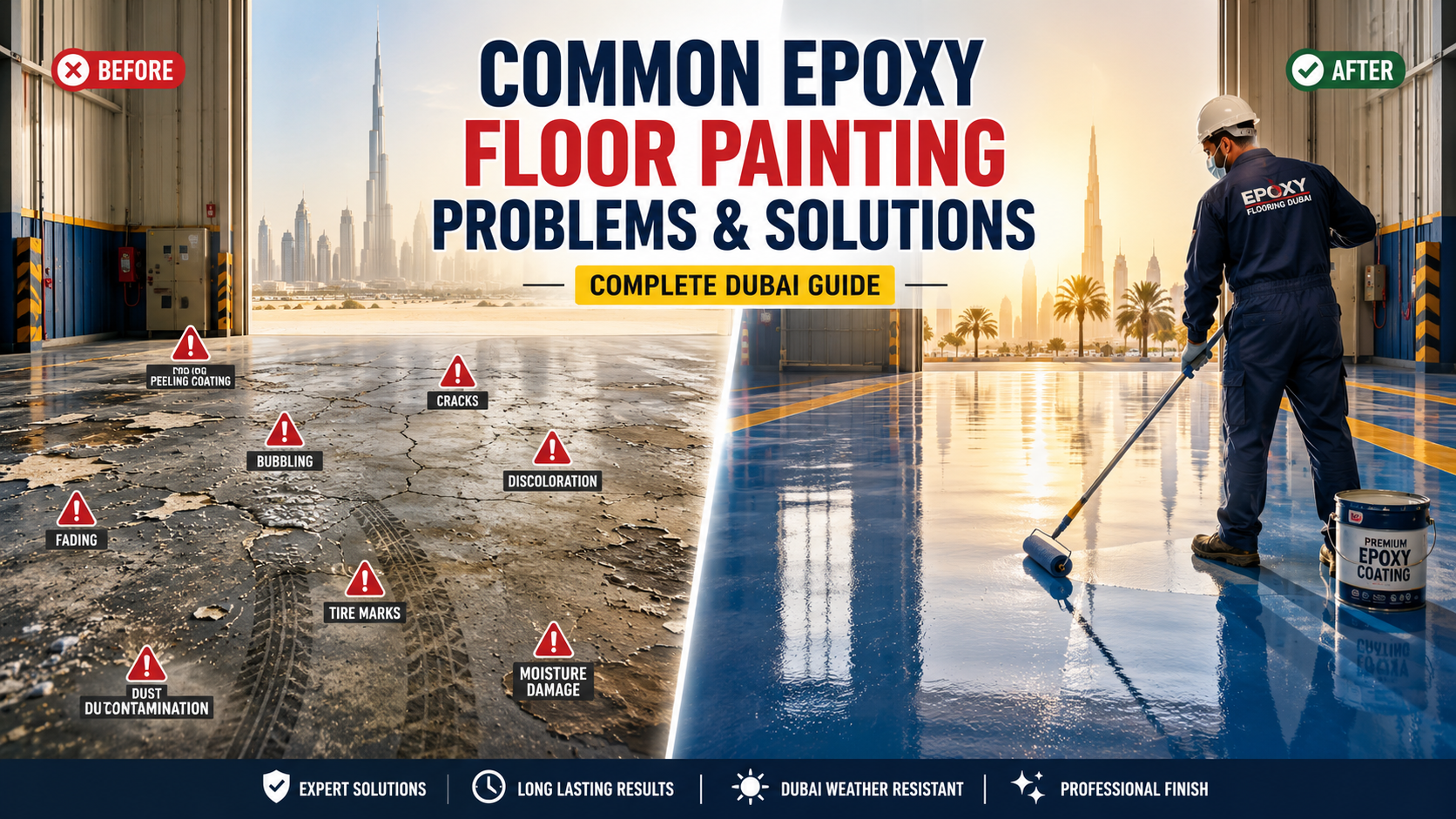
I’ll never forget the look on Ahmed’s face when I walked into his villa garage last summer. He’d just spent AED 12,000 getting his concrete floor “professionally sealed” six months earlier, and it was already falling apart. The coating was peeling in sheets, cracks were spreading like spiderwebs, and the whole surface looked like it had aged twenty years in half a year.
“I thought I was getting a good deal,” he told me, frustrated. “The guy said it would last for years.”
The problem wasn’t Ahmed. It was that he’d hired someone who didn’t understand what Dubai’s climate does to flooring or what it takes to fight back.
This is exactly why choosing the right epoxy floor painting Dubai solution isn’t just about price — it’s about expertise, materials, and proper surface preparation. In a city where heat, humidity, and dust constantly attack your floors, only high-quality epoxy systems applied the right way can truly last.
Let me tell you what actually works.
Dubai’s Climate is a Flooring Nightmare
If you’ve lived in Dubai for more than one summer, you already know the basics. It’s hot. Really hot. But what most people don’t realize is just how brutal that heat is on the floors beneath your feet.
During peak summer, exterior concrete surfaces regularly hit 70°C in direct sunlight. Even shaded garage floors can reach 45-50°C. Interior floors in non-air-conditioned spaces? Easily 35-40°C by mid-afternoon.
That kind of heat creates serious problems.
Concrete expands when it heats up and contracts when it cools down. Over time, this constant expansion and contraction causes cracking. Tiles develop stress fractures along the grout lines. Adhesives fail. Coatings separate from the substrate. I’ve seen brand-new tile installations crack within eighteen months purely from thermal stress.
Then there’s the dust and sand. Dubai’s desert location means fine particles are constantly in the air, settling on every surface. These abrasive particles act like sandpaper, gradually wearing down whatever they touch. Polished concrete loses its shine. Painted floors fade and scratch. Tile grout gets ground down until the gaps widen.
And don’t forget humidity. Yes, Dubai is a desert, but coastal areas experience surprising moisture levels, especially during the summer months when humidity can spike above 90%. That moisture seeps into porous flooring materials, causing swelling, staining, and in extreme cases, structural damage.
Most traditional flooring options simply weren’t designed to handle all three of these factors simultaneously. But epoxy flooring was.
What Makes Epoxy Different
Epoxy isn’t just a coating you brush on top of concrete it’s a complete flooring system that bonds at the molecular level with the substrate beneath it.
When properly applied, epoxy creates a seamless, non-porous surface that’s typically 3-5mm thick (though industrial applications can go much thicker). This isn’t like paint that sits on top of concrete. The epoxy actually penetrates into the pores of the concrete and creates a chemical bond that becomes part of the floor itself.
That’s why it performs so differently than other options.
There are three main types of epoxy used in Dubai:
100% solids epoxy is the premium option. It contains no solvents or water just pure resin and hardener. When mixed and applied, it creates the thickest, most durable coating. This is what you want for garages, workshops, or any high-traffic area. It’s more expensive (typically AED 120-180 per square meter installed), but it lasts 20-30 years in residential settings.
Solvent-based epoxy is the middle ground. It’s easier to apply because it’s thinner, and it still provides excellent durability. Most residential interior applications use this type. Cost runs around AED 80-120 per square meter. Lifespan is typically 15-20 years with proper maintenance.
Water-based epoxy is the budget option. It’s thinner, easier to work with, and has less odor during installation. However, it’s also less durable and won’t stand up as well to heavy use or extreme conditions. I generally don’t recommend this for Dubai unless you’re coating a low-traffic area like a storage room. It costs AED 60-90 per square meter but may need replacement in 8-12 years.
Understanding these differences matters because not all “epoxy flooring” is created equal. When you get quotes, make sure you know which type the contractor is proposing.
How Epoxy Handles Dubai’s Heat
Quality epoxy formulations are engineered to remain stable across a wide temperature range. Standard residential-grade epoxy maintains its structural integrity from about -20°C up to 80°C. Industrial grades can handle up to 150°C.
Why does this matter?
Because unlike tiles (which are rigid and crack under thermal stress) or vinyl (which softens and warps in heat), epoxy has just enough flexibility to expand and contract with the concrete underneath without losing adhesion or developing cracks.
I’ve installed epoxy in unconditioned warehouses where floor temperatures regularly exceed 55°C. The epoxy surfaces in those facilities are now over a decade old and still performing perfectly no peeling, no cracking, no delamination.
The key is proper installation. The concrete must be at the right temperature when the epoxy is applied (ideally between 15-30°C), and the material must cure completely before being exposed to extreme heat. Rush the installation during a hot week, and you’ll have problems. Do it correctly, and the surface becomes incredibly resilient.
There’s also the UV factor to consider. Standard epoxy will yellow when exposed to direct sunlight over time. If you’re coating an outdoor area a driveway, a pool deck, a rooftop terrace you absolutely must use a UV-stable aliphatic polyurethane topcoat over the epoxy base. This adds AED 20-30 per square meter to the cost, but it’s non-negotiable for outdoor applications. Without it, your beautiful floor will turn amber-yellow within a year.
The Dust and Sand Problem Solved
Here’s a question: How often do you clean your tile floors?
If you’re like most Dubai residents, probably every day or every other day. And even then, the grout lines always look slightly dirty because dust gets embedded in them and is almost impossible to remove completely.
Epoxy flooring eliminates this problem entirely.
Because the surface is completely seamless no grout lines, no joints, no gaps dust and sand have nowhere to hide. They stay on the surface where you can see them and easily sweep or mop them away.
I have clients who used to spend 30-40 minutes mopping their garage floors weekly. After switching to epoxy, they’re done in 10 minutes. The difference is dramatic.
The smooth, hard surface also resists scratching much better than you might think. Yes, if you drag heavy sharp objects across it, you can damage it. But normal wear from foot traffic, bicycles, car tires, even dropped tools epoxy handles all of that without showing significant wear for years.
One tip: if you’re particularly concerned about scratches (maybe you work on cars in your garage and have metal tools everywhere), ask your installer to add an anti-scratch additive to the topcoat. It’s a fine aluminum oxide powder that increases surface hardness. Costs about AED 15-25 per square meter extra and is worth every dirham.
Moisture Resistance in a Humid Climate
Even though Dubai is in the desert, moisture is a real issue in many homes, especially:
- Ground-floor rooms in older villas (where concrete slabs weren’t properly waterproofed)
- Basements (increasingly common in newer developments)
- Coastal properties (where humidity regularly spikes above 80%)
- Bathrooms and laundry rooms (obviously)
Traditional flooring materials handle moisture poorly. Tiles can look fine on the surface while moisture slowly destroys the adhesive underneath. Laminate and wood flooring swell and warp. Even polished concrete can develop efflorescence (those white chalky deposits) when moisture brings salts to the surface.
Epoxy, being completely non-porous, doesn’t absorb moisture at all. Water stays on the surface where it evaporates or gets wiped away. This makes epoxy an excellent choice for areas with potential moisture issues.
However and this is critical you cannot install epoxy over concrete that currently has a moisture problem. The concrete must be dry and properly sealed first. Before any reputable installer applies epoxy, they’ll do a moisture test using a calcium chloride kit or a relative humidity probe. If the moisture levels are too high, they’ll need to address that first with a moisture-blocking primer or by fixing the source of the moisture.
I’ve seen too many failed epoxy installations where contractors skipped the moisture testing step. The epoxy bubbles up within weeks because moisture vapor is trapped underneath and has nowhere to go. Proper preparation prevents this entirely.
Real-World Durability: What to Actually Expect
Let’s talk numbers based on real installations I’ve done and maintained over the years.
Residential living areas (bedrooms, living rooms, hallways) with moderate foot traffic: 15-20 year lifespan before you’ll need to recoat. The floor will still be functional after that, but you might want to refresh the topcoat for aesthetic reasons.
High-traffic residential areas (entryways, kitchens, family rooms): 12-18 years. More wear, more cleaning, more stress but still excellent longevity.
Garage floors (residential, two-car usage): 20-25 years if you use 100% solids epoxy with proper surface prep. I have garage installations from 2008 that still look fantastic.
Commercial and retail spaces: 10-15 years depending on foot traffic volume. Stores and showrooms see much heavier use than homes.
Industrial warehouses and workshops: 15-20 years even under heavy equipment use, as long as you’re using industrial-grade epoxy and maintaining it properly.
Compare those numbers to other options:
- Tiles in Dubai: 8-12 years before widespread cracking (faster in unconditioned spaces)
- Polished concrete: 5-8 years before it needs re-polishing; surface degrades from dust abrasion
- Vinyl flooring: 5-10 years in air-conditioned spaces; less in heat-exposed areas
- Painted concrete: 2-4 years before peeling and wear become unacceptable
The math is straightforward. Yes, epoxy costs more upfront than some alternatives. But when you factor in longevity, maintenance costs, and replacement frequency, it’s often the most economical choice over a 20-year period.
Installation: What Actually Happens
A proper epoxy installation in Dubai should take 5-7 days from start to finish for a typical residential project (200-300 square meters). Anyone promising to complete it faster is cutting corners.
Here’s the real timeline:
Day 1: Surface Preparation
This is the most important phase. The concrete surface is diamond-ground to remove any existing coatings, laitance (weak surface layer), and contaminants. This also opens up the pores of the concrete so the epoxy can penetrate properly.
Any cracks are routed out (widened into a V-shape), cleaned, and filled with epoxy crack filler. Small holes and divots are patched. Expansion joints are properly prepared.
The workspace is thoroughly vacuumed and cleaned. Any dust left on the surface will prevent proper bonding.
Day 2: Moisture Testing and Priming
Moisture tests are conducted. If levels are acceptable, a penetrating primer is applied. This seals the concrete and provides a bonding layer for the epoxy.
The primer needs to cure for 12-24 hours depending on temperature and humidity.
Day 3: Base Coat Application
The main epoxy layer is mixed and applied. For residential applications, this is typically done with a combination of roller application and squeegee spreading to achieve even thickness (usually 2-3mm).
In decorative installations, this is when color flakes or metallic pigments might be broadcast into the wet epoxy.
The base coat needs 24 hours minimum to cure before anyone walks on it.
Day 4: Topcoat Application
A clear polyurethane or aliphatic topcoat is applied over the cured base. This provides UV protection, chemical resistance, and enhances the shine.
For outdoor areas or high-wear applications, a second topcoat might be applied on Day 5.
Day 5-7: Curing
Initial curing allows light foot traffic after 24-48 hours. However, the floor doesn’t reach full hardness and chemical resistance for 7-14 days.
During this period, avoid:
- Heavy furniture or equipment
- Spilling chemicals or harsh cleaners
- Vehicle traffic (if it’s a garage)
- Excessive water or moisture
Week 2-4: Full Cure
The epoxy continues to harden and reaches its maximum strength around the 30-day mark. Only after this point can you subject it to its full intended use without concerns.
I know this seems like a long process, but it’s necessary for a quality result. Quick installations skip the proper prep work, don’t allow adequate curing time, and fail prematurely.
The Real Cost Breakdown
Let’s be specific about what you’ll actually pay in Dubai for quality work.
For a 200 square meter villa ground floor (living areas, hallways):
Using solvent-based epoxy with a decorative flake finish:
- Surface preparation: AED 8,000
- Materials (epoxy, primer, topcoat): AED 12,000
- Labor: AED 10,000
- Total: AED 30,000 (AED 150/sqm)
For a 40 square meter garage:
Using 100% solids epoxy, solid color:
- Surface preparation: AED 2,000
- Materials: AED 3,200
- Labor: AED 2,000
- Total: AED 7,200 (AED 180/sqm)
For a 300 square meter commercial showroom:
Using industrial-grade epoxy with anti-slip topcoat:
- Surface preparation: AED 15,000
- Materials: AED 21,000
- Labor: AED 18,000
- Total: AED 54,000 (AED 180/sqm)
Now compare that to tiles over the same 20-year period:
Tile installation (200 sqm):
- Initial installation: AED 20,000 (AED 100/sqm)
- Replacement after 10 years: AED 22,000 (costs increase)
- 20-year total: AED 42,000
Plus ongoing maintenance:
- Grout cleaning and re-sealing every 2-3 years: AED 2,000 per service = AED 12,000+ over 20 years
- Cracked tile replacements: AED 3,000-5,000 over time
Realistic 20-year tile cost: AED 55,000-60,000
Epoxy total for same period:
- Initial installation: AED 30,000
- Minor touch-ups or recoating after 15 years: AED 8,000
- Minimal cleaning maintenance (no grout): AED 0
- 20-year total: AED 38,000
The savings are real and substantial.
What Epoxy Can’t Do (Let’s Be Honest)
I believe in being upfront about limitations. Epoxy flooring is outstanding, but it’s not perfect for every situation.
It won’t hide major surface imperfections. If your concrete is badly cracked, severely uneven, or has significant height variations, epoxy will follow those contours. You’ll need substantial prep work (possibly even a new concrete overlay) to create a smooth substrate first.
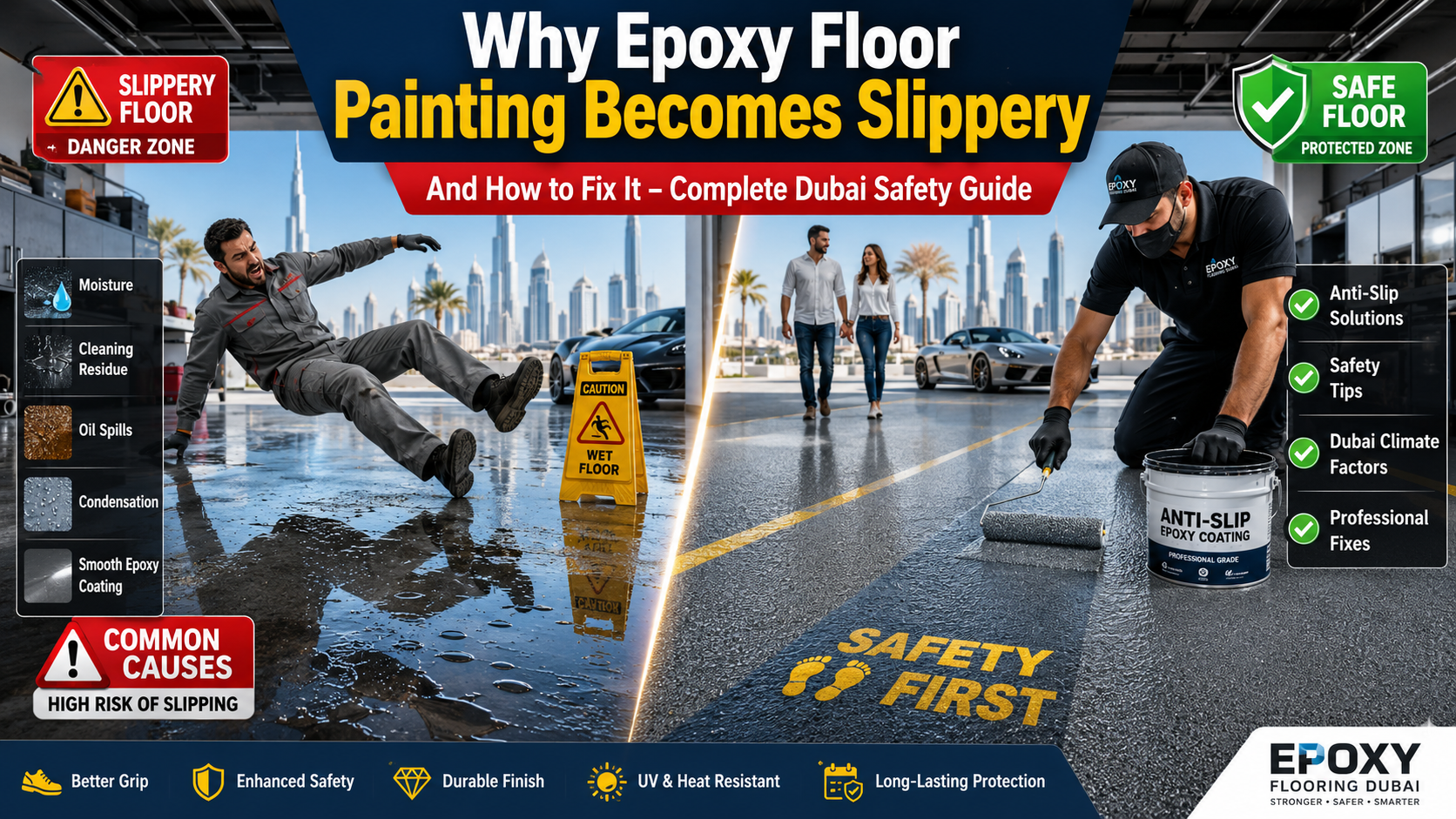
It can be slippery when wet. The smooth, glossy finish that makes epoxy so beautiful also makes it slick when water is present. For bathrooms, outdoor areas, or commercial spaces where spills are common, you must add an anti-slip aggregate to the topcoat. This slightly dulls the shine but massively improves safety.
Dark colors show scratches more easily. Light scratches that would be invisible on a light gray floor really stand out on dark charcoal or black. If you want a dramatic dark floor, consider a matte finish instead of high-gloss.
It’s a permanent installation. Unlike tiles that can be removed relatively easily if you change your mind, epoxy bonds so thoroughly to the concrete that removing it requires grinding the entire surface. Think carefully about your color and finish choices because you’ll live with them for a long time.
It requires professional installation. This isn’t a DIY project unless you have specific training and equipment. I’ve seen countless botched DIY epoxy jobs where homeowners watched a YouTube video and thought they could do it themselves. Surface prep, moisture management, proper mixing ratios, application technique these all require expertise. Save yourself the headache and hire professionals.
Maintenance: Easier Than You Think
One of the biggest selling points of epoxy flooring is how little maintenance it actually requires.
Daily/Weekly:
- Sweep or vacuum to remove dust and debris
- Damp mop with plain water or a pH-neutral cleaner
- Wipe up spills promptly (though epoxy is highly stain-resistant)
Monthly:
- Damp mop with a dedicated epoxy floor cleaner (available at most hardware stores)
- Check for any areas needing touch-up
Yearly:
- Deep clean with a neutral pH cleaner and soft brush if needed
- Inspect for any damage or wear patterns
Every 5-10 years:
- Consider applying a fresh topcoat to restore shine and protection (costs AED 30-50/sqm)
What to avoid:
- Harsh acidic or alkaline cleaners (they can dull the finish)
- Abrasive scrubbing pads or steel wool
- Dragging heavy sharp objects across the surface
- Leaving standing water for extended periods (though epoxy is waterproof, it’s still best practice to wipe up water)
That’s it. Compared to the constant grout cleaning, re-sealing, and crack repairs that tiles require, epoxy maintenance is remarkably simple.
Choosing the Right Contractor
Not all epoxy installers are created equal. The quality of your final result depends heavily on the skill and professionalism of your contractor.
Here’s what to look for:
Verifiable experience in Dubai’s climate. Ask how long they’ve been working in the region. Dubai’s heat and humidity create unique challenges that contractors from other climates might not understand.
Portfolio of completed projects. Any reputable company should have extensive photos of previous installations. Ask to see both freshly completed projects and older installations (5+ years) so you can judge how the work holds up.
Detailed written proposals. The quote should specify:
- Type of epoxy being used (brand, product line, 100% solids vs solvent-based)
- Surface preparation methods
- Number of coats and thickness
- Type of topcoat and UV protection
- Complete timeline
- Warranty terms
Licensing and insurance. The company should be licensed by Dubai Municipality and carry proper liability insurance. Don’t skip this if something goes wrong during installation, you want to be protected.
Warranty coverage. Expect at least a 2-year warranty on labor and adhesion, and 5-10 years on materials (based on manufacturer warranties). Be suspicious of companies offering no warranty or only 30-90 days.
References you can actually contact. Ask for phone numbers of at least three recent clients with similar project types. Call them. Ask about the company’s professionalism, whether they stayed on timeline and budget, how the floor has held up, and whether they’d hire them again.
Get at least three detailed quotes before making your decision. The cheapest option is rarely the best value. Focus on finding contractors who demonstrate expertise, use quality materials, and stand behind their work.
Is Epoxy Right for Your Space?
Epoxy flooring works exceptionally well for:
Garages – The number one application in Dubai. Protects against oil stains, tire marks, and heavy use.
Basements – Moisture resistance makes it ideal for below-grade spaces.
Workshops and hobby rooms – Handles spills, stains, and equipment with ease.
Commercial showrooms – Clean, professional appearance with excellent durability.
Warehouses and industrial spaces – Can handle forklift traffic and heavy equipment.
Retail stores – Attractive, easy to clean, long-lasting.
Modern living spaces – Growing trend in contemporary Dubai villas for main living areas.
It’s less commonly used (but still viable) for:
Bedrooms – Usually chosen for aesthetic reasons; tiles or other options might feel warmer underfoot.
Outdoor patios and pool decks – Requires UV-stable topcoat and anti-slip additives; can get hot in direct sun.
Traditional-style homes – The modern aesthetic doesn’t always fit classical interior designs.
Final Thoughts
I started this article talking about Ahmed and his failed garage floor. We ended up removing that cheap coating, properly preparing the surface, and installing a quality 100% solids epoxy system. That was four years ago, and his floor still looks nearly perfect.
He told me recently, “I wish I’d just done it right the first time. Would’ve saved myself money and frustration.”
That’s the lesson here.
Dubai’s climate is unforgiving. Heat, dust, humidity they combine to create one of the harshest environments for flooring anywhere in the world. You can fight this with cheap solutions that need constant replacement and maintenance, or you can invest in a system engineered specifically to handle these exact conditions.
Epoxy flooring costs more upfront than some alternatives, but over the 15-20+ year lifespan of a quality installation, it’s often the most economical choice. More importantly, it eliminates the ongoing hassle of repairs, replacements, and constant cleaning.
If you’re building a new villa, renovating an existing one, or simply tired of dealing with problematic floors, epoxy deserves serious consideration. Just make sure you work with experienced professionals who understand both the material and the unique challenges of installing it in Dubai.
Your floors are one of the largest surface areas in your home. Getting them right makes a bigger difference than most people realize not just in appearance, but in functionality, maintenance burden, and long-term cost.